

This article by Pablo Carlos Rojas Gómez originally appeared in the May 22, 2026 edition of Revista Contralínea. The views expressed in this article are the author’s own and do not necessarily reflect those ofMexico Solidarity Mediaor theMexico Solidarity Project*.*
Morena’s problems began paradoxically: at the same time its founder reached the presidency (an objective for which many had fought for years), a crisis was brewing because the party was overly dependent on his leadership, and in his absence, internal factions lost their way, lacking true independence and therefore demanding instructions to impose order from within. Instead of being a vanguard of transformation, the party became a burden, or rather, the rearguard of the government, acting merely as a reaction to or follower of the president’s actions.
Yeidckol Polevnsky attempted to lead Morena as she had led CANACINTRA (Mexico’s National Chamber of the Transformation Industry – a quasi-lobby / advisory body comprised of industrial interests which advise the state on industrial policy – ed), but she failed to grasp that a political party has a more ideological and contentious character, something she completely lacked, in addition to her total absence of class consciousness—or perhaps she did possess it, and that’s why she served business interests more than the popular sectors. Alfonso Ramírez Cuéllar’s tenure was very brief, and he was never well-received by Andrés Manuel López Obrador, who, fed up with internal disagreements, demanded outright uniformity—or unity, as it would later be called—to guarantee the party’s political stability. He opted to intervene and call for an open poll targeting Mario Delgado, a close ally of Marcelo Ebrard, with whom AMLO wanted to maintain a peaceful relationship, knowing that the presidential elections were approaching.
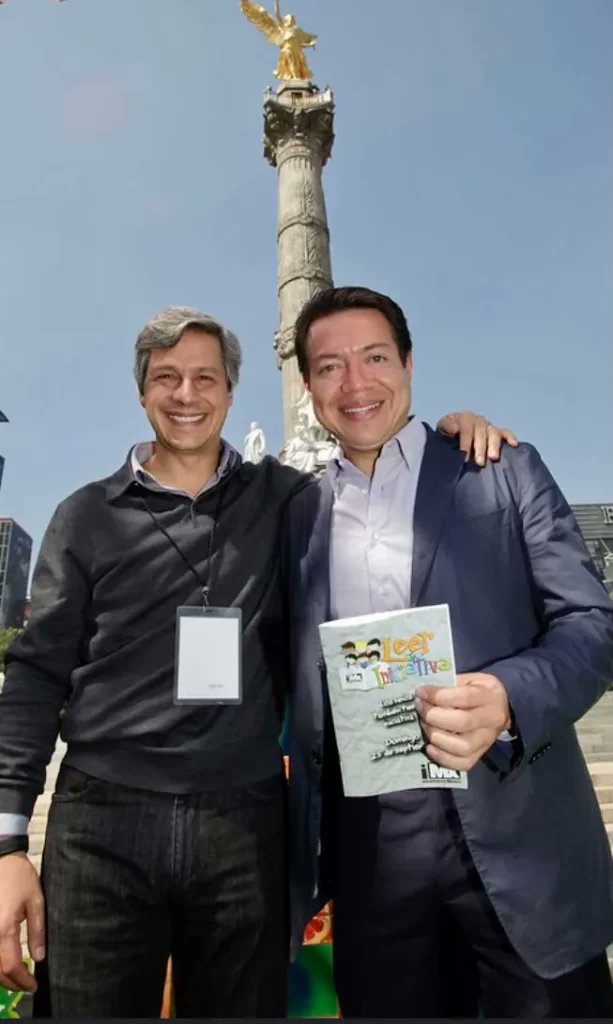
Mario Delgado with Claudio X. González, neoliberal opposition funder and figure.
Mario Delgado fueled Morena’s crisis, adding gasoline to the fire by introducing a large number of his friends from a neoliberal cohort disguised as progressives, paving the way for a massive political opportunism devoid of any leftist substance. The 2021 and 2024 elections weren’t actually won by Delgado, as his defenders so vehemently claim, but rather by the pull, strength, and legitimacy of AMLO, who maintained extremely high popularity and approval ratings through his governing style. The call for open competition to achieve Plan C and judicial reform was the true banner that led to electoral victories in those two processes, and this, it must be said clearly, was AMLO’s strategy, not Delgado’s. Delgado simply rode on the president’s coattails and allowed him to decide on the strongest candidates. In exchange, he was able to discreetly impose the other, less prominent candidates. Ultimately, this consolidated a conservative faction within Morena.
AMLO turned a blind eye because either he was fed up with the party’s infighting, or he didn’t have time to deal with it; or he simply agreed with Delgado that it was a path that had to be followed to consolidate Morena’s hegemony—that is, the inclination to negotiate and win over opponents to maintain control and leadership. In party matters, AMLO was more pragmatic than he was in matters of government; he was a reformer, not a revolutionary.
With Claudia Sheinbaum’s arrival to the presidency, a tacit agreement was reached between her and the outgoing president to leave the former Secretary of the Interior, Luisa Alcalde, in charge of Morena. Although it is often insisted that she won thanks to the grassroots, the truth was different, because no one wins a national congress of 3,000 delegates unanimously without a directive from above.
Although Luisa Alcalde wasn’t a corrupt, neoliberal figure like Mario Delgado, neither was she the social leader that propaganda tried to portray her as. Some people have said, “She was involved in the movement since she was little,” and that’s true, but that was because her mother took her everywhere and encouraged her career, not because she learned to mobilize people from a young age. It’s crucial to understand that she didn’t come from the student movement or popular activism, but rather from the family elites who paved the way for her.

A podcast.
However, a privileged background does not guarantee effective leadership in a political party, where it is not enough to have the patronage of government leaders; something much more complex is required: a capacity for deep political analysis and ideological projection, in order to decipher the current situation and make very decisive decisions about which strategies to adopt.
Luisa Alcalde’s presidency fizzled out very quickly, not because of her youth (as the adult-centric narrative claims), that has nothing to do with it. Rather, it was because she hadn’t been trained in grassroots activism nor did she have the analytical skills to guide her to make tough decisions. She was calculating her next positions; she wasn’t leading a force with ideological undertones.
At this point, Morena has become a party that supports everything the presidential figure says, whether it be Andrés Manuel or Claudia, but that proved clearly insufficient in a context of siege by a United States that threatens isolation and direct intervention without restraint.

Campeche Governor Layda Sansores (red wig), dressed as Marie Antoinette.
Now, in this new situation, the weak and opaque figures tolerated in the candidacies assigned by Mario Delgado in the 2021 and 2024 elections have turned against the Fourth Transformation. Figures like Rubén Rocha, David Monreal, Evelyn Salgado, Layda Sansores, Sergio Mayer, and so many others are proving counterproductive; it’s as if they are digging their own grave.
For that reason, Morena’s grassroots members insisted so vehemently on safeguarding the candidacies. Of course, their voices were ignored and disregarded despite their protests. Now, the consequences are stark. The principle of “always listening to the people” was disregarded, and that’s why we have to confront this new landscape and learn from it as quickly as possible, because our political independence is at stake.
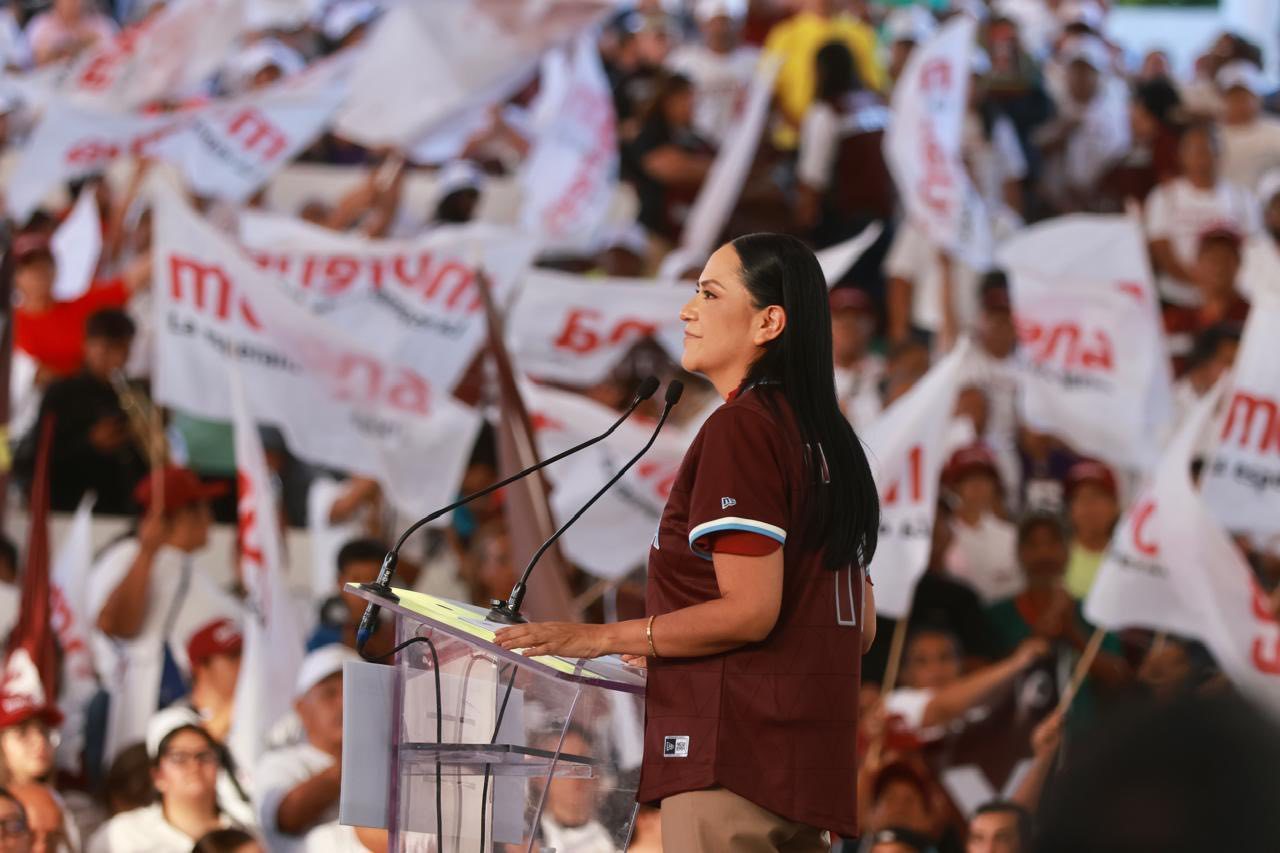
Ariadna Montiel Reyes
The arrival of Ariadna Montiel carries two messages, one less optimistic and the other somewhat more so: the first is that the presidency is once again intervening, directly deciding who should lead the Morena party, as if it were just another cabinet position; the second may be more beneficial, because it seems to place someone who at least has greater clarity in political analysis and in the need to establish minimally mobilizing strategies. Polevnsky, Delgado, Alcalde, and Montiel all arrived as a result of presidential intervention; however, the first three were unfamiliar with the tactics and strategies of popular and ideological mobilization. Rather, they came from the business sector—Yeidckol—, from pragmatic neoliberal operations—Delgado—, or from family elites—Alcalde—and that is why they failed. Montiel comes from another sector that, although equally disciplined, pragmatic, and operational, carries a more ideological connotation and is linked to the principles of López Obrador’s movement.
Of course, saying “Obradorism” does not necessarily mean “grassroots” democracy, because much of the time it maintains presidential verticalism, but what is certain is that it has a content with a greater knowledge of popular demands and political mobilization tactics.
Obradorism is an articulation between non-revolutionary reformist pragmatism aimed at regenerating the hegemony of the State—although this necessarily implies redressing its capitalist domination—and the idea of fostering greater integration of the popular classes, even by making use of mobilization and protest.
Let us remember that Obradorism is an articulation between non-revolutionary reformist pragmatism aimed at regenerating the hegemony of the State—although this necessarily implies redressing its capitalist domination—and the idea of fostering greater integration of the popular classes, even by making use of mobilization and protest. Obradorism does appeal to the mobilization of the popular classes, if only to regenerate the hegemony of the State and not to revolutionize it.
In contrast, the most optimistic message conveyed by Ariadna Montiel’s actions as leader of Morena is that, finally, the leadership of the Fourth Transformation (4T) has grasped the importance of carefully selecting candidates and fostering political mobilization. This explains the call for a march in Chihuahua last Saturday, May 16, and the statements by the new Morena president that the profiles of candidates running in next year’s elections will be scrutinized much more closely.
At least the urgency has been understood. Let’s hope that the importance of future leadership emerging from “below” and not from “above” is now understood.
Pablo Carlos Rojas Gómez is a Doctor of Political Science and Latin American Studies and researcher at the University Program of Studies on Democracy, Justice and Society (PUEDJS-UNAM).
-
Messages in Morena’s New Leadership
May 27, 2026May 27, 2026
Presidential verticalism is being maintained, but Montiel’s appointment brings a greater knowledge of popular demands and political mobilization tactics.
-
Mexico City Deputies Unanimously Approve Care System Law
May 27, 2026May 27, 2026
More than three million people in Mexico City require care due to life stage, disability, or dependency: unpaid work in this area is equivalent to approximately 12% of GDP.
-
200,000 Mexican “Dreamers” at Risk of Deportation
May 27, 2026May 27, 2026
Changes and delays in procedures implemented by the Trump administration put them at risk, according to Mexico’s External Relations Secretariat.
The post Messages in Morena’s New Leadership appeared first on Mexico Solidarity Media.
From Mexico Solidarity Media via This RSS Feed.