

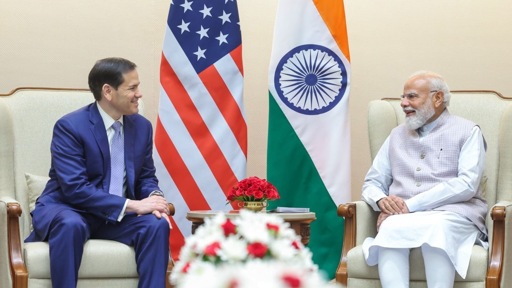
US Secretary of State Marco Rubio’s visit to India has further intensified the debate regarding the nature of relations between the two countries and exposed the inability of the Narendra Modi government to confront Washington’s open disregard for his country’s core concerns.
Rubio landed in India on May 23 and left the country after attending the Quad foreign minister’s meeting scheduled on Tuesday, May 26. This is his first visit to India since he assumed office as Secretary of State last year.
The objective of Rubio’s visit to India was to intensify the countries’ strategic relationship and push for increased trade in energy in the context of the ongoing war in West Asia and the continued blockade of the Strait of Hormuz.
India has deep concerns about the lack of adequate energy supplies created by the US-Israeli war on Iran. Its anxiety has increased following the US refusal last month to extend its earlier exemptions to sanctioned Russian or Iranian oil.
Just before leaving for India, Rubio claimed that the US has enough production of its own and is ready to sell to India “as much energy as they will buy.”
Rubio met Prime Minister Narendra Modi on Saturday and India’s Minister of External Affairs Subrahmanyam Jaishankar on Sunday.
“We discussed sustained progress in the India-US comprehensive global Strategic Partnership and issues related to regional and global peace and security,” Modi tweeted, after meeting with Rubio on Saturday.
During his meeting with Jaishankar, Rubio called India “one of the most important Strategic Partners in the world.” He expressed hope of an early signing of the trade deal declared finalized in February this year and pushed for increased energy trade.
Jaishankar admitted the need to diversify the sources of its energy supply, without explicitly committing to buying more US oil.
Directionless foreign policy
The Quad Foreign Minister’s Meeting was a central activity on Rubio’s agenda.
Quad (Quadilateral Security Dialogue) was founded for the second time in 2017, during Donald Trump’s first term as president, after its failure to take off in 2007. Apart from the US and India, the grouping also includes Japan and Australia and is largely seen as an anti-China grouping with an objective to “contain” its rise in the Indo-Pacific region.
The grouping and India’s membership to it has been a question of deep concern for the members of BRICS and the Shanghai Cooperation Organization (SCO), as it contradicts their declared goal of strengthening multilateralism and creating a world free of the Cold War mentality of blocks.
India has defended its engagements with these contradictory groupings, calling it “multi-alignment” and claiming that it does not look at engaging with countries and groups as a “zero-sum game,” as Jaishankar reiterated on Sunday.
He also called Quad a maritime alliance based on “shared democratic values”, ignoring the obvious militaristic nature of the alliance and its stated “containment” objectives in the Indo-Pacific region.
The inability of the Narendra Modi government to decide a clear path in its foreign policy has caused strains in India’s relations with China, which has openly called Quad a block with a Cold War mentality, and even with members of BRICS and the SCO.
This has impacted the overall progress of these groupings, with India often seen as stalling progress, such as the agenda of de-dollarization.
Independence of India’s foreign policy questioned
The political opposition in India has also found Modi’s government’s approach to the US problematic, often describing it as aimless and bordering on capitulation.
They have questioned the failure of the state to defy US dictates of not buying oil from Russia or Iran, which is relatively cheaper and easier to transport than oil bought from the US.
Read more: India trades in Russian oil for 7% reduction in US tariffs
Opposition parties in India have condemned that in many instances, it seems that the US has announced India’s foreign policy decisions instead of the government of India itself. This was evident in the war with Pakistan last year (the so-called Operation Sindoor), when Trump announced a ceasefire even before India or Pakistan had acknowledged it.
Before commencing his visit to India, Rubio repeated the pattern. He announced the visit of Delcy Rodríguez, Venezuela’s interim president, to India later this week. Her visit is apparently to discuss India buying more Venezuelan oil.
However, neither India nor Venezuela have made any such announcement about Rodriguez’s visit yet.
Along with the fact that India has been reluctant to independently decide sources of energy, the opposition accused the Modi government of surrendering India’s sovereignty and independent foreign policy to US dictates.
“Why have the prime minister and foreign affairs minister renounced their responsibility to communicate to the Indian people and to the world foreign policy of our sovereign state,” Jairam Ramesh, senior leader of the main opposition party Indian National Congress (INC) questioned on Sunday.
Ramesh also demanded that India declare the trade deal announced in February as “null and void”, quoting the decision of the US Supreme Court declaring Trump’s reciprocal tariff regime illegal and claiming that it was signed under duress and threats.
In light of Prime Minister Modi asking citizens to cut down consumption and buy less imported items to deal with the pressure on the economy, the opposition demanded the rationale behind agreeing to buy USD 500 billion worth of US goods in the next five years, as per the deal.
This would mean doubling yearly imports from the US, which is just above USD 50 billion at the moment.
India’s Left parties and major farmers unions have already rejected the logic of the trade deal, calling it capitulation and demanding the country withdraw from it.
The post Rubio’s visit intensifies debate on India’s foreign policy independence appeared first on Peoples Dispatch.
From Peoples Dispatch via This RSS Feed.