


Shirley Sneve*ICT*
MINNEAPOLIS – How do high school dropouts get advanced degrees and become leaders in their community?
Turns out one of the keys might be language. Indigenous language.
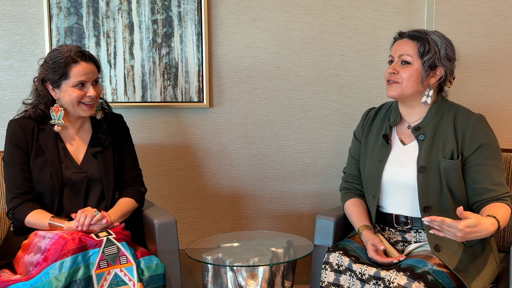
Kate Beane and Carly Bad Heart Bull are identical twins and citizens of the Flandreau Santee Sioux Tribe in South Dakota and Muscogee Creek.
They dropped out of school in El Cerito, California, at age 15 but each went on to get advanced degrees and move back to – and take leadership roles in – their ancestral community in Minneapolis, Minnesota, on unceded Dakota land.
“For both of us, reconnecting to our Dakota language and really understanding, not just the root words or vocabulary, but the meaning and how the language is so closely tied to the land. All of that was incredibly important for us to feel centered and to understand also our place in Minnesota,” Beane said. “Because as people who come from a community that was removed from the state, for us to come back home and to understand this place at that deeper level helped us to understand ourselves.”

Twins Kate Beane, left, and Carly Bad Hear Bull made the cover of City Pages magazine in Minneapolis, Minnesota, for their successful efforts to change the name of a major lake in the city to remove the name of a Civil War era politician who championed slavery. (Courtesy photo)
In 2018, the sisters led an effort to change Lake Calhoun to its traditional Dakota name, Bde Maka Ska. Named for John C. Calhoun, who was no friend to Dakota people and a pro-slavery politician. Bde Maka Ska is the largest lake in Minneapolis. It is surrounded by city parkland and a favorite for year-round recreational activities.
In their day jobs, Beane is the executive director of the Minnesota Museum of American Art. She holds a Ph.D. in America Studies from the University of Minnesota. She was also the Charles A. Eastman Predoctoral Fellow at Dartmouth College.
Bad Heart Bull is the executive director of Native Ways Federation. She holds a Juris Doctorate degree cum laude from the University of Minnesota Law School, a Bachelor of Arts degree summa cum laude from the University of Minnesota, and an Associate of Arts degree from Minneapolis Community and Technical College.
I got the chance to ask them about their journey from dropouts to leadership in March during the Indian Land Tenure Foundation conference at Mystic Lake Casino in Pryor Lake, Minnesota – a property of the Shakopee Mdewakanton Sioux Community.
Beane is the oldest – by three minutes. Her Indian name is Ahdipiwiŋ, which translates to English as “Brings Them Home Woman.” Bad Heart Bull’s Dakota name is Wakan’yan Mani Win, “Woman who Walks Toward the Future.”
The family lived in El Cerrito, California, when the twins were growing up.
“We went to a large high school where the history of our people was not being taught. We didn’t see the use of going, and, you know, when I look back now, I wish that wasn’t the case,” Bad Heart Bull said. “I used to blame myself for it. It wasn’t my fault. It’s the system.”
Beane said the school let them skip the eighth grade.
“They gave us a social promotion, because they said we were more mature than other students. We stopped going to school and they wanted us to go back,” Bad Heart Bull said. “What they found was it wasn’t an issue with the work. We could do the work. We just didn’t want to.”
The twins dropped out when they were 15 years old. Because a student needed to be 16 to take the GED (general education development) test, they took the California High School Proficiency Exam.
“When we took that test, it was a legal way to opt out of school so that our parents wouldn’t get in trouble,” Beane said. “No teachers encouraged us to stay. And that’s something that I’ve thought about a lot as a parent now. As a mother of three little girls, two of whom do not like school, and who struggle in school, I constantly tell them what really is important for them to understand is not the grades that they bring home, it’s that they’re good people.”
Charles Eastman, the storied medical doctor and writer is a great uncle, or grandfather in the Indian Way. For generations, education for the Flandreau Santee Dakota family has been important.
But the twins credit their parents with their ability to learn beyond the classroom and the sisters agree that, while education is important, it’s the connections to people and organizations that have really shaped their careers. Understanding “the system” has been instrumental in being change makers.
Parents Syd Bean and Beck Barnette Beane made careers out of activism and working to create better economic and cultural opportunities for Native peoples.

Twins Kate Beane and Carly Bad Hear Bull toddle along with their mother Beck Barnette Beane in this undated family photo. The twins later dropped out of school but didn’t end their education. “We were raised to read. We were avid readers growing up. For us, our frustrations were with the educational system. We came from a family of teachers and organizers who told us, if we don’t like the system, change it,” Beane said. (Courtesy photo)
“We grew up going to nonprofit board meetings, sitting under the table with those yellow notebooks and pens and playing office,” Bad Heart Bull said. “We played nonprofit, because that’s what our parents were doing.”
Beane added: “We were raised to read. We were avid readers growing up. For us, our frustrations were with the educational system. We came from a family of teachers and organizers who told us, if we don’t like the system, change it. And when we were younger, that was something we had no interest in. We were like, why are we going to fix that problem? It was really frustrating. But then as we grew older and I think for me, it was years of waitressing, it was years of working in a factory. It was like doing all these jobs, across the country, struggling and working for other people. We were frustrated with the educational system coming from a family where our grandparents were in boarding schools. They didn’t trust that system. And I think at a certain point, I realized I needed to figure out a way to create a better opportunity for my kids. And so for me, it was thinking about the next generation.”
The post They dropped out – but later led appeared first on ICT.
From ICT via This RSS Feed.