

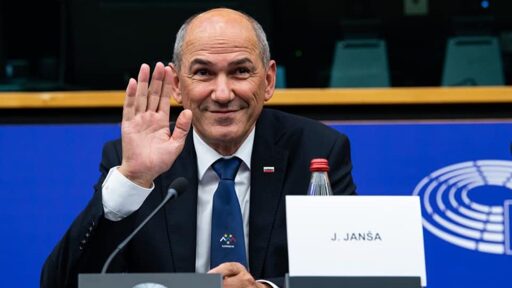
Three-time prime minister Janez Janša is on track to lead another right-wing government in Slovenia after two months of uncertainties following the March general election. Despite winning fewer parliamentary seats than liberal former Prime Minister Robert Golob, Janša’s SDS party built a coalition with smaller conservative parties and secured additional support from the right-wing populist Resnica party. Analysts warn the new administration will be marked by pro-business policies, privatization of public assets, and a significant shift in foreign policy.
Read more: Activists urge continued mobilization to ensure Slovenia’s arms embargo on Israel
Israeli Prime Minister Benjamin Netanyahu and Foreign Minister Gideon Sa’ar were among those who congratulated Janša – marking an early and notable break with Slovenia’s previous stance on the genocide in Gaza. Throughout the past three years, the Golob administration had introduced partial measures to hold Israel accountable for its disregard of international law. Janša’s fourth administration, instead, heralds closer ties with occupation authorities.
“Under the leadership of Janez Janša, Slovenia will thus be a supporter of Benjamin Netanyahu, an extremist politician, a war criminal, the main culprit for the genocide in Gaza, an oppressor of the human rights of the Palestinian population, a constant violator of the principles of international law, the values of the modern international community and a politician who is the subject of investigations in Israel for alleged fraud, bribery and breach of trust,” Golob stated. “Janez Janša is thus placing Slovenia on the shameful side of history.”
Former cabinet members warn of the likely influence Israeli authorities will have over Janša due to allegations of the occupation’s interference in the electoral process. They emphasize that positive reactions from Israel provide additional proof that interference concerns were grounded. “The reaction from Janša and Netanyahu has also shown just how much truth there is to the Black Cube scandal,” Golob told the media on May 25. “This revelation proves that Israelis were deeply involved in Slovenian politics ahead of the elections. Now it’s time for the incoming government to settle the score.”
Read more: Brussels protest marks 15th demonstration against austerity in 18 months
Widespread concerns also exist about the new government’s policies in labor, press freedom, and civil rights. Previous Janša administrations, including during the COVID-19 pandemic, were notorious for attacks on critical cultural institutions and civil society – resembling aspects of Viktor Orbán’s rule in Hungary. “Every time Janez Janša is in power, critical intellectuals, artists, civil society, and everyone who disagrees with him come under attack,” wrote Asta Vrečko from the progressive Levica party, Minister of Culture in Golob’s administration.
“There is absolutely no reason to believe that the fourth time will be any different from the first, second, or third,” Vrečko also wrote. “On the contrary, as we can also see in the US with Trump, we can expect this version of Janez Janša to be the worst and most aggressive of all.”
Read more: Antifascism is anti-militarism: socialist industrial legacy at risk of becoming motor of EU armament
The new government coalition’s program measures threaten to erode labor rights, including by removing automatic payment of union dues under the guise of “fighting bureaucratization” – actually an attempt at retaliation against trade unions that have already signaled opposition to the right-wing groups’ plans, media outlet Mladina warned. The coalition has also pushed for measures to lower taxes on entrepreneurs and ease dual public-private work for physicians, aligning with the privatization agenda, even before Janša was confirmed as prime minister-to-be. Progressive forces have announced they will fight these attempts through a referendum.
The newly-formed government coalition has also started discussing proposals that relativize the antifascist resistance’s contribution to Slovenia’s history, in line with historical revisionism and anti-communism pursued by regional right-wing and center groups. “Their first-introduced bill is written for the rich,” Levica commented on the developments. “Their second bill is already dragging us back into squabbles about partisans and guardsmen […] The intent isn’t any kind of reconciliation – it is the continuation of the culture war and ideological offensive against something that is the foundation of our society and should be a shared value for all of us. But obviously it isn’t.”
The post Far-right Janez Janša to return for fourth government term in Slovenia appeared first on Peoples Dispatch.
From Peoples Dispatch via This RSS Feed.