

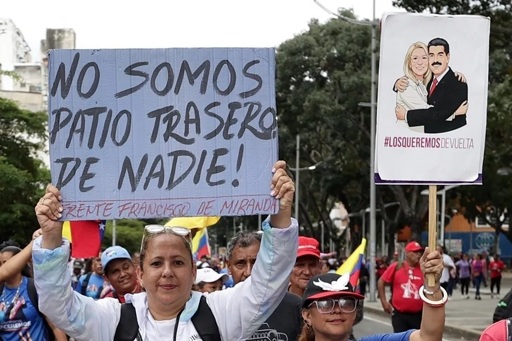
By Andreína Chávez Alava – May 25, 2026
For the majority of my adult life as an anti-imperialist journalist who grew up alongside the Bolivarian Revolution in Venezuela, I have tried to live and work by the principle taught by Fidel Castro in 1961: “Everything for the Revolution; nothing against the Revolution.”
I am not claiming that I have lived it perfectly. I have had stretches where I contributed to the very problem that I am about to describe. But I have also been on the receiving end of it: a left that polices its own with more energy than it organizes, that values being the first to condemn instead of building solidarity, and that treats pointing out setbacks as a way to accumulate moral authority rather than to genuinely correct course. Understanding this dynamic cost me dearly, but it also gave me a clearer sense of what revolutionary discipline actually requires.
For me, “everything for the revolution” means that everything I say, from criticism to defense, must always serve the revolution’s right to exist. I’m not going to mistake setbacks amid extreme imperialist aggression as proof of treason or that everything is lost for Chavismo. I’m not going to free imperialism from blame for the difficult and humiliating periods that revolutionary movements across history have faced. As imperialist fascism is trying to devour all of humanity, the fight is not against those still resisting imperfectly.
This principle of “everything for the revolution” is what guides me as I consider Venezuela’s current situation, the pressure Washington is applying, and the decisions being taken by the government of Acting President Delcy Rodríguez in that context. These circumstances are shaped and driven by devastating US sanctions, a naval siege off Venezuela’s coast, a military attack, and the kidnapping of President Nicolás Maduro. US sanctions are still firmly in place, while the US has now forcefully taken control of (stolen) our oil revenue. US warships are still pointing at Venezuela as you read this.
Nowhere is this tension clearer than in the case of Alex Saab, where principle, pragmatism, and a nation’s survival under siege have become nearly impossible to untangle. Some hindsight, truth-telling, accountability, and memory-shaking are necessary.
The Saab case: A chronology of political contradictionOne of the most controversial decisions by the acting administration of Delcy Rodríguez was to allow Alex Saab to be transferred to the US on May 16. This contradicted the narrative that had been built up around him as a long-standing trusted business ally who had heroically helped to bypass US sanctions.
Saab’s first significant involvement in Venezuela began in 2011 when he secured state contracts to import prefabricated building materials for the Great Housing Mission. Between 2016 and 2019, Saab became an important contractor for state-funded imports for the government’s CLAP food program, which distributed subsidized food boxes to millions of households across the country. This was the period when US sanctions cut off key imports such as foodstuffs, resulting in food, fuel, and medicine shortages, creating an economic crisis, migration wave, and the near collapse of Venezuela’s social fabric.
The sanctions, aptly dubbed “starvation sanctions,” were part of Washington’s strategy to provoke “regime” change. This strategy included sanctioning the oil industry, which is the country’s most important source of revenue. Consequently, Caracas was forced to rely on unconventional methods to sell oil and procure food, medicine, and fuel.
Saab was involved in these operations, which included obscure contracts that also benefited his corporate network. In Venezuela, we recognized Saab’s contribution to the national effort to circumvent illegal US sanctions and bring in food and other essentials. However, I would like to clarify that Saab was not solely responsible for feeding Venezuela. While it was important to emphasize this role during the campaign for his freedom between 2020 and 2023, repeating it now as an absolute truth belittles the efforts of Venezuelan campesinos and workers who produced and transported food to cities despite fuel shortages and a lack of agricultural supplies.
Against the backdrop of intensified US sanctions and Venezuela’s financial isolation, Alex Saab’s corporate network played a key role in opening financial and trade channels. In April 2018, the Colombian-born Saab was appointed as a special envoy to facilitate negotiations on behalf of the Venezuelan state. Special envoys operate in temporary “ad hoc” diplomacy and carry out informal negotiations. They are granted diplomatic immunity and do not necessarily need to hold the same nationality as the country they represent.
Alex Saab was unknown to the Venezuelan people until he was arrested in Cape Verde in June 2020, becoming a media sensation. He was detained while carrying out his duties as a special envoy during a refueling stopover in response to an international arrest order issued by Washington for alleged money laundering. Under the custody of Cape Verde, Saab was physically tortured and beaten, allegedly on US orders, to extract information on how his sanctions-evading network functioned.
In response, Caracas defended Saab’s human rights and diplomatic immunity, rejecting Washington’s extradition demands. The Maduro government even appointed Alex Saab as deputy ambassador to the African Union in December 2020, thereby solidifying his diplomatic status. The designation was possible because of a purported Venezuelan national ID card obtained in 2004.
The diplomatic shield did not work, and Saab was extradited by Cape Verde to the US in October 2021 to face a Florida indictment issued in 2019 on money laundering conspiracy, allegedly using the US banking system to move millions of dollars. These charges were allegedly tied to overcharging imported food items for the CLAP program. No public supporting evidence was ever provided.
The Maduro government condemned the politicization of Saab’s case, which was intended to criminalize and delegitimize Venezuela’s revolution. Caracas recognized the importance of supporting a businessperson who had knowledge about the companies and shipping routes used to circumvent US unilateral sanctions. This does not mean that Saab was either innocent or guilty or that Caracas was fully aware of either. It is well documented that the legal voids created by US sanctions allow for irregularities to flourish. Saab’s defense was still paramount from a diplomatic and anti-imperialist position.
In this context, the International Free Alex Saab campaign emerged to condemn imperialist abuses while Venezuela negotiated for three years with the Biden administration to lift sanctions and secure Saab’s release as part of the same anti-sanctions effort. These talks were conducted via backchannels until October 2023, when the Venezuelan government and the hard-line opposition signed the Barbados Agreement. Facilitated by Qatar, these accords outlined electoral guarantees for 2024 and a commitment to the joint protection of Venezuelan assets seized abroad. Caracas also secured the easing of some US sanctions on the oil, gas, and gold industries, which were unsurprisingly reimposed in April 2024.
The Barbados Agreement paved the way for another deal. In December 2023, Caracas secured the release of Saab as part of a prisoner exchange in which Venezuela handed over 10 US citizen detainees, six of them involved in corruption in Venezuela’s US-based CITGO refining and retail operation. Former US President Joe Biden granted Saab clemency, and he returned to Venezuela to a hero’s welcome. In interviews, Alex Saab recounted that, prior to his release, he spent two days in a specialized glass cell at freezing temperatures, without food or water.
In 2024, Saab was appointed minister of industries and national production, building on his previous roles as business ally and diplomat. He held this position until early this year, when Venezuela’s political reality was upended following the US military attack, the abduction of President Maduro, and the takeover of the country’s oil revenue by Washington. The military escalation has created a subordinate relationship that Caracas is currently attempting to navigate (and maybe ease) through delicate and muddy diplomatic negotiations.
On January 16, barely a fortnight after the US bombed Venezuela, Acting President Delcy Rodríguez dismissed Saab from his role as industry minister, which could indicate it was another of Washington’s conditions for not blowing up the rest of the country. In February, media reports confirmed that Saab had been detained in a joint operation with the US.
No further details emerged until the communiqué announcing his transfer to the US on May 16, which referred to Saab as a Colombian national who had been deported in accordance with national migration law, citing pending legal issues with the US. The news broke through the media, Chavista, and international left-wing circles like wildfire, and since then, Caracas has revealed Saab’s alleged shifting loyalties and his ongoing cooperation with US federal agencies.
The uncomfortable questionsOn May 19, Acting President Rodríguez stated that Saab’s deportation was justified on the grounds of protecting “national interests,” asking for trust and dismissing the narrative of betrayal that has plagued Chavismo since President Maduro’s abduction.
For his part, National Assembly (AN) President Jorge Rodríguez made startling accusations: Saab had betrayed Venezuela’s loyalty and had maintained cooperation with US agencies since 2019, presumably acting against Venezuela’s interests. He said the full extent of it would soon be revealed.
Rodríguez has been the government’s lead negotiator with the hard-line opposition and the US since 2021. He was in charge of the talks that led to the 2023 Barbados Agreement and Saab’s release. As such, Rodríguez defended the fight for Saab’s release, saying it was “our duty,” similar to the fight for the return of the 252 Venezuelans imprisoned in El Salvador or the Venezuelan children stranded in the US after their parents were abducted by ICE. He claimed that Saab violated Venezuela’s “trust” and that this betrayal would come to light.
On May 21, United Socialist Party (PSUV) leader and Interior Minister Diosdado Cabello recounted on national television how efforts to legally defend Saab’s Venezuelan citizenship in response to US judicial demands, presumably in the months before his transfer to Florida, ended up uncovering irregularities in his documentation along with evidence of his standing ties to US agencies. Cabello’s reference to Saab’s “cooperation mechanisms” with US law enforcement tracks with unsealed court records from February 2022, which showed Saab had signed on as a DEA informant in 2018.
“Saab has always maintained cooperation mechanisms with US agencies,” Cabello said, accusing Saab of betraying Venezuela “in the worst way,” but did not provide details.
The PSUV leader referenced statements made by Abelardo de la Espriella, who was Saab’s lawyer between 2013 and 2019, when he faced money laundering accusations in Colombia (acquitted in 2024). De la Espriella, currently a far-right presidential candidate in Colombia, confirmed in a recent interview that Saab had meetings with US agents in 2017 and 2018.
Despite the alleged cooperation, Saab was still charged by the US Department of Justice in 2019 with money laundering. This raises some questions: Was Saab playing both sides? Was he providing false tips about Venezuela to cut himself a deal only to ultimately be used as a pawn to build politically motivated legal cases against Venezuelan officials? Why was Venezuela blindsided by all of this after years of building a defense for Saab? Where is the evidence of Saab as a US asset, and will it be provided?
Recent statements by government officials suggest that Saab pursued his own agenda in the recent past in response to his deals with the US. Admitting that Saab was not vetted before being appointed as a diplomat and a minister is not ideal. However, he played a trusted role as a business operator at a time when Venezuela was financially isolated, which may have taken precedence. I wholeheartedly believe that President Maduro acted in good faith.
That said, I want to be careful here. The exact nature of Saab’s US cooperation and whether it was known to the Venezuelan government at the time is still not fully clear from the public record. There is a well-documented pattern of the US recruiting informants for foreign policy ends, and those informants have a track record of unreliable or fabricated testimonies as part of coerced negotiations to reduce their own sentences.
For Venezuela, the campaign for Saab’s release was always a risky political decision. There was always a chance that it would backfire, either because Saab is guilty of wrongdoing or because, due to his known links with the DEA since 2018, he had effectively become a US asset, whether he wanted to or not, as his former lawyer recently admitted.
For the record, the Chavista movement has never overlooked corruption and treason, even when it is deeply embarrassing. In 2024, former oil minister Tareck El Aissami was arrested in connection with a multimillion-dollar corruption scheme involving irregular oil sales, exacerbating the economic harm already caused by US sanctions. El Aissami was a long-standing revolutionary figure who had served under both Hugo Chávez and Nicolás Maduro. His arrest was a moral blow, reminding us that revolutionary discipline requires more than just trust.
The full story of Saab’s alleged treason, namely whether he was indeed a US asset, remains to be revealed. If the Saab affair reveals anything, it is that Venezuela’s leadership is making painful calculations in real time, and the “gaining time” strategy requires more trust than the Chavistas were willing to offer. However, the grassroots are still counting on unity to confront Washington’s colonization plan.
The strategy of gaining timeVenezuela is experiencing an uncomfortable reality. It is a country that continues to demand an end to US sanctions and defend its Bolivarian ideals while appeasing the enemy that has stolen its economic freedom.
This approach is partly due to Venezuela’s lack of international support. Neither the United Nations (UN) nor any other regional or international forum has ever taken action to stop the US’s illegal economic sanctions beyond issuing statements that ultimately go unheeded. Last year, when the US deployed its armada to the Caribbean Sea and the Pacific Ocean, bombed civilian vessels, and stole ships carrying Venezuelan crude, the UN failed to respond to Venezuela’s calls for help, as it is doing now with Cuba. These actions culminated in a military attack and the kidnapping of a sitting head of state, which was also ignored.
It became clear that Venezuela had to negotiate or die. This strategy has meant significantly reducing confrontation with the Trump administration and applying unpopular policies:
• Peace diplomacy to prevent further strikes and protect the lives of President Maduro and Congresswoman Cilia Flores. Many argue that Caracas should have opted for a military response. Venezuela had only five months (since August 2025) to prepare for a US invasion, and its military had never been to war. In contrast, Iran has spent over two decades actively preparing for a potential US or allied attack.
• Diplomatic ties, cut off in 2019, were re-established, with the US embassy reopening in Caracas and vice versa.
• Caracas has received US officials, including CIA director John Ratcliffe and energy secretary Chris Wright, for face-to-face political and economic negotiations.
• The mass release of people detained for politically motivated crimes.
• The reshuffle of the cabinet to include more pragmatic figures.
• Reforming the Hydrocarbons Law to allow for more private control of production and sales, as well as various royalty schemes to attract foreign investment, with disputes to be settled via international arbitration. This was the cost of avoiding full US on-the-ground seizure of the oil industry.
• Possibly included in this list is the handover of Alex Saab to US custody.
These are dangerous measures. While gaining time to create room for possibilities is the ultimate goal, the short-term consequences are the loss of sovereignty and the perception that the anti-imperialism of the Chavista movement is weakening.
Washington, for its part, has its own evolving and radicalizing strategy, consisting of three phases: stabilization, recovery, and transition. The first two involve taking Venezuela’s oil and managing its sales, with only a portion of the revenue returning to Caracas. This revenue is also limited to the purchase of US goods, making this plan a profit scheme for imperialism. The third phase has been intentionally kept vague but refers to a future political transition leaning towards the US-friendly far right.
The US strategy includes psychological operations (psy ops) that are deeply demoralizing to the Chavista movement. Examples include Trump mocking the idea of Venezuela becoming a 51st state, the constant portrayal of Delcy Rodríguez as someone who is doing a great job, and the US military drill on May 23 that involved two MV-22B Osprey aircraft landing near the US embassy in Caracas, igniting protests from social movements. The US embassy posted a video on its social media, calling it part of the three-phase strategy.
Political analysts suggest that the current Chavista leadership will be forced to hold elections by 2027 or 2028. The “gaining time” game could allow for negotiations that include the lifting of (some) sanctions against Venezuela before a vote and the release of President Maduro and his wife. This could mean time to revitalize the economy and create opportunities for the grassroots movements, including for the vital socialist communes, to secure their path forward. Some experts, however, believe US sanctions might never be permanently lifted given the leverage these measures provide to Washington.
The Return of the “Repentant Dog”: How the Purist Left Judges Venezuela from Afar
Still here, still fightingVenezuela’s uncomfortable reality does not have to be praised. Its strategy could fail too. Being in our shoes has never been harder, and our allies don’t have to make it harder.
The Alex Saab case has astonishingly become a breaking point for the fragile left in the Global North, which judges the victims of US imperialism and their survival strategies more harshly than it judges US imperialism itself. Saab’s case is being wrongly used to claim that the Chavistamovement has sealed its own fate, with people screaming betrayal from their keyboards. No one can determine the fate of Venezuela’s socialist process on behalf of the Venezuelan people as a whole. That is internalized colonialism.
This is also an exhausting line of thought. During the difficult period from 2016 to 2021, President Maduro was branded a traitor to Hugo Chávez by left-wing factions in Venezuela and around the world due to his economic policies amid US sanctions. Following the 2024 elections, he was demonized again, with some declaring the end of both Chavismo and democracy. Now, some of those same people and new ones are accusing Delcy Rodríguez of betraying Maduro and Chávez. It’s an ongoing theme of declaring the revolution’s demise.
Venezuelans think for themselves. We are still here, bruised, blockaded, and bombed, but still fighting. Do not write Venezuela’s obituary just yet.
ACA/OT/SL
From Orinoco Tribune via This RSS Feed.