

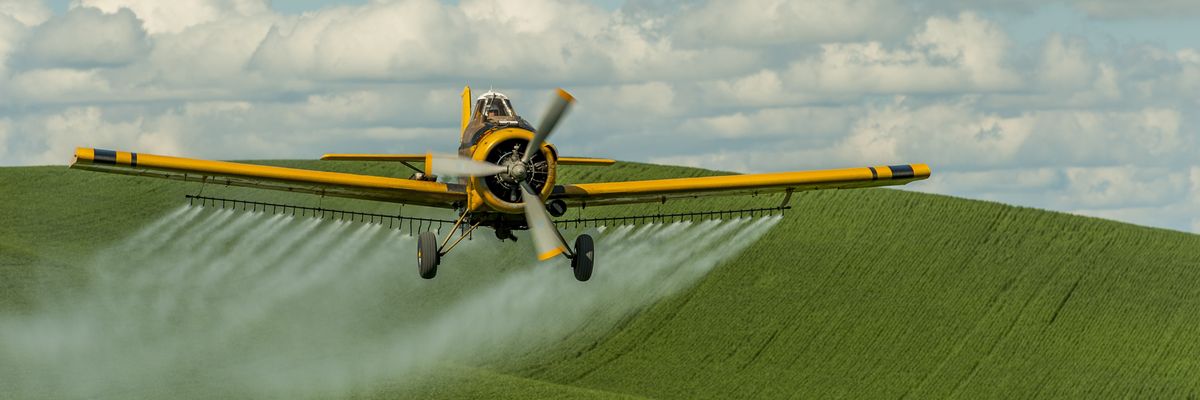
In a move cheered by advocates for public health and the environment, Vermont on Tuesday became the first US state to ban paraquat, a neurotoxic herbicide banned in over 70 countries but protected by the Trump administration despite being linked to Parkinson’s disease.
Democratic Vermont Gov. Phil Scott signed H. 739, which bans the sale and use of paraquat, after the legislation was passed by the state Legislature with strong bipartisan support. The ban—which contains a provision allowing for limited use of the chemical on fruit orchards through the end of 2030—is set to take effect on November 1.
As Public Interest Research Group (PIRG) campaigner Liam Sacino recently noted, the US Environmental Protection Agency [EPA] acknowledges that “even a small amount” of paraquat “can be fatal, and there is no known antidote.”
“The agency has also decided that due to health risks, it should never be used around home gardens, schools, recreational parks, golf courses, or playgrounds,” Sacino added. “Regardless of these conclusions, the EPA still allows paraquat to be sprayed on farms, posing a potentially increased risk to those who work on the farms and live nearby.”
The EPA paradoxically calls paraquat “an important tool for the control of weeds in many agricultural and non-agricultural settings,” a stance promoted by the chemical industry, some of whose highly toxic products the pesticide-friendly Trump administration has designated as vital to US national security.
Ban advocates point to mounting evidence that paraquat exposure greatly increases the risk of developing Parkinson’s disease, a neurodegenerative illness. One recent UCLA study found that the odds of developing Parkinson’s could more than double for people living within 500 meters of paraquat application.
That study added to a body of research linking paraquat to Parkinson’s that dates back to at least 2011, when National Institutes of Health researchers concluded that the brain disorder is “positively associated” with the herbicide. A 2013 paper published in the peer-reviewed journal Neurology found that exposure to paraquat roughly doubled the risk of developing Parkinson’s. In 2020, four of the world’s leading neurologists published a book citing paraquat as a cause of the ailment.
Parkinson’s advocacy groups, including the Parkinson’s Foundation and Michael J. Fox Foundation, hailed the Vermont ban.
The Michael J. Fox Foundation noted that “70+ countries and one US state have now banned paraquat.”
“This is a clear and critical message to other states and our federal government: The time to ban paraquat is now,” the group added.
Environmental groups also cheered the ban.
"We applaud Gov. Scott and the champions in the Legislature that made this moment possible that will protect all Vermonters, including farmers and children, from being exposed to this dangerous chemical,” Environmental Working Group legislative director Geoff Horsfield said in a statement.
“With Vermont leading the way, states across the country now have a clear path to end the use of one of the most toxic herbicides still on the market,” Horsfield added. “This is a turning point in the effort to protect public health from a chemical that has been tied to devastating neurological harm.”
Other states including California, New Jersey, New York, and Pennsylvania have either introduced bills to ban or strictly limit paraquat, or are considering doing so.
“We should not wait for federal action when we can act now to protect farmworkers and families,” PIRG’s Sacino said Tuesday.
From Common Dreams via This RSS Feed.