

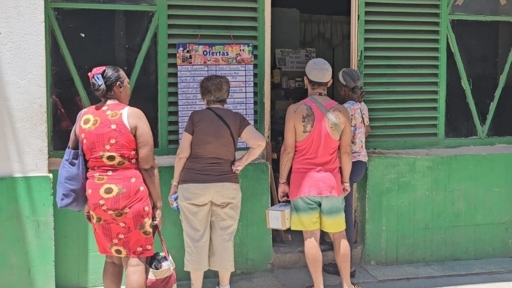
The streets of Havana and daily life in Cuba reveal the devastating effects of the oil embargo imposed by the United States, which has deepened a massive energy and social crisis. The island is in darkness, despite the intense sun that shines upon it.
Power outages — lasting 20 to 22 continuous hours a day in the capital and up to 40 hours at a stretch in other parts of the country — are devastating daily life. Food rots in home refrigerators, the hospital system is beleaguered, and universities and schools are operating only partially. Public transportation has practically disappeared thanks to a lack of fuel.
Tourism, Cuba’s main source of foreign currency over the past few decades, has plummeted, given visitors’ fears of power outages and President Trump’s threats. Meanwhile, the government continues to allocate enormous resources to hotel infrastructure at the expense of essential sectors like health and education. Luis, a high school teacher forced to work as a tour guide, told us that every day he faces the need to support his family. “Now, in the best-case scenario,” he said, “I have work just one day a week.”
The cynicism of Trump and Secretary of State Marco Rubio, who seek to present themselves as Cuba’s “saviors,” is evident in the harsh effects of a reinforced blockade. With each passing day, Washington intensifies economic pressure and threats of military intervention, seeking to impose the conditions demanded by the White House and to turn Cuba back into a vassal state.
In recent weeks, U.S. officials have intensified their threats against the Cuban government, including an indictment against former president Raúl Castro. All of this adds to the uncertainty among the population.

The Cuban People, Caught between the High Cost of Living and Rising Social Inequality
The difficult situation faced by working people is palpable. The well-known garbage crisis in Havana — particularly noticeable in the most densely populated areas, where people set trash on fire at night — is compounded by a clear increase in poverty and the precariousness of daily life: it is now common to see people searching for food in garbage dumps. As a resident of the Cerro neighborhood told us, “If you had told me before that you saw people searching for food in the trash, I would have said that doesn’t happen in Cuba. But now I see it with my own eyes. And there are barefoot children who go out begging because their mothers can no longer give them anything.”
This is happening while the urban landscape bears the deep scars of more than 300 building collapses each year, a result of both the lack of construction materials, which is in turn the result of the U.S. blockade and Cuban government policies that prioritize hotel development. A few months ago, the historic (and beautiful) building of the Higher Institute of Design, which occupied an entire block on Belascoain Street in the capital, also collapsed.
Wage data highlight the plight of the Cuban people. Although the basic food basket costs around 60,000 pesos (US$2,500) for two people, the average salary is just 6,000 pesos (US$250). Yasmani, a chemist, filmmaker, and activist for the rights of people of African descent, told us, “I’m a university professor, and I earn 5,000 pesos. Every day I have to figure out how to put food on the table. But many people are worse off than I am and work many more hours.”
The reality is that one can survive only by receiving remittances from relatives abroad, taking on additional jobs, or working at one of the micro, small, or medium enterprises (MSMEs), which now number around 10,000 and do not impose limits on working hours or include union representation. But they do offer greater exploitation. This also explains the shortage of doctors, nurses, and teachers that many people mention. “The thing is, you’d rather work 12 or 14 hours in a bar like this — even if you’re a doctor or a teacher — just to bring home a plate of food,” Yasmani said. The situation is becoming even more difficult with the drastic reduction in the ration book, which the postrevolutionary state uses to allocate many basic subsidized goods.
This dire situation also has other consequences. As Luis, who is also a left-wing activist, explained, “This is a polycrisis. It’s also demographic. In the last five years, more Cubans have emigrated than in all the exoduses combined since the revolution.”
The consequences of this crisis fall on the shoulders of the working class, especially people of African descent, women, and children, who are the hardest hit. They are living in a situation from which the privileged sectors linked to the ruling bureaucracy and the armed forces are exempt — including GAESA, the parastatal conglomerate run by the military, which some say controls 40 percent of the economy. A new bourgeoisie emerging around private enterprises can also access a higher level of consumption.
Havana, like all of Cuba, bears the consequences of the reforms pushed by the government and the resulting growth in inequality. The aforementioned MSMEs — which can employ up to 100 workers — account for around 60 percent of retail trade. It is through this channel that Cubans can get many of the basic goods they need, provided, of course, they have sufficient foreign currency to do so; there are even stores that sell in dollars. Food provision is thus drastically privatized, as is access to transportation. The expansion of these enterprises is clear from what Ramón, an independent left-wing activist, told us. “MSMEs,” he said, “account for 20 percent of international trade, 17 percent of GDP, and 37 percent of employment.”
Anyone who has visited Havana recently cannot fail to notice that, in a country where the imperialist blockade and black-market fuel prices — at $10 a liter — are driving the use of electric vehicles, high-end hybrid cars are already abundant. Most of these vehicles are Chinese, costing around $20,000. This is happening while restaurants and bars abound with prices that are astronomical for those earning average wages.
Most Cubans cannot afford any of this, highlighting the growing inequality in Cuba under the reforms promoted by recent governments, including the creation of joint ventures and the opening up to investments by Cuban American citizens, like the “gusano” bourgeoisie of Miami, in strategic sectors of the economy. These pro-capitalist reforms, presented by the ruling bureaucracy as the only viable response to the crisis, have strengthened capitalist-style relations and spaces for private accumulation, and represent an austerity measure that hits the working classes hard, while an increasingly wealthy minority benefits economically. They rapidly erode the foundations of the workers’ state that emerged from the revolution. In the wake of this and growing inequality, a social base favorable to the restoration of capitalism is emerging.

The Healthcare System in Crisis
Cuba was known for establishing one of the most advanced healthcare systems, not only in Latin America but internationally. The expropriation of the capitalists and the expulsion of the imperialists in the early 1960s were accompanied by the development of an educational and healthcare system that became a true model in Latin America. Today, all of that is in danger.
During our visit to Havana, we interviewed several healthcare workers who described a critical situation exacerbated by the blockade. One told us: “Thousands of surgeries have been suspended, thousands of patients are being discharged against their will, and doctors and nurses often cannot get to work due to a lack of transportation.”
As Dr. Liliana, a neurosurgeon, explained the dangerous consequences for the population:
The shortage ranges from a syringe, gauze, or medical oxygen to vital equipment like defibrillators or electrocautery devices — nothing is exempt from shortages. Across the entire country, only two MRI machines are operational — and with multiple limitations — which leads to underdiagnosis and inadequate treatment, and CT scanners are out of service in most of Cuba due to a lack of spare parts.
Indeed, the lack of even basic medications and medical supplies is now commonplace on the island. Dr. Liliana continued,
I am a neurosurgeon at a national healthcare center, and the materials needed for surgeries, such as sutures, instruments, or hemostatic agents — without which it would be impossible to perform surgery — have reached me thanks to small donations or personal efforts through doctors I know in other countries. Despite my efforts, I do not have the tools that would allow me to perform spinal surgery or open a skull on patients with brain tumors, to cite just one example.
This situation worsens daily under the imperialist blockade. Cuban authorities have recently acknowledged that infant mortality has risen, a stark indicator of the health crisis.
Social Discontent and the Imperialist Threat
For the past five months, since the bombing of Caracas and the kidnapping of Nicolás Maduro and Cilia Flores, Trump’s constant threats have kept the island on edge. The negotiations between Washington and Havana, where Raúl Castro’s grandson, “El Cangrejo” (the Crab), acted as his envoy, were marked by opacity and secrecy. The only certainty is that, while these talks were taking place, the pro-capitalist measures we mentioned earlier were moving forward.
In that context, Roberto, a university researcher, told us, “There are no polls in Cuba, but government support is no higher than 20 percent today. Moreover, [President Miguel] Díaz-Canel has neither the prestige nor the charisma of Fidel [Castro].”
Activists, intellectuals, and independent journalists agreed that the government’s approval and popularity ratings are at rock bottom. Some justifiably doubted the authenticity of the more than 6 million signatures the administration claimed to have gathered in support of its “My Signature for the Homeland” campaign to encourage Cubans to pledge their support for the government. Others claimed that for the same reason, the government changed the venue for the May 1 demonstration from Revolution Square to the Anti-imperialist Tribune in front of the Malecón and the U.S. Embassy: “They want to hide the low turnout. There’s no fuel for ambulances, but there is enough to bring people to the event by bus.”
Yet criticism of and opposition to the Díaz-Canel administration do not imply support for imperialist intervention. Many oppose U.S. interference. Take, for example, Alma, who works more than 12 hours a day at a small company. After pointing out the inequality in Cuba and the rise of what she calls “the new bourgeoisie,” she told us, “The situation is difficult. We could lose what little remains of what we’ve achieved.” She went on to tell us how much the Cuban Revolution means to her.
Ramón, a veteran of Cuba’s intervention in Angola and a member of the critical Cuban Left, did not hesitate to share his position: “I am against the government, but if the Yankees come, I’ll take up arms again.” Most on the Cuban Left share this stance against intervention.
The Cuban reality is complex and riddled with contradictions. Both critics and supporters of the government tell us that there is a sector on the streets — though still a minority — that sees U.S. interference as a way out of the current crisis. This is a regrettable and mistaken perspective, one that, if it really exists, is the result of the Cuban state’s policies, which have generated disillusionment and weariness.

Growing Censorship and Political Oppression
The consequences of the government’s economic reforms, like the so-called 2021 Ordering Task, sparked various protests and popular mobilizations, including those on July 11, 2021. Although the government portrayed these as driven by the Right, the truth is that they expressed social discontent over economic policy, growing inequality, and the repression of the Díaz-Canel regime. The response was more repression. Thousands of workers and poor youth were imprisoned, and many of them received long prison sentences.
More recently, popular anger has surfaced in response to power outages, such as in March in the city of Morón, where protesters attacked the Communist Party headquarters, and through pot-banging protests sometimes held inside homes to avoid arrest.
The single-party regime has always prohibited free organization, association, and demonstration — repression typical of Stalinism. Recall, for example, the imprisonment of Trotskyists in the early 1960s, the ideological and cultural persecution during the “Gray Five-Year Period,” and the stigmatization and criminalization of sexual diversity.
This repression, however, has intensified in recent years. Several independent left-wing activists we interviewed in Cuba have been frequently detained, subjected to surveillance and persecution by state security organs, and had their phones and social media accounts hacked; many have been forced into exile. Spaces that have emerged outside state-sanctioned organizations — such as recent organizing among university students — have been boycotted by the government. In the arts, various mechanisms are used to censor and silence critical voices: as workers in the film industry told us, official institutions selectively allocate resources, favoring those who support the government.
In response, critical opposition sectors persistently seek ways to remain organized and circumvent the repression, censorship, and political oppression accompanying the government’s economic reforms.
Cuba and the Challenges for the Left
In recent years, what is now known as the critical Cuban Left has emerged, bringing together political and social activists, artists, journalists, and cultural workers. It is a heterogeneous space, ranging from those who consider themselves democratic socialists — some of whom advocate for a mixed economy under state control — to those who see themselves as part of a revolutionary socialist tradition. This opposition merits recognition for combining criticism of the government with a principled stance against imperialist intervention, which many view as a defense of national sovereignty.
We had many conversations with members of this political and cultural space, which allowed us to better understand the Cuban reality and the contradictions facing the critical Left, contradictions stemming from a situation marked by economic, energy, and social crises. These contradictions are also inherent to the political and ideological consequences of confronting a government that, in the name of socialism, maintained a Stalinist one-party regime for decades and upheld the reactionary notion that it is possible to build socialism on an island while hindering the development of the revolution in other Latin American countries — such as in Central America, where Fidel Castro called for “not turning Nicaragua into another Cuba.” Today, this government implements pro-capitalist reforms under ironfisted political oppression.
Undoubtedly, any left-wing program worthy of the name must be based on the complete, absolute, and unconditional rejection of the atrocious and criminal blockade against Cuba, any imposition or blackmail by the United States, and all imperialist intervention. Today, those of us who run La Izquierda Diario and are part of the organizations that make up the Current for Permanent Revolution – Fourth International believe we must call for the broadest international and anti-imperialist mobilization in defense of Cuba.
In particular, the U.S. working class, its trade unions, and the entire Left must launch an active campaign against the blockade and any imperialist intervention in Cuba carried out by its government. To paraphrase Martí, we must defeat the beast from within and deploy consistent anti-imperialism north of the Río Grande. This is also an urgent task in Mexico and throughout Latin America and the Caribbean, where trade unions, the women’s movement, the youth, and the Left must demand the immediate shipment of oil to Cuba, particularly from the “progressive” governments that submit to the oil blockade imposed by Trump and Rubio.
In Cuba, it is urgent to rebuild a socialist perspective that challenges the idea that the only options for the island’s people lie in capitalist restoration under the tutelage of Trump and the Miami gusanos or in maintaining the political regime led by the ruling bureaucracy.
Building on the anti-imperialism that is part of the Cuban people’s tradition, it is necessary to construct a socialist perspective from below, based on democratic self-organization, freedom of association and organization, and the right to legal recognition for political organizations dedicated to defending the revolution and its gains while seeking an end to the economic and social privileges of the bureaucracy and its repressive policies.
Workers and the popular sectors can democratically subject the measures adopted during the “special period” and the governments of Raúl Castro and Díaz-Canel to a thorough and radical review — including concessions to foreign capital — while confronting the current crisis and the threats of imperialist intervention, seeking the support and solidarity of the workers and peoples of the region, who are the true allies of the Cuban people.
This is the path to defend the remaining gains of the revolution and to fight for an anti-imperialist, internationalist, and socialist perspective.Originally published in Spanish on May 24 in La Izquierda Diario.
The post Dispatches from Cuba: An Island Caught Between Imperialist Offensive and Social Crisis appeared first on Left Voice.
From Left Voice via This RSS Feed.