


Global Sumud Flotilla activists are returning home. Many suffered IOF torture, beatings and sexual violence. The Canary spoke with British flotilla activist, Alice Chapman, who was abducted by Zionist Navy forces.
I joined the flotilla in Sicily, in Augusta, and from there we were sailing for about four days before we were intercepted — I think on night five. We were still in international waters, fairly close to Greek waters.
We’d had a warning that day. At that same geographic point, the previous flotilla in September had encountered boats carrying explosives.
From Barcelona to Italy, there’d been a lot of surveillance drones — presumably Israeli, though you can’t really tell. When we reached that position, a message came through:
Watch out — from here on, drones are unlikely to be surveillance drones anymore.
Everyone needed to be really alert on night watches. Then it was far worse than we’d anticipated.
Messages weren’t coming in about drones dropping explosives — they were coming in from people saying the IOF were boarding boats. We had Signal, radio, and livestream cameras on our vessels.
The livestreams went first, then the radios. After that, Signal was all we had.
Flotilla volunteers victim to Israel’s illegal interception
Our boat received warnings for about an hour and a half before we were intercepted. It was around midnight when they came aboard. They told us they would shoot if we didn’t comply. It wasn’t quite guns to heads but actions to that effect.
We were ordered to the front of the boat and to kneel with our hands up. Then we were brought back to the cockpit one by one, where we sat in two rows of three facing each other. They pulled the sail down between us so we couldn’t see one another, then took a knife and began slashing through it.
At that point, honestly, my mind went to the worst places. I thought I was going to be killed or that something horrific was happening to my crew on the other side of that sail. Thankfully, it didn’t.
We were then ordered — shoved, really, hands forced behind our backs — on to a speedboat. From the speedboat we were transferred to a massive warship.
Captive on an IOF warship
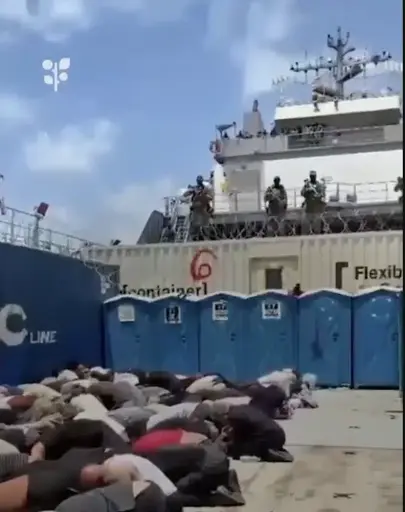
On the warship we were made to kneel with our hands behind our backs for around 20 minutes, then ordered to remove our extra layers until we were in t-shirts.
What followed was a series of random processes — dragged from one position to another, made to kneel, moved again. We were body searched. It became aggressive. Some people were beaten.
Then we were placed, one by one, into a kind of makeshift prison constructed from shipping containers on the deck.
We stayed there for two days with no food or water. They would pour water on us while we were trying to sleep — which, in some ways, felt more disturbing than outright violence. It was so deliberate, so psychological.
They conducted head counts where we were all made to kneel while they fired rounds — rubber bullets, but rubber bullets can kill. Stun grenades were thrown constantly.
I was woken on the second day to soldiers simply walking in and throwing grenades around the space. They also took people out individually to beat them inside the containers. We couldn’t see it, but we could hear everything. Then those people simply didn’t come back.
View this post on Instagram
Calling at ‘complicit’ Crete
On day two they told us we were arriving at Crete and would be getting off. We refused until we had proof of life for individuals who had been taken into solitary confinement — six in total, including Saif and Thiago.
The soldiers said they were already on land, and fine. We said we didn’t believe them, and we weren’t leaving until we saw them. Eventually, we held a group discussion among the 180 of us: anyone who wanted to leave could go, anyone who wanted to stay in solidarity with Saif and Thiago could stay. About half left.
Then soldiers told us: “This is your last chance. If you don’t leave now, you come with us to Israel”. We said, fine. That seemed to confuse them, and then the violence began again.
We sat peacefully — we weren’t being violent in any way — [but] they dragged people out one by one, beating them in the containers as they went.
I was the last person, or second to last, remaining. I was too frightened to lift my head to check if anyone was behind me. I thought, if there’s no one left in this room, these soldiers can do absolutely anything and there is no one to bear witness.
They came at me and told me to get up or they’d use force. I didn’t move. They said they would be very violent. I didn’t move. One said he would break my wrist. I still didn’t move. He picked me up and dragged me out, and in the container he punched me a few times. I was okay.
Aftermath of Zionist violence
We were then taken out and made to lie on the floor again. Many people were being beaten. I saw several whose trousers had been pulled down.
Then we were transferred to a Greek coast guard vessel and taken to Crete — dumped on a scrubland on the coast with no idea where we were. When we arrived, we realised Saïf and Thiago weren’t there.
Everyone just went to pieces. It was like a zombie apocalypse. People were covered in blood, starving, severely dehydrated, standing on this strange scrubland with no infrastructure. No phones, no money, no food, no water, and barely any clothes. What clothes we had were soaking wet.
Three buses eventually arrived: one medical, the others for us. We waited four or five hours before any left — even the medical bus, despite the fact that people had broken ribs, broken necks, and fractured skulls.
The Greek [authorities] spent all their time on bureaucracy, rather than treating it as the emergency it was. It became clear they were entirely complicit [and] following Israeli orders. Collecting us without question.
We spent about a week in Crete after that. It was a strange week — a lot of trauma, a lot to process. The local Palestine solidarity community was incredible. We were all staying in a squat in Heraklion and I felt such a sense of belonging. People came together and were so kind. It was exactly where I needed to be.
Focus on Palestinians’ suffering
At the end of the day, this is about the Palestinian people. What’s happened in the last couple of weeks has really highlighted the West’s double standards.
The way they respond when Palestinian people are abused, as opposed to when people from their own countries are abused. Not that there has been a massive response from Western governments — they’ve done next to nothing — but people are finally paying attention because Western people have been subject to Israeli torture.
This is what Palestinians have been going through for decades, but they do not have another country to go to. They do not have families to go back to. They do not have a passport to get them out of those situations. They do not have another government to, supposedly, hold to account.
They are stuck there for their whole lives, with absolutely nothing to fall back on. That is what needs to be changed. That is what needs support. The world needs to wake up to the fact that this is happening every single day to thousands of people no different from you or I.
Featured image via Global Sumud Flotilla
From Canary via This RSS Feed.