

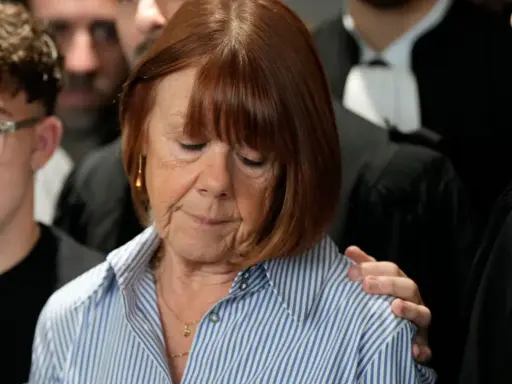

Gisèle Pelicot has expressed deep shock at the recent decision to spare three rapists from prison after they victimised two teenage girls and filmed it.
In two separate attacks in November 2024 and January 2025, three teenage boys raped two girls only to receive Youth Rehabilitation Orders and curfews.
Today, the prime minister announced that the Attorney General has reviewed the case and referred the sentences to the Court of Appeal for reconsideration.
Pelicot, who waived her legal right to anonymity as the victim-survivor in a multiple rape case, praised the victims’ courage and strength to come forward.
In an interview with the BBC, she also condemned the choice to allow these boys to escape custody.
Pelicot said she was “deeply shocked that these individuals were in fact able to gain their freedom again when in fact the victims are suffering so hard they will never be able to heal”.
French rape survivor Gisèle Pelicot has told #BBCBreakfast she is “deeply shocked” that three teenage boys have been spared custodial sentences over the rape of two girls in Hampshire.
She said social media played an ‘unbearable’ role in the attack on the girls then aged 15 and… pic.twitter.com/iLEFFoMwZD
— BBC Breakfast (@BBCBreakfast) May 26, 2026
Pelicot reminds viewers of ‘essential role’ of justice
The perpetrators in this case are two boys, aged 15, and another 14-year-old.
Despite their malicious and predatory collaboration, they each received Youth Rehabilitation Orders, supervision and surveillance over 180 days, and a measly three-month curfew. They are also subject to a restraining order to not contact their victims for 10 years.
This lenient and, many would argue, pretty typical approach to sentencing male perpetrators leaves victim-survivors of sexual assaults even more traumatised and at increased risk of encountering their attackers.
Commenting on this choice to rehabilitate rather than punish the teen rapists, Pelicot said:
Rape is a crime and justice has an essential role. It’s there to, in fact, name the crimes, to recognise the suffering of victims, and to remember that in fact they must not remain unpunished.
Nevertheless, despite noting the courage of the victims, Judge Nicholas Rowland deemed it to be most important.
Explaining his sentencing decision, Judge Rowland said:
I should avoid criminalising these children unnecessarily and understand the effects of their behaviour and support their reintegration into society.
NEW: The Government will review the sentencing of three teenage boys after they avoided jail for raping two girls, including one at knife point
Two of the boys received youth rehabilitation orders while the judge praised their behaviour in court
— Politics UK (@PolitlcsUK) May 22, 2026
Why are girls less important than male abusers?
As a result, it is hard not to see a hierarchy of justice at play. One which many women and girls will recognise from their own experiences.
Society downplays male rapists’ offences by portraying them as lacking agency or control over their abusive actions, while simultaneously dismissing female victims’ trauma as though it does not matter in Western society.
Subsequently, Keir Starmer condemned the “appalling” decision, stating that the boys should not have been spared custodial sentences.
He added that the survivors had shown “extraordinary bravery and strength in heinous circumstances”.
However, two traumatised young girls must now navigate life in fear of encountering their attackers while attempting to heal from the horrific ordeal these teenage boys inflicted upon them.
Judge Rowland also acknowledged the girls’ “great courage” and hoped they would take some comfort from that. Nonetheless, justice would have been far more comforting.
Founder @DrProudman on BBC Radio 4 this morning discussing the harrowing case where three teenage boys escaped custodial sentences for raping two teenage girls at knifepoint.https://t.co/lqyvAvXKtG pic.twitter.com/v0GY0sUKx0
— Proudmans (@proudmanslaw) May 25, 2026
Survivor questions why she endured the court case
Now aged 16, one of the girls heartbreakingly spoke to the BBC about the ‘justice’ they received.
She said:
Why did I sit and put myself through the pain of going to court, going through a trial, reliving everything because of evidence and watching it all happen again?
It took six months for the pair to speak up, which is unsurprising in a society where women and girls often learn to live with their trauma due to feeling unsafe to report the crimes against them.
That fear of reporting is likely to be compounded by this unfair ruling, with this 16-year old adding:
It sort of gave me a sense of what’s the point…What was the point in putting me through that just to say that it’s fine?
Moreover, rulings like this continue to make women and girls less safe by signalling to male attackers that they can excuse or minimise their violence by claiming they “couldn’t help it”. They’re effectively being handed a continual ‘Get out of jail free’ card to play.
Ranvir Singh, “Judge Nicholas Rowland said about three teenage boys, who were convicted of, between them, 10 counts of rape”
“Two different girls, one at knifepoint”
“Forcibly taken, raped. They filmed it, on both occasions”
“They’ve been community orders, and not prison”… pic.twitter.com/c8vBr4dwa5
— Farrukh (@implausibleblog) May 26, 2026
No accountability for abusive men and boys
Increasingly, society forces more women and girls to carry trauma and pain while excusing predatory and misogynistic behaviour as something perpetrators cannot control.
At the same time, the courts pressure female victims — regardless of age — to rationalise their suffering. The legal process convinces them that they somehow “asked for it” or brought it upon themselves.
This sinister hierarchy is a story as old as time, and misogynistic patriarchal systems continue to keep women and girls exactly where they want them: silenced, undermined and unsafe.
Therefore, it is essential that victims and survivors are amplified, supported, and defended — and that the fight for meaningful justice continues.
Featured image via Julien Goldstein/ Getty Images
From Canary via This RSS Feed.