

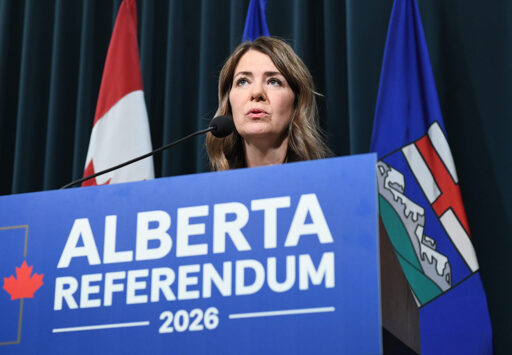
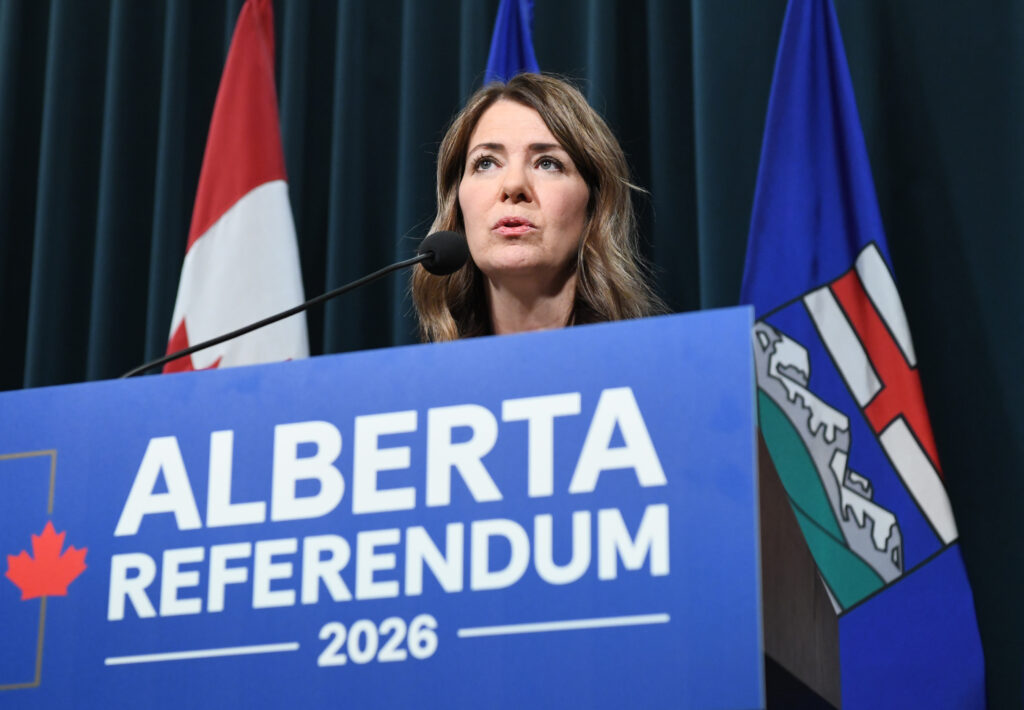
Alberta Premier Danielle Smith takes questions on Friday about her promise to ask voters on Oct. 19 if they want to hold a future referendum to separate from ‘Canada.’ Photo courtesy Government of Alberta/Chris Schwarz
This story was originally published inAlberta Native News in two parts (here & here), and appears here with permission and minor edits.
First Nations leaders have some choice words for Premier Danielle Smith after the “Alberta” leader promised to hold a referendum on whether there should be a future vote for provincial independence.
Last Thursday, on her personal YouTube page, Smith announced she will add another question to an already scheduled Oct. 19 ballot.
Voters will be asked if they want to “remain a province of Canada or should the Government of Alberta commence the legal process required under the Canadian Constitution to hold a binding provincial referendum on whether or not Alberta should separate from Canada?”
Smith’s announcement came after an Alberta Court of King’s Bench judge quashed the approval of Stay Free Alberta’s proposed “independence petition” on May 13 because of a lack of consultation with treaty First Nations.
Chief Billy-Joe Tuccaro of Mikisew Cree First Nation in Treaty 8 issued a statement calling the United Conservative Party (UCP) premier a “traitor and a separatist,” which noted that First Nations haven’t received “even an invitation to the table.”
“The question announced today is intended to be the beginning of the end of treaty,” Tuccaro said, referencing a “manufactured UCP separatist crisis.”
Smith concluded her address by cautioning “against the trap of using division and demonization tactics.”
READ MORE: Judge sides with First Nations to prevent ‘Alberta’ separatist petition count, for now
“The premier talks about hatred and vilification,” said Tuccaro, “but she opened up a world of hate on First Nations and continues to do so by attacking independent courts for siding with us, treaty and the constitution.
“Her words are meaningless.”
Sturgeon Lake Cree Nation Chief Sheldon Sunshine issued a brief statement in response to the additional referendum question, characterizing Smith and the UCP as “undemocratic, authoritarian, and willing to bend to the whims of a loud, angry minority.”
“First Nations have been sounding the alarm bell for months now,” Sunshine wrote. “Danielle Smith continues to trample on treaty, and continues to damage the economy and reputation of the province in order to stay in power.
“It’s time for others to join us in fighting for our rights, the rule of law, and a functioning democracy.”
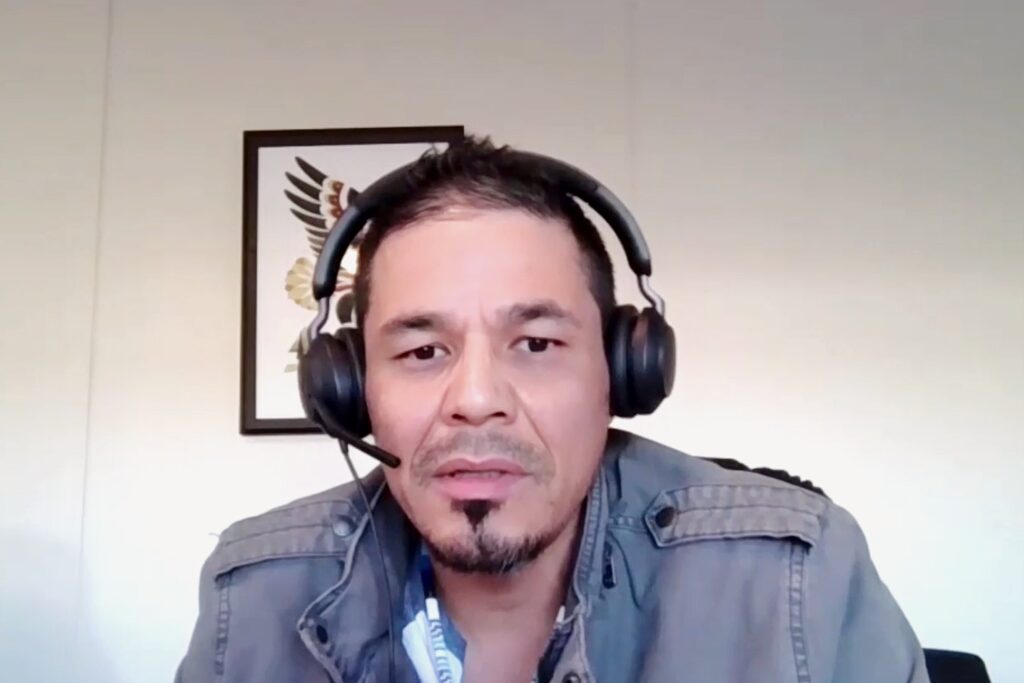
Billy-Joe Tuccaro, Chief of Mikisew Cree First Nation, testifies at the House of Commons standing committee in Indigenous and Northern Affairs in 2024. Screengrab courtesy Parliament of Canada
Judges’ rulings ‘should have been the end of it’
Smith’s announcement was made hours after NDP MLAs’ proposal to engage in consultation with First Nations before proceeding with an independence referendum was voted down in committee.
On May 13, Court of King’s Bench Justice Shaina Leonard quashed a separatist referendum petition drive, agreeing with Athabasca Chipewyan First Nation and the Blackfoot Confederacy’s argument that the government needed to consult with them before the chief electoral officer approved the petition.
The Confederacy of Treaty Six First Nations called the decision a reaffirmation of treaty rights and constitutional law. Leonard’s decision effectively blocks the petition process tied to the separation question.
Treaty 6 leadership says her ruling reinforces what First Nations have long argued: that any attempt to pursue separation must recognize and respect Treaties 6, 7, and 8 as legally binding agreements.
The Confederacy of Treaty Six First Nations expressed gratitude for the continued legal and political advocacy of Athabasca Chipewyan First Nation, the Blackfoot Confederacy, and Sturgeon Lake Cree Nation, noting their ongoing role in challenging separatist proposals through the courts.
In its statement, the Confederacy said the decision should bring a final end to efforts to advance a referendum question on separation. Leaders pointed to an earlier court decision in December, which ruled that a separation referendum would be illegal under existing constitutional frameworks.
“That should have been the end of it,” the Confederacy noted, adding that continued efforts to revisit the question reflect a disregard for treaty rights, the Constitution, and the rule of law.
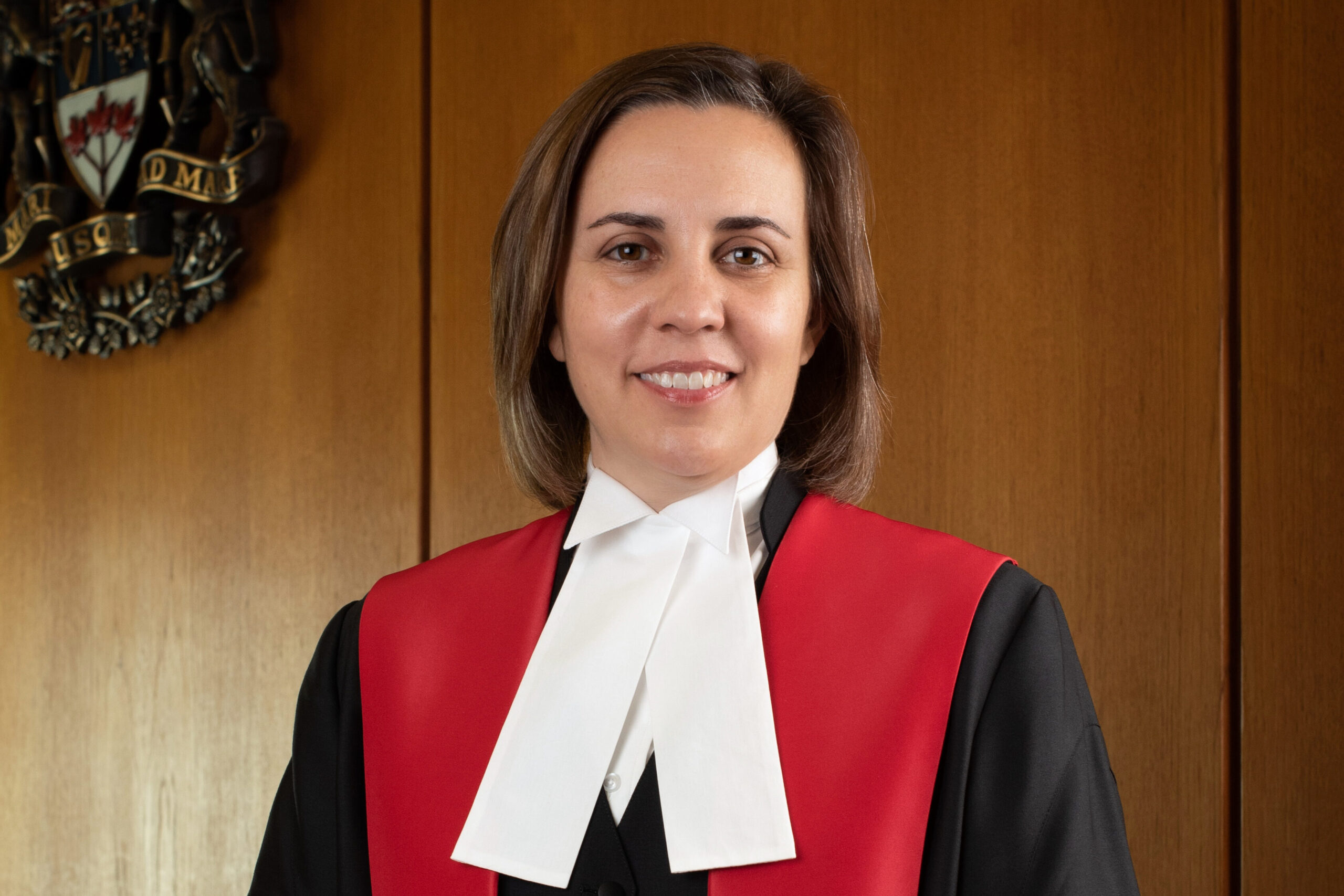
Justice Shaina Leonard, of the Court of King’s Bench of Alberta, was appointed in 2020. Photo courtesy Alberta Courts
The Confederacy also raised concern over the Government of Alberta’s continued political positioning on separatist discourse, stating it has contributed to division across the province.
In last week’s YouTube address, the premier reiterated previously expressed criticism of what she called Leonard’s “troubling decision.”
“This ruling fundamentally misinterprets the nature of the duty to consult, which was never meant to prevent citizens from making their voices heard through a democratic process,” Smith said.
The premier added that her government intends on appealing Leonard’s “incorrect ruling,” a process which she acknowledged “will take many months, possibly years.”
She portrayed the new referendum question as “another way to hear from Albertans while we wait for our legal appeal to be heard.”
“This proposed referendum question does not directly trigger separation,” said Smith, “but if successful would ask Alberta’s government to commence the legal process necessary to hold a binding referendum on the matter, the recent court ruling would not be applicable.”
She emphasized that she intends on voting in support of remaining in “Canada,” citing Prime Minister Mark Carney’s retreat from various policies she objected to, including an oil and gas emissions cap and clean electricity regulations.
READ MORE: ‘Carney is at a crossroads’ with First Nations, says AFN national chief
First Nations leaders say the ongoing debate over separation has had consequences beyond the courtroom.
The Confederacy said there has been increased racism directed at First Nations peoples, the spread of misinformation regarding Treaties, and growing financial and legal burdens placed on nations forced to defend treaty rights through litigation.
It also expressed concern that Smith has indicated an appeal of the ruling is being considered, describing this as a continuation of political tension surrounding the province’s sovereignty debate.
The Confederacy emphasized that treaties are not symbolic historical documents, but living agreements that remain foundational to governance and relationships.
“Treaty unites us all on these lands,” the statement reads. “They are living agreements that remain foundational to this land and the relationship between First Nations and the Crown, including the province of Alberta.”
The organization further underscored that courts have repeatedly affirmed Treaties cannot be disregarded in constitutional matters affecting land, governance, or sovereignty.
As Treaty 6 marks its 150th year, the Confederacy called for renewed focus on honouring treaty relationships rather than pursuing political paths that deepen division.
“It’s time to move on from this and return to the important work of honouring relationships, not destroying them,” the statement concluded.
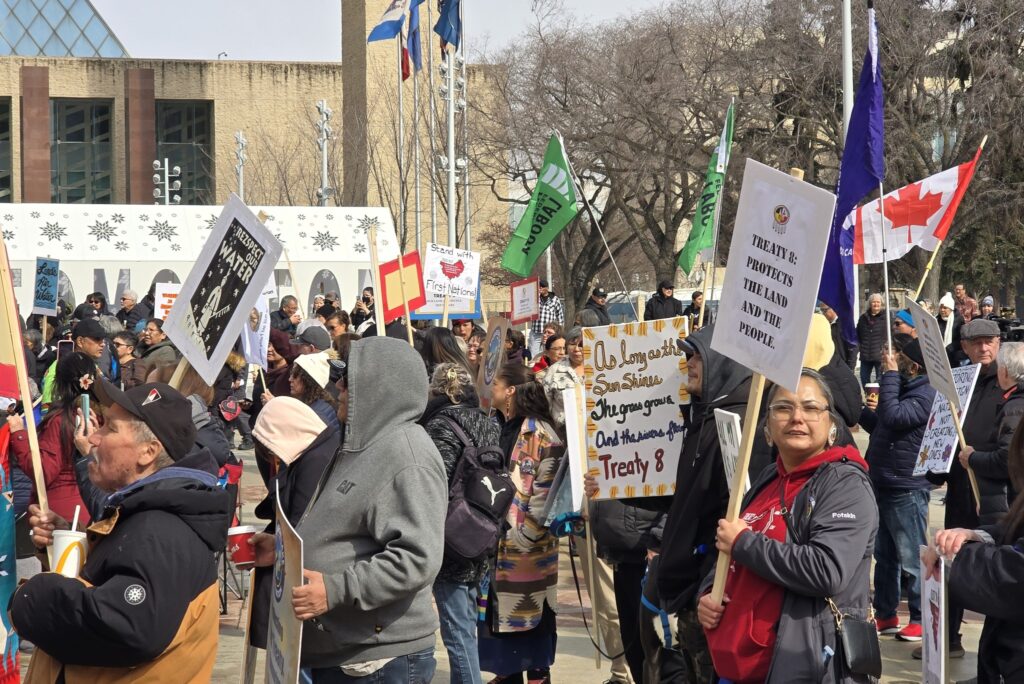
Participants attend a Rally to Defend the Treaties protest on April 8 in ‘Edmonton, Alberta.’ Photo courtesy Treaty 9 First Nations
Committee debates rival anti-separation petition
Last Wednesday, a provincial committee met to discuss what to do with a rival pro-federalism petition, which obtained 438,568 verified signatures, which asked: “Do you agree Alberta should remain in Canada?”
The Forever Canada petition was spearheaded by former deputy premier Thomas Lukaszuk.
The Stay Free Alberta, the organization behind the pro-independence petition drive, says it collected 300,000 signatures.
These haven’t been verified due to a stay Justice Leonard ordered on counting separatist petition signatures until she issued her decision, which ultimately rendered the number moot.
Unlike the separatists’ petition, which was a constitutional referendum proposal, Forever Canada submitted a policy proposal, giving the government the option of debating the petition in the Legislature or sending it for a referendum.
As the petition was being debated in committee, the UCP caucus sent out a news release claiming the committee had voted to proceed with a referendum via the Forever Canada question, which led to the meeting’s adjournment until Thursday.
READ MORE: ‘Alberta’ chiefs say oil company’s forceful approach is an attack on treaty rights
The committee, which consists of four UCP MLAs and two NDP MLAs, ultimately voted to send a report to Cabinet advocating for a referendum on whether “Alberta” should stay in “Canada,” with the NDP MLAs writing a minority report.
But before that, NDP MLA Court Ellingston proposed an amendment to explicitly call on the committee to consult with First Nations before recommending a referendum, noting how “anything with respect to First Nations” was “glaringly absent” from the motion they debated.
“The government can’t bypass the duty to consult,” said Ellingston. “We heard that from the courts last week.”
MLA Rakhi Pancholi, the other New Democrat on the committee, noted that deputy chair Sawhney, who serves as Indigenous relations minister, was silent during the amendment debate.
“We are only here now because the preferred question that the government wanted to go forward to referendum was struck down by a court for failure to consult,” she said, referencing the Stay Free Alberta petition. “Let’s not make that same mistake twice.”
Ellingston’s proposed amendment was rejected along partisan lines.
After the committee voted to recommend a referendum, Confederacy of Treaty Six First Nations Grand Chief Joey Pete released a statement accusing the premier of overseeing a “separatist regime.”
“Premier Danielle Smith and her party are beholden to the separatists who put them in power. Everything they do is subservient to that debt – without consideration for laws, treaty obligations or the wellbeing of future generations,” said Pete.
He lamented how “First Nations are once again carrying the burden of defending the Constitution of Canada while the Government of Canada remains silent.”
The post After court win, First Nations denounce ‘Alberta’ premier’s separation referendum plan appeared first on Indiginews.
From Indiginews via This RSS Feed.