

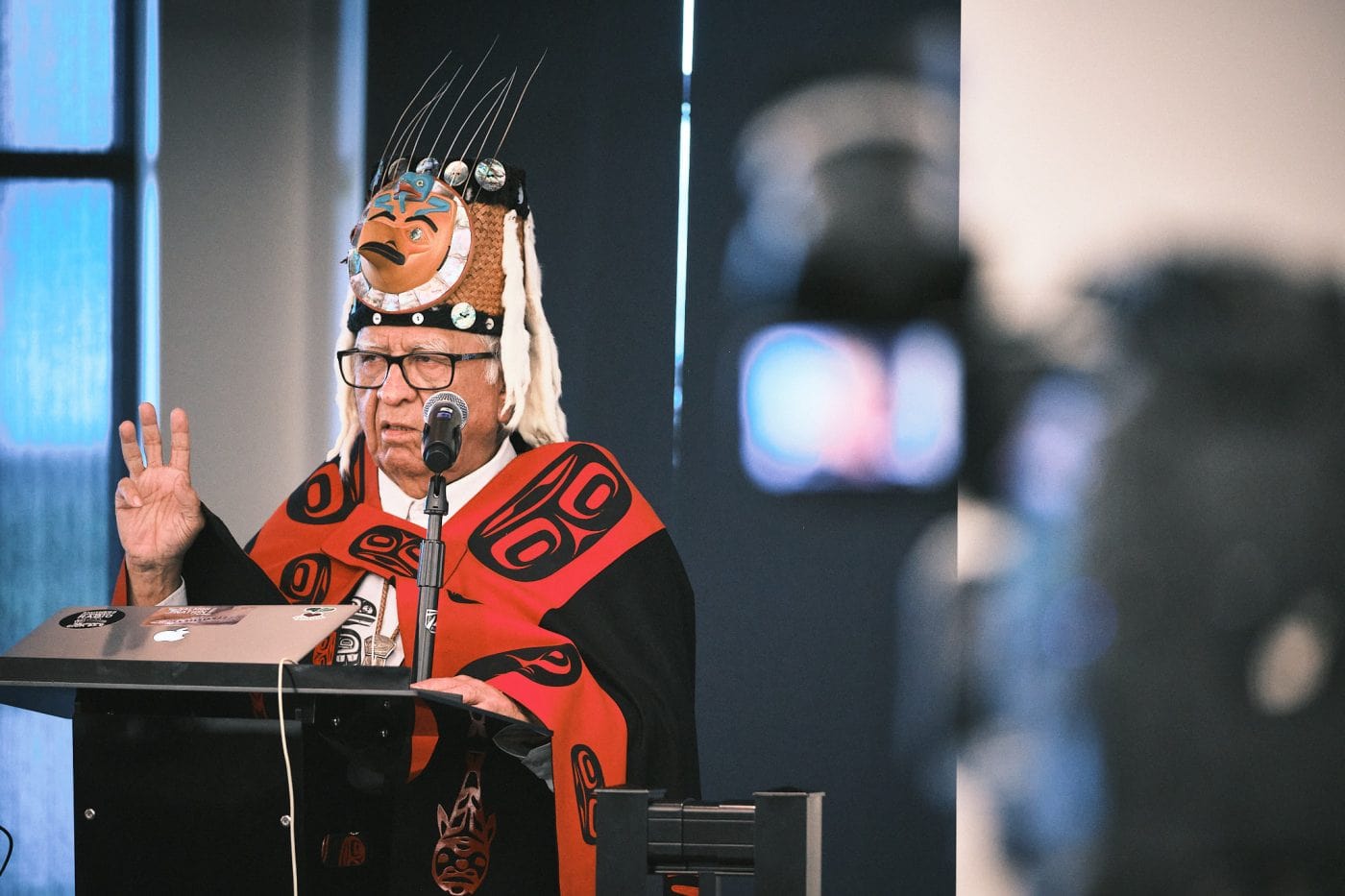
Photo: Dan Mesec / SkeenaWild
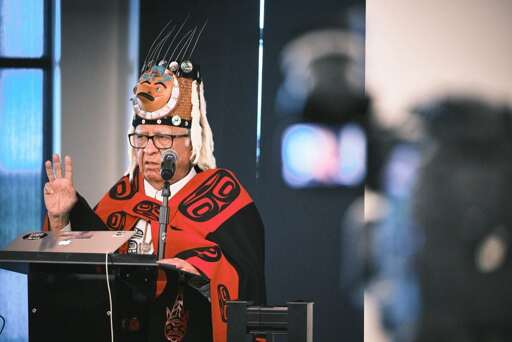
Wearing regalia bearing the raven crests of his mother’s clan, S’mooygyet (Chief) Algax’m Hax, Murray Smith, of the Gitwilgyoots Tribe, shared where he comes from. Sharing his lineage is a necessary precursor to welcoming visitors to his lands, he explained.
“When I get up here to speak, I have to tell you who I really am,” he told a group gathered in Prince Rupert, B.C., earlier this month. “My grandfather is Haida. My mother’s mother was Ts’msyen from Lax Kw’alaams.”
“There’s a word in my language called sg̱an,” he continued. “Sg̱an is a welcome mat made out of cedar and they place it at the bow of a canoe. When the Chief steps off, he doesn’t step on the ground, he steps on the welcome mat.”
“Chiefs, matriarchs, high-ranking women, young people that are here: the welcome mat is out,” he declared.
Algax’m Hax is a Hereditary Chief of the Gitwilgyoots, one of the Nine Allied Tribes of Lax Kw’alaams. Ten years ago, he and other chiefs signed the landmark Lelu Island Declaration, placing vital salmon habitat in the Skeena River estuary under the protection of Indigenous laws. In solidarity with the Gitwilgyoots Chiefs, leaders of First Nations and elected officials from across the region signed onto the declaration, which extended an invitation to all to join in “defending this unique and precious place and to protect it for all time.”
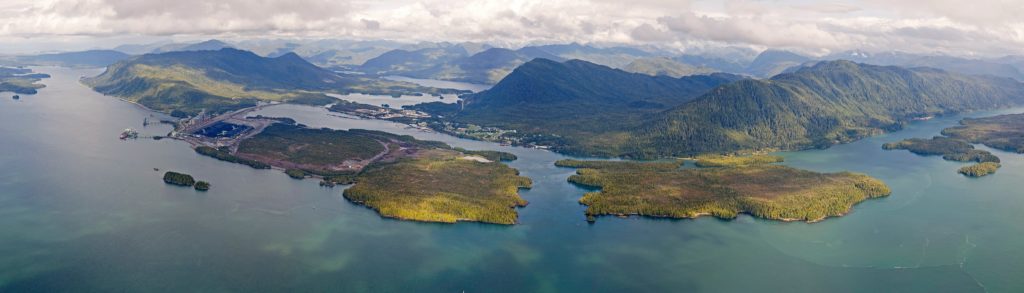
Lelu Island and Flora Bank (bottom right), an important juvenile salmon habitat, have been under the protection of Indigenous laws since 2016. Photo: Prince Rupert Port Authority / Facebook
At the time, the estuary — one of the most productive and ecologically important salmon habitats in B.C. — was threatened by the looming prospect of a major liquefied natural gas (LNG) export terminal, which was to be built on the island. The following year, Malaysian oil and gas giant Petronas cancelled its plans to build the Pacific Northwest LNG facility. A totem pole was raised on the island, to keep watch and assert stewardship. Two years later, the Prince Rupert Port Authority imposed a development moratorium over the sensitive area.
This spring, as juvenile salmon migrated from the creeks and rivers out to the ocean, Indigenous leaders and allies met to mark the anniversary of the declaration and talk about the future of salmon stewardship in the estuary and watershed. Algax’m Hax spoke to the importance of salmon and expressed solidarity with all who give of themselves to protect the species.
“I see you all here fighting for one thing, and that’s for our salmon,” he said. “So goes the salmon, so do we.”
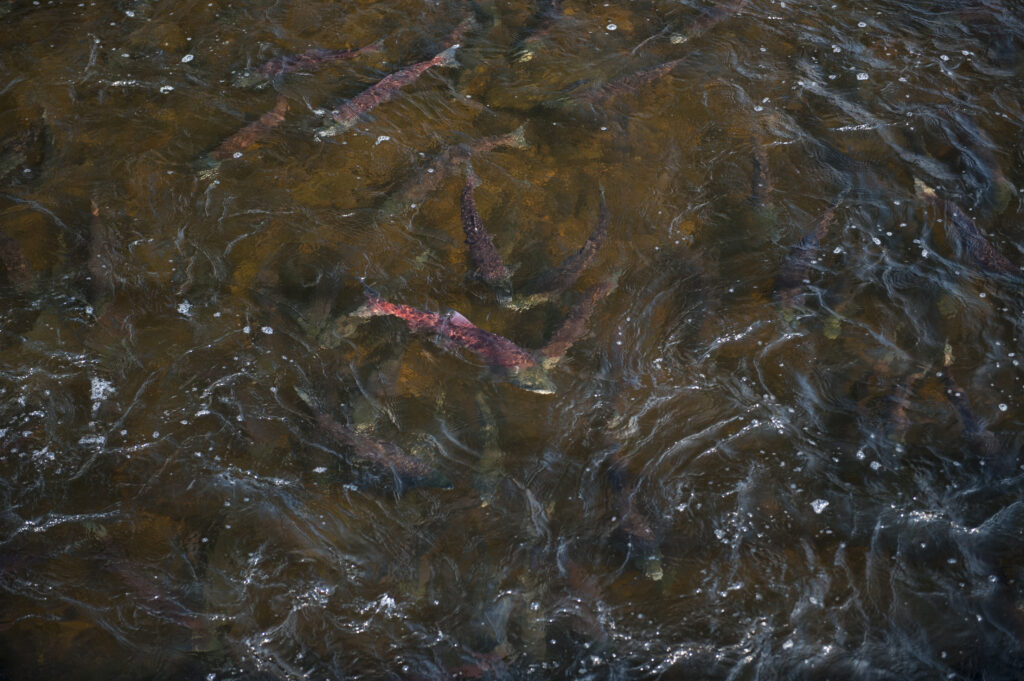
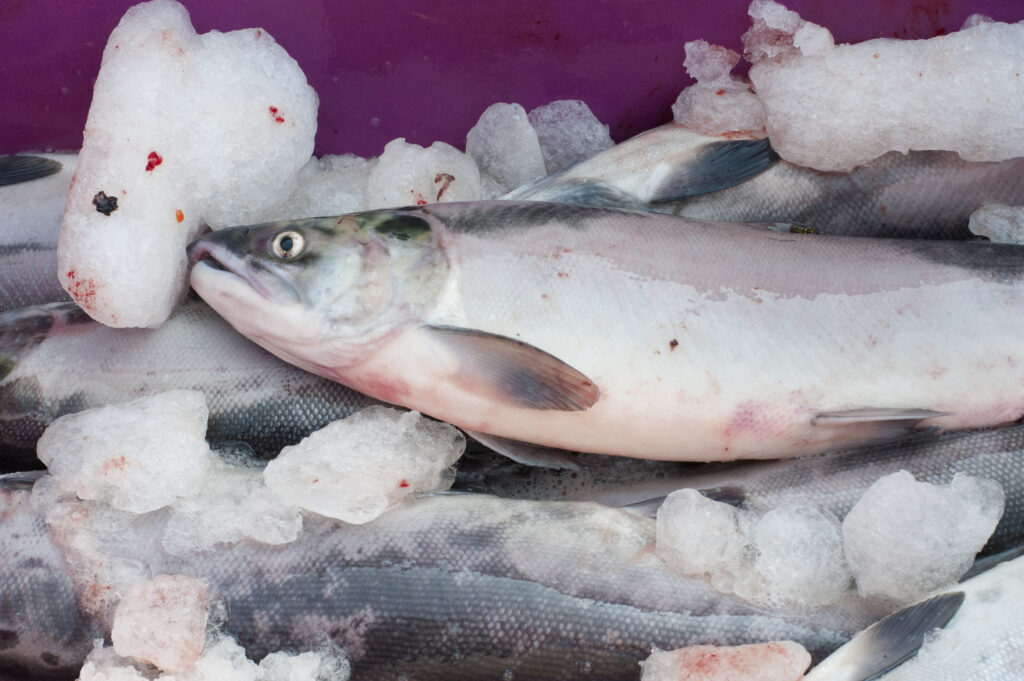
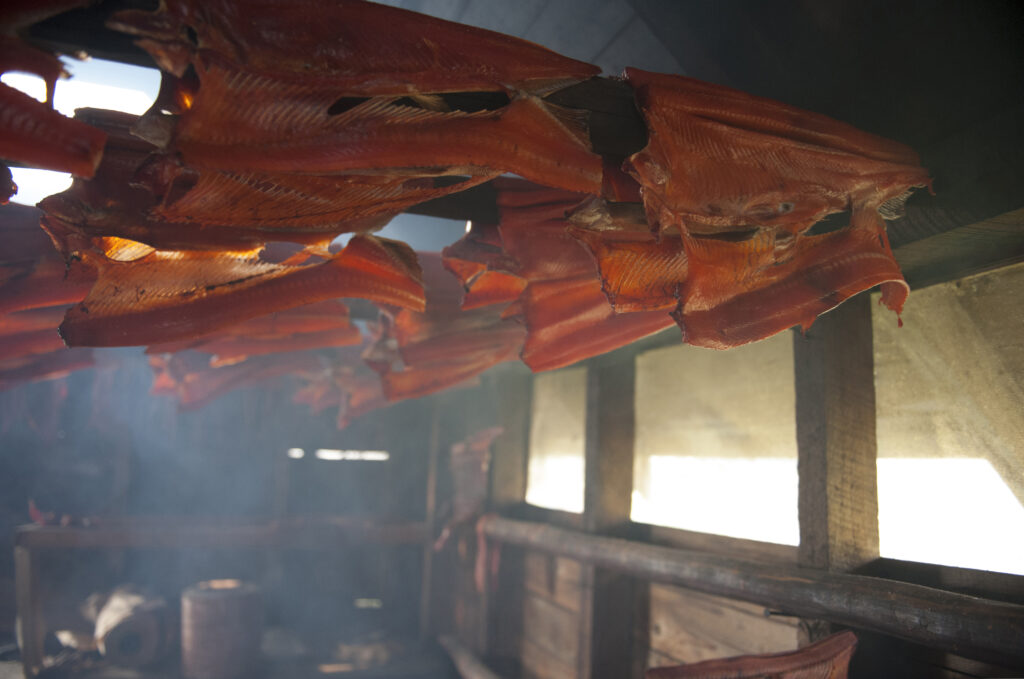
Salmon that rely on the estuary at Lelu Island migrate hundreds of kilometres to the Skeena watershed, providing sustenance to communities. Photos: Matt Simmons / The Narwhal
He looked around the room and said he was called to speak by his fellow chief, Yahaan, who wasn’t able to attend the gathering. He said he phoned Yahaan the night before the event and asked what he should say.
“He said, ‘You’ll find your words,’ ” Algax’m Hax recounted. “It’s easy when I sit amongst people that care, people that dedicate themselves to the wellness of our salmon here on the North Coast, on the coast altogether. I take my hat off to you.”
Salmon connect ‘communities, cultures and generations’
The protection of Lelu Island — and Flora and Agnew Banks, the delicate estuarine habitat around the island — took years of dedication and sacrifice by Indigenous and non-Indigenous leaders and community members.
Loggers, commercial fishers, scientists, politicians and more agreed building a massive LNG facility in the sensitive estuary would be a catastrophic mistake with far-reaching impacts on the livelihoods and cultures of communities across the region. Weaving Indigenous science and academic research, allyship and land defence, people from across the Skeena watershed and beyond came together to stand up for the salmon, sending ripples far and wide.
“Salmon do something extraordinary,” Julia Hill, executive director of SkeenaWild, said at the two-day event. “They connect ecosystems … communities, cultures and generations. They’re part of the social, cultural and economic fabric of this place.”
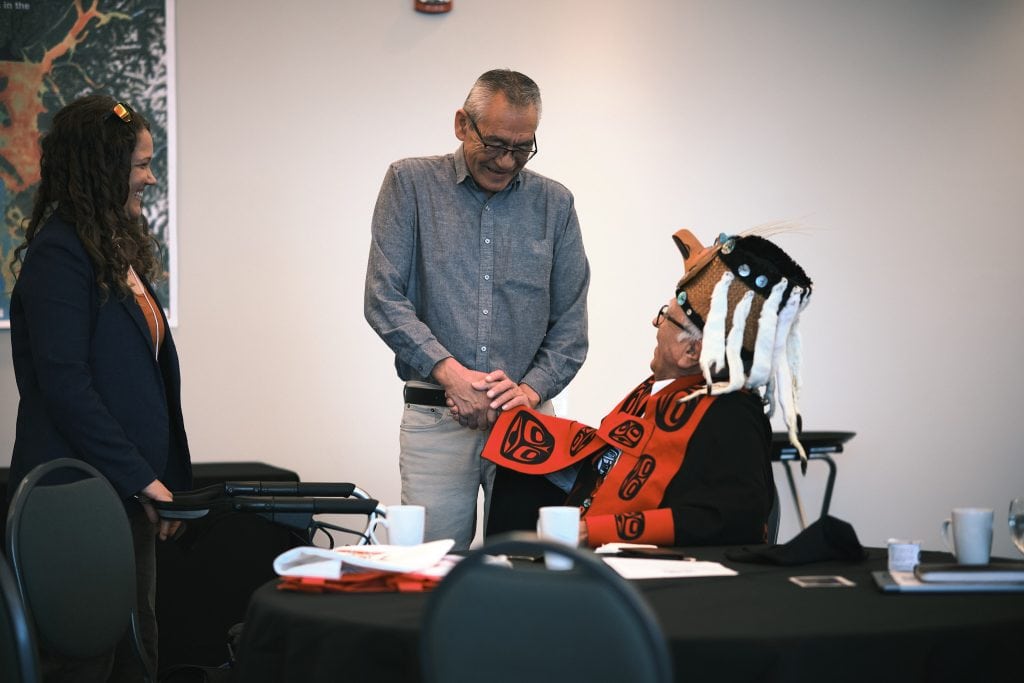
Wet’suwet’en Hereditary Chief Na’moks greets S’mooygyet (Chief) Algax’m Hax, Murray Smith, of the Gitwilgyoots Tribe, at the gathering in Prince Rupert, B.C. Photo: Dan Mesec / SkeenaWild
In the years since the declaration was signed, Indigenous and non-Indigenous salmon stewardship and science has been ongoing throughout the Skeena watershed. At the gathering, representatives from Fisheries and Oceans Canada presented alongside environmental organizations, academics and First Nations.
Jonathan Moore, director of the Salmon Watersheds Lab at Simon Fraser University, said the reason the species is able to thrive today is because of this unity and the continuity of stewardship.
“Right now, as we gather, literally hundreds of millions of young salmon are migrating down from throughout the Skeena, potentially hundreds of kilometres away, and they’re all coming down just around the corner and they’re hitting the ocean,” he said, grinning. “It gives me chills, honestly, to think about that phenomenon that unfolds every year because of these intact ecosystems that have been stewarded for millennia.”
But while the protections of Lelu Island remain in place, wild salmon continue to face multiple threats. Many populations across the watershed are struggling.
“This region is experiencing enormous pressure and rapid change, from climate change and warming waters to industrial expansion and growing global demand for resources,” Hill said. “At the same time, many communities here depend on resource-based economies. So the question isn’t development or no development. The question is how much, where and to whose benefit.”
That tension is rising amid talk about new pipelines from Alberta and the spectre of lifting the oil tanker moratorium on the North Coast. A slew of projects supported by the provincial and federal governments are putting increased pressure on already-impacted salmon habitat throughout the northwest.
All of this is set against a backdrop of talk by the provincial government about amending or repealing B.C.’s Declaration on the Rights of Indigenous Peoples Act. It leads some to fear hard-won battles like the protection of Lelu Island could be undermined by an onslaught of new industrial developments that would provide little benefit to the communities who would pay the highest costs.
“We’re witnessing this backlash against Indigenous Rights, against Indigenous stewardship, against title to the land being recognized,” Naxginkw Tara Marsden, Wilp sustainability director with the Gitanyow Hereditary Chiefs, said. “We’re at a critical juncture for salmon stewardship and for the well-being of our communities.”
Marsden emphasized the intersection between rights and responsibilities.
“If we receive a full basket, we have to make sure we pass on a full basket,” she said. “So in my lifetime, if I see the salmon stocks decline to a point of extirpation, then I haven’t done my job for my kids, my grandkids.”
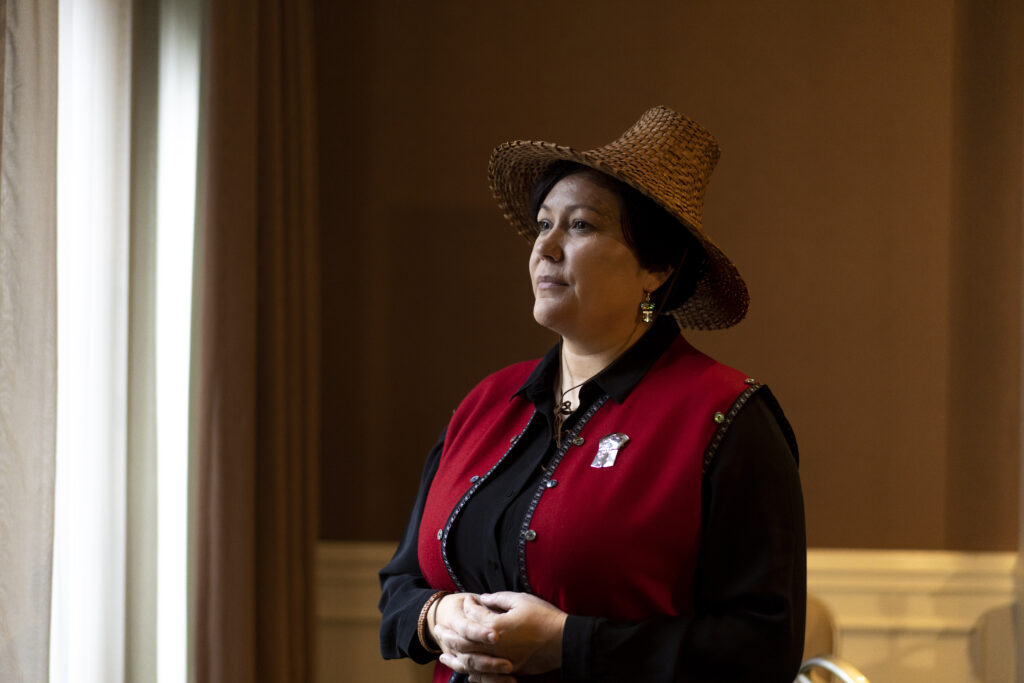
Naxginkw Tara Marsden said salmon stewardship is at a “critical juncture” as the political and economic landscape prioritizes industrial development. Photo: Jimmy Jeong / The Narwhal
‘This impacts everybody’
For Grace Vickers, daughter of Andrea Vickers and revered carver Roy Henry Vickers, all conversations about stewardship and economy need to start from a shared baseline. Introducing herself as Heiltsuk belonging to the House of Walkus, she spoke about the importance of place-based knowledge.
“What’s important today is what is sustaining us,” she said, during a youth panel at the gathering. “It’s the air we breathe, it’s the fish we eat and it’s the water we drink.”
Vickers and four other young women — Nasya Moore, Oasis Cleveland, Drew Harris and Kayla Mitchell — shared what it’s like being young at a time when so much is changing. They spoke about cultural disconnection and reconnection and the strength and restorative value of spending time on the land, harvesting and processing fish.
Harris, who is Wet’suwet’en and Gitxsan, said she sees how land protections, human rights and stewardship of the likes of salmon can become siloed.
“Like: there’s the fish, there’s the land, there’s the people, there’s the health,” she said. “But it’s all connected. We can’t just silo these things and differentiate them and not talk about it together. Just seeing the different connections and looking from a different perspective can really help you understand the full picture and how to treat that problem.”
She said acknowledging the scale of the problems facing communities can be unifying and called out fossil fuel expansions as a global issue.
“Everywhere we go, we meet the youth and they all have their own projects that they’re fighting,” she said. “It’s sad but it connects us all together.”
“This fight isn’t just for the Indigenous people,” she added. “This impacts everybody.”
The Narwhal’s reporters are telling environment stories you won’t read about anywhere else. Stay in the loop by signing up for our free weekly dose of independent journalism.
From The Narwhal | News on Climate Change, Environmental Issues in Canada via This RSS Feed.