

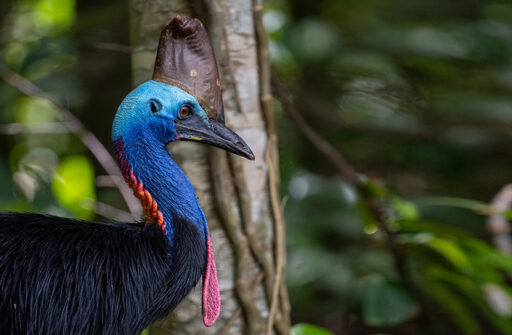
With a striking blue neck, jet black plumage and bright red drooping wattles, the southern cassowary cuts an imposing figure in the dense tropical rainforests of Far North Queensland, Australia. Standing up to 2 meters (6.5 feet) tall and armed with razor-sharp claws, it is often labeled as the world’s most dangerous bird. In reality, it’s a shy, gentle and solitary animal rarely seen by people. While it’s listed as endangered under Australia’s Environment Protection and Biodiversity Conservation Act 1999, southern cassowary (Casuarius casuarius) populations have always been difficult to track. “They occupy very rugged and remote terrain. So, to be able to find scats, get sightings through camera traps or collect DNA is very challenging,” said Wren McLean, a cassowary researcher and member of the Cassowary Recovery Team. Estimates have changed dramatically since the turn of the 21st century, growing from fewer than 1,500 birds in the early 2000s to around 4,400 in the most recent national survey, which was conducted between 2012 and 2014. Led by Australia’s national science agency, CSIRO, that survey recommended that population monitoring become a “central component” of the species’ management and should be carried out more frequently. More than a decade later, that hasn’t happened. A camera trap image of an adult female cassowary roaming the Apudthama National Park in the Cape York Peninsula. Image courtesy of Wren McLean, Ipima Ikaya Aboriginal Corporation and Cape York NRM. The Cassowary Recovery Team has produced a new conservation plan for the species, set to be…This article was originally published on Mongabay
From Conservation news via This RSS Feed.