

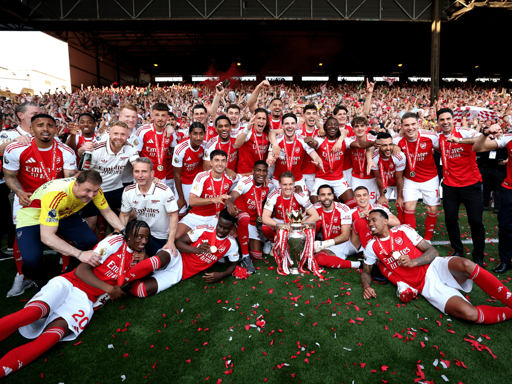

Martin Ødegaard hoisted the Premier League trophy aloft for Arsenal and the noise that followed was predictable: pundits dissected style, social feeds mocked set-piece reliance, and rivals sniffed at the manner of victory.
None of that changes the simple fact on the pitch. Arsenal finished top of the table and did what champions do and that is to win more games than everyone else.
Arsenal face criticism
All season Arsenal have been a target for critics who labelled their football “unwatchable” or reduced their success to lucky refereeing and dead-ball routines.
That chatter reached a peak when opponents and commentators pointed to Arsenal’s heavy reliance on set-pieces and a perceived lack of a single, standout goalscorer. Yet trophies are not awarded for aesthetics; they are awarded for points. Arsenal collected 85 of them.
Arteta’s response to the critics has been pragmatic rather than defensive. He has repeatedly framed the team’s approach as a set of priorities shaped by resources, injuries, and the realities of the Premier League. When you can’t outscore opponents in open play every week, you make other areas of the game unassailable and Arsenal did exactly that.
Set-Piece FC
One of the stickier narratives was that Arsenal are “Set-Piece FC” a tag meant to diminish. The truth is crisper; Arsenal turned a weakness in other seasons into a weapon this year. Opponents crowded the box, committed bodies, and tried to snuff out Arsenal’s creative channels. Arsenal adapted by mastering dead-ball situations and marginal gains around the penalty area. The result: a high conversion rate from crowded scenarios and a steady stream of match-winning moments.
Yes, rivals pointed to the numbers, even suggesting that a large share of Arsenal’s goals came from set-pieces, but that’s not cheating; it’s coaching. When the margins are fine, the team that finds repeatable, reliable ways to score will win more often. Arsenal did exactly that.
Defence first
‘Attack wins you games, defence wins you titles’ is a cliché for a reason. Arsenal’s defensive record this season was the backbone of their title charge. After April, no team scored from open play against them in a run that included Champions League semi-finals and the decisive league fixtures. That kind of consistency is not accidental; it’s the product of structure, discipline and coaching.
Arteta’s side managed to be ruthlessly efficient: they didn’t need to blow teams away with possession or fireworks. They suffocated chances, controlled the tempo when necessary, and closed out games with a clinical stubbornness that frustrated opponents and neutral observers alike. The result was a string of 1–0 victories that, while not always pretty, were brutally effective.
A big reason Arsenal didn’t always look like the textbook attacking machine was availability. Key players missed chunks of the season; Ødegaard himself played 45 minutes or more in the league only a dozen times, and the most successful front three only started together 14 times.
That instability in the final third forced Arteta to find other routes to victory. When your frontline is constantly changing, you lean on structure, set-pieces and defensive resilience. That’s not a lack of ambition, it’s adaptation.
This context matters. If you judge Arsenal against a hypothetical, fully fit version of themselves, the verdict might be different. But football is played with the squad you have, not the squad you wish for. Arteta engineered a system that maximised the available resources and minimised the damage of absences. The trophy is the proof.
The psychology of winning
There’s a psychological edge to being hard to beat. Once Arsenal went 1–0 up, the belief that they would hold on became almost automatic. Opponents learned that opening up against them was dangerous; sitting deep invited Arsenal’s set-piece threat.
That dynamic created a self-reinforcing loop: defensive solidity bred confidence, which bred results, which bred more confidence. Champions are not always the most beautiful team, but they are always the most consistent.
Arteta’s side also showed mental resilience in moments when the title looked fragile. In two periods once before Christmas and an injury-hit international break in March, which really tested the squad. Instead of collapsing, they tightened and found ways to grind out points. That capacity to survive and then thrive is a hallmark of championship teams.
Criticism of Arsenal’s style often confuses preference with principle. Fans and pundits who value expansive, high-possession football are entitled to their taste. But the Premier League is a competition where adaptability, pragmatism and results matter more than purity of style.
Arsenal’s season was a lesson in prioritisation: when you can’t rely on a 35-goal striker or a fully fit creative spine, you build a team that wins in other ways. That is coaching, not capitulation.
Moreover, the absence of red cards and penalties conceded all season undermines the “dirty” narrative. Arsenal’s methods were legal, disciplined and effective. They deserve credit as they did not rely on cynical fouls or reckless behaviour to get results.
A club reborn
This title is more than a trophy; it’s a statement of progress. Arteta has rebuilt a club culture, installed a tactical identity that can flex, and created a squad capable of winning under pressure. The Champions League run and the domestic title together suggest Arsenal are not a one-season wonder but a team with a platform for sustained success.
Fans will debate style until the next transfer window, and pundits will keep their hot takes ready. That’s football. But when the dust settles, the record books will show Arsenal as champions and that cannot be taken from them.
Mikel Arteta’s Arsenal did what mattered: they won the league. They did it with a blend of defensive steel, set-piece mastery, and tactical pragmatism born of necessity.
Critics can argue about aesthetics; rivals can grumble about methods. The trophy, however, is indifferent to opinion. It sits in the cabinet because the team earned it, and in football, that is the only verdict that truly counts.
The reality is that winners do not need approval; the trophies speak for themselves.
Featured image via Getty/Michael Regan
By Faz Ali
From Canary via This RSS Feed.