

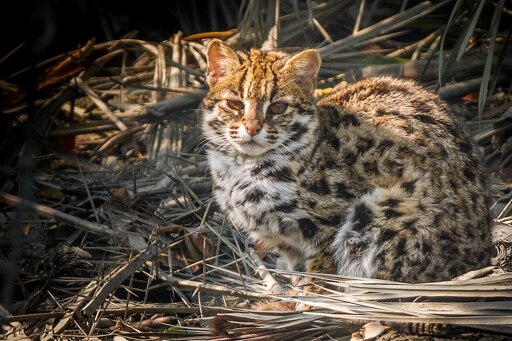
Founder’s Briefs: An occasional series where Mongabay founder Rhett Ayers Butler shares analysis, perspectives and story summaries. Asia’s mainland leopard cat is easy to overlook. It’s small, nocturnal, and often mistaken for a domestic cat or a leopard cub. On paper, it appears secure. The species ranges from India to the Russian Far East, and is listed as “least concern” on the IUCN Red List. It may be one of the world’s most abundant wildcats. That status is reassuring, though only to a point. The leopard cat (Prionailurus bengalensis) is a generalist, able to live in forests, plantations, and other human-shaped landscapes. This adaptability has helped it persist where more specialized animals have declined. It also makes the species easy to misread. A wildcat can be widespread and still poorly understood, reports contributor Annelise Giseburt for Mongabay. Much of the uncertainty lies in the gap between maps depicting the cat’s global range and field data. Country-level population figures are often thin or missing. Researchers rely on small local studies and extrapolation. In some places, the cat may be doing well. In others, it faces habitat loss, hunting, road deaths, and genetic isolation. Local declines can disappear inside a global assessment that looks stable across a large range. The pattern is familiar in conservation. Big cats draw funding, monitoring technology like camera traps, and political attention. Smaller cats, even common ones, receive far less. That leaves the leopard cat in a strange position: present across much of Asia, yet still scientifically…This article was originally published on Mongabay
From Conservation news via This RSS Feed.