

By Jerwin Baure
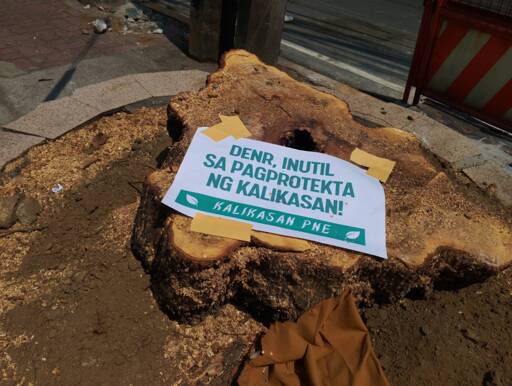
For a city where the heat index can reach as high as 45°C during the hottest days of the dry season, the cutting of more than 200 mature, decades-old trees along Quirino Avenue by San Miguel Corporation means that residents and pedestrians would now have to endure greater exposure to the sun and extreme heat. Worse, the Department of Environment and Natural Resources (DENR) even defended the decision following public backlash.
Under Philippine law, as cited by the DENR in its statement, tree-cutting is allowed as long as mitigation measures such as tree-planting are implemented. SMC may reforest mountains with new trees as part of the conditions of its tree-cutting permit. However, this kind of mitigation assumes that trees are interchangeable across space. A tree planted in a mountain reforestation site does not shade a commuter along Quirino Avenue, reduce heat in that particular street corridor, nor replace the habitat functions of mature urban canopy in the same locality.
The issue, therefore, is not only how many trees will be planted, but whether the ecological and public-health functions lost in the affected urban corridor can be replaced. Without these mature trees, more Filipinos in Metro Manila, especially commuters, street vendors, traffic enforcers, delivery riders and pedestrians, may become more vulnerable to urban heating, while urban wildlife such as birds will lose their habitats. Replacing mature carbon-capturing trees with an expressway would also generate induced demand, leading to higher traffic volumes and increased carbon emissions, thereby exacerbating the climate crisis.
From an ecosystem service and climate mitigation perspective, mature trees cannot be treated as equivalent to newly planted seedlings. Mature trees already store substantial carbon and provide large canopy cover, while newly planted seedlings may take years or even decades to approximate these functions, if they survive at all. There is also the uncertainty of whether these tree-planting activities will succeed, considering how extreme climate events such as typhoons, floodings and droughts recurrently occur in the Philippines. Replacement planting should therefore be evaluated based on species suitability, soil and hydrological conditions, maintenance plans, survival rates, and long-term monitoring, and not merely by the number of seedlings planted.
The DENR must carefully consider the environmental, public health, social, and cultural impacts of tree-cutting on affected communities, especially in urban areas vulnerable to climate change, before issuing such permits. At minimum, such decisions should be supported by a public tree inventory, species and age profile, diameter and canopy assessment, tree-health evaluation, heat-risk assessment, biodiversity assessment, consultation records, and clear replacement and survival-monitoring plan.
Given the public outrage, there are legitimate questions about whether affected communities and other stakeholders were properly consulted. Even securing a Certificate of No Objection from the local government does not guarantee careful consideration of these impacts, especially when officials who issue such documents may lack the technical expertise to assess them comprehensively. Tree-cutting permits in urban heat-risk areas should be subject to stricter technical review, public disclosure, community consultation, and long-term monitoring.
This problem is not unique to roadside trees. Similar questions about ecological replacement have emerged in other SMC-linked projects, such as the cutting of mangroves in Bulacan in 2018 to pave the way for the New Manila International Airport. When the company attempted mangrove planting in 2020, scientists and environmental advocates observed improper practices, including planting the wrong species and damaging specialized mangrove roots, known as pneumatophores, while digging planting holes. This illustrates why restoration cannot be reduced to planting alone. Ecological function depends on appropriate species, suitable site conditions, correct planting methods, and post-planting monitoring.
Environmental advocates, including the author as the representative of scientist group AGHAM, wrote to the DENR to investigate the matter. However, it was only in April 2023 that former DENR Secretary Maria Antonia Yulo-Loyzaga invited us to a dialogue regarding reclamation issues in Manila Bay, which included SMC’s Bulacan airport project. Current DENR Secretary Juan Miguel Cuna, who was then a DENR Undersecretary, was also present. During the dialogue, we reminded the DENR about the unresolved mangrove-planting issue involving SMC that we raised during the term of former DENR Secretary Roy Cimatu. It has been six years since we raised that issue and three years since the dialogue. The DENR administrations have changed several times, yet the issue remains unresolved.
We are losing more green spaces in Metro Manila. It is high time for DENR officials to reflect on what they should prioritize. The recent statement by DENR-NCR Assistant Regional Director Henry Pacis that the cutting of mature trees is “the price we have to pay” is alarming. Development should not come at the expense of the environment and the welfare of the people.
The DENR must stop treating the environment as a disposable commodity that can easily be replaced. What we need is a government that genuinely protects the environment, not one that bends environmental laws to accommodate corporate greenwashing.
About the author
Jerwin Baure is an environmental advocate and a PhD student at Sorbonne University studying the impacts of warming and increased carbon dioxide emissions on marine organisms. The views expressed by the author are personal.
The post Lab notes | Can tree-planting replace decades-old urban trees? appeared first on Bulatlat.
From Bulatlat via This RSS Feed.