

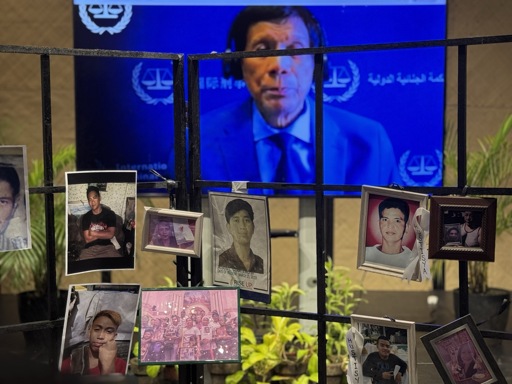
MANILA — The International Criminal Court (ICC) Trial Chamber III ruled on May 22 that former President Rodrigo Duterte shall continue to be detained at The Hague due to his political influence, non-cooperation with the court, and the appointed experts’ medical report.
“Duterte’s express rejection of the authority of the ICC puts him at great risk of escape, and underscores the necessity of his continuing detention,” said Atty. Neri Colmenares and Atty. Kristina Conti, both of them counsel for the victims.
The ICC Trial Chamber III observed that Duterte refused to attend the confirmation of charges hearing and continued to challenge the jurisdiction of the high court.
Duterte specifically wrote before the hearing: “I do not recognize the jurisdiction of the ICC over my person.” Such a statement, the Chamber said, showed that Duterte will not comply with any orders from the court if he will be released. Moreover, the Chamber cited that he has vast resources and contacts, including family and supporters in the Philippines, that can assist him in evading justice.
“There is a real and substantial risk that the Accused could nonetheless abscond or obstruct justice either on his own or through his associates,” the Chamber wrote.
Again, Duterte waived his right to attend the first status conference scheduled on May 27, 2026.
Since the ICC trials started to hear Duterte’s alleged crimes against humanity, the families of extrajudicial killing victims have continued to face intensified attacks. In social media, there were posts attacking their loved ones who already died at the height of Duterte’s so-called drug war. The attacks included online violence harassment, fabricated narratives, and threats of sexual assaults.
Read: Women human rights defenders face rising tech-assisted violence
It also stressed that the Defense’s counsel and the Registry did not present any new information on Duterte’s medical condition. The examination of three Court-appointed medical experts remained the main deciding factor about Duterte’s physical condition and cognitive capacities.
Article 58 of the Rome Statute states that the arrest of the person is necessary to “prevent the person from continuing with the commission of that crime or a related crime which is within the jurisdiction of the Court and which arises out of the same circumstances.”
The ICC maintained jurisdiction over the case of Duterte and his co-perpetrators as the crimes transpired when the Philippines was still a state party to the Rome Statute. The court can investigate and prosecute crimes of humanity that happened before the official withdrawal of the Philippine government on March 17, 2019.
Read: Duterte defeated twice on ICC jurisdiction challenge
“Non-cooperation with the ICC, especially at this point, denies victims and the Filipino people the due process and justice that they have long sought,” Colmenares and Conti said. They called on the Marcos, Jr. administration to enforce the ICC arrest warrant against Sen. Ronald “Bato” Dela Rosa who is now considered a fugitive. In an en banc session on May 20, the SC rejected Dela Rosa’s prayer for a temporary restraining order.
Read: PH gov’t urged to arrest Bato after SC denial of TRO plea
“Simply put, Duterte and Bato refuse to take accountability for the rights abuses and violations imputed to them,” the victims’ lawyers noted. “Victims of the ‘war on drugs’ have gone to court, collected evidence, and painstakingly argued their case before a recognized authority. We condemn how the Dutertes and their supporters continue to disrespect the process, the people, and the principles of fairness and justice.”
Senate President Alan Peter Cayetano defended Duterte’s so-called drug war, stressing that it was a “pro-life campaign because drugs kill people.” Many human rights defenders found the statement an insult to over 30,000 victims recorded by the watchdogs.
For human rights group Karapatan, Cayetano’s remarks are not only an insult but also a grotesque distortion of reality as the so-called “pro-life campaign” resulted in normalized extrajudicial killings, terrorized poor communities, orphaned children, and encouraged impunity among state forces.
Of the thousands of casualties recorded, only five resulted in court convictions, according to Amnesty International. Moreover, some of these cases remain on appeal by the perpetrators.
“Instead of standing with victims, Cayetano chose to justify a campaign that treated poor Filipinos as disposable targets,” said Cristina Palabay, secretary-general of Karapatan. “He would rather remain loyal to his detained master in The Hague than to the people he claims to represent in the Senate.” (DAA)
The post Duterte’s non-cooperation fuel continued ICC detention appeared first on Bulatlat.
From Bulatlat via This RSS Feed.