

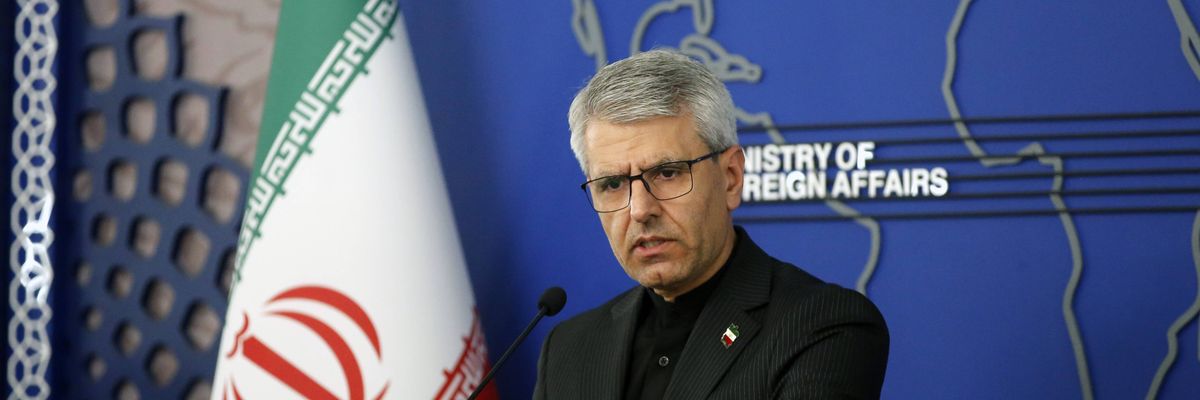
Officials in Tehran on Monday swatted down President Donald Trump’s assertion that an agreement to end the nearly three-month Iran War was imminent, citing frequently shifting US positions and Israeli “sabotage” as obstacles during ongoing talks.
“It is correct to say that we have reached a conclusion on a large portion of the issues under discussion," Iran Foreign Ministry spokesperson Esmail Baghaei said during a press briefing. "But to say that this means the signing of an agreement is imminent—no one can make such a claim.”
Trump tempered his own Saturday claim that a peace deal had “been largely negotiated” with Tehran, “subject to finalization.”
“Negotiations with the Islamic Republic of Iran are proceeding nicely!” the president said Monday on his Truth Social platform. “It will only be a Great Deal for all or, no Deal at all—Back to the Battlefront and shooting, but bigger and stronger than ever before—And nobody wants that!”
A 14-point memorandum of understanding between the US and Iran reportedly contains a ceasefire and 30-day negotiation period for a broader agreement, reopening of the Strait of Hormuz, easing or lifting the US naval blockade on Iran, unfreezing Iranian state assets abroad, relief from US sanctions, and restrictions on Iranian nuclear development.
Naming countries including Turkey, Pakistan, Egypt, Saudi Arabia, Qatar, and Jordan, Trump wrote that “after all the work done by the United States to try and pull this very complex puzzle together, it should be mandatory that all of these Countries, at a minimum, simultaneously sign onto the Abraham Accords,” the US-brokered normalization pacts between the United Arab Emirates, Bahrain, Morocco, Sudan, Kazakhstan, and Israel that the Palestinian writer Karim Kattan called “a fever dream of dictators.”
Trump suggested that Iran could also normalize relations with Israel by signing the Abraham Accords and said that “it would be an Honor to have them also be part of this unparalleled World Coalition.”
However, Baghaei threw cold water on Trump’s optimism, stressing Monday that “the focus of the negotiations is on ending the war on all fronts, including Lebanon," and that this critical point is “one of the core elements of understanding in any agreement.”
What negotiators aren’t discussing at this time, according to both sides, is ending Iran’s nuclear development.
“The focus of the negotiations is on ending the war, and at this stage we are not discussing nuclear issues,” Baghaei said.
Also not under current discussion is the future management of the Strait of Hormuz, the Iranian-controlled maritime chokepoint through which around 20% of the world’s oil is shipped.
“How this region should be managed concerns the littoral states,” Baghaei said, referring to Iran and Oman. “We understand that the security of the Strait of Hormuz is a concern for the entire world.”
Baghaei affirmed that negotiations on the 14-point memorandum of understanding would continue over the next two months, but that the US blockade of Iranian ports and shipping “must stop.”
According to Iranian state media outlet Press TV, Baghaei “criticized the inconsistency in US policymaking, saying contradictory positions within short periods complicate negotiations.”
A major sticking point in the talks is Iran’s insistence that any agreement to end hostilities must also include an end to Israel’s attacks on Lebanon, which have killed or wounded more than 12,000 people, according to officials there. After the current Pakistan-brokered ceasefire took effect on April 7, Israel responded by escalating its war on Lebanon, killing or wounding more than 1,400 people, many of them civilians, over a 24-hour period.
Baghaei said Monday that “one should expect nothing from Israel except the sabotage of any process.”
It’s not just Israel; Iranian, Pakistani, and Omani negotiators have accused US officials of blowing up previous Iran peace talks when they were on the verge of success.
Israeli Prime Minister Benjamin Netanyahu claimed Sunday that while he supports the US effort to end the war, “President Trump and I agreed that any final agreement with Iran must eliminate the nuclear danger.”
Israeli and US intelligence agencies have said for decades—including under Trump—that Iran is not trying to build nuclear weapons and stopped trying to do so in the early 2000s.
Pro-war Republican US lawmakers joined many Israeli leaders in both government and the opposition in expressing alarm over a potential peace deal that is widely viewed as a major win for Iran.
“Details of the deal between the United States and Iran are so disturbing,” Israeli opposition leader Yair Lapid said Monday in West Jerusalem. “The deal is bad for Israel, bad for the region, bad for the citizens of Iran.”
“Netanyahu has failed to achieve every single one of the war’s objectives as he himself defined them,” he added.
Some US Congressional Democrats also said the outcome of the illegal US-Israeli war of choice is likely to favor Iran, even as airstrikes have killed or wounded more than 30,000 Iranians, many of them civilians, according to the country’s Ministry of Health.
“If this deal with Iran is real, I will welcome it because every day this insane war goes on, America gets weaker,” Sen. Chris Murphy (D-Conn.) said Sunday. “The priority is to end the war—now. But make no mistake: These are Iran’s terms. Our nation emerges humiliated.”
“The deal is basically this: We give Iran billions to get back to where we were before the war. And reports suggest the deal might codify Iran’s right to control the strait,” he continued. “There are reports there may be a tiny nuclear concession from Iran in the deal and if so, great. But I doubt it—they are most likely postponing all the nuclear issues.”
“But a promise to ship out enriched uranium (the reported concession) was also in [Former President Barack] Obama’s deal (as well as a lot of other things Trump will never get),” the senator noted, referring to the landmark Joint Comprehensive Plan of Action (JCPOA)—also known as the Iran nuclear deal—that Trump unilaterally abrogated during his first term.
“And now that we are dropping sanctions, we have less leverage to get them to give more in future negotiations,” Murphy said. “And just remember, Trump hasn’t accomplished ANY of his constantly shifting goals. Iran still has its ballistic missile and drone program. They still have a navy that can close the strait. A hardline regime is still in charge.”
“Of course, none of those things could be accomplished by an air campaign—which is why so many of us opposed this war,” he added. “And now the new regime is emboldened. They took our best shot and beat us. Iran emerges more powerful.”
Iranian leaders underscored their readiness to continue the fight should negotiations fail.
“Look, Americans talk too much and keep changing their story by the minute,” Khatam al-Anbiya Central Headquarters Commander Ali Abdollahi Aliabadi said Monday. “We’ve said it many times before: On the battlefield, we’ll show what we’re capable of.”
From Common Dreams via This RSS Feed.