

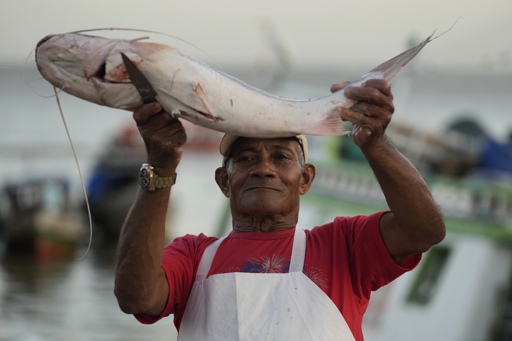
The background was right for the announcement of the bad news. Fish swam in a wall-sized tank that framed a table of scientists and environmentalists in the auditorium of the Pantanal Biopark, the world’s largest freshwater public aquarium, in the Brazilian city of Campo Grande. They’d gathered for the launch of a report on the state of the world’s freshwater migratory fish. The event opened with a dire statement from a top official from Brazil’s environment ministry: “The numbers are chilling,” said Rita Mesquita, the ministry’s secretary of biodiversity. Mesquita was there to address the 15th Conference of the Parties to the U.N. Convention on Migratory Species (CMS COP15), a treaty adopted in 1979 that focuses on conservation of migratory animals and their habitats. Currently, 132 nations and the European Union are signatories. The meeting, which took place in Campo Grande, the capital of the Brazilian state of Mato Grosso do Sul, from March 23-29, also drew experts and civil society representatives from across the globe. This was the first time in more than a decade that experts analyzed data on global ichthyofauna: fish life. The last assessment, conducted in 2011, examined the status of 3,000 species. The new round was far more comprehensive, covering 15,000 species. Of these, 349 are migratory, almost all of them threatened. The CMS report recommended that 325 of those species be added to the convention’s appendices. Migratory species threatened with extinction are listed on Appendix I, giving strong protections, while species that need international…This article was originally published on Mongabay
From Conservation news via This RSS Feed.