

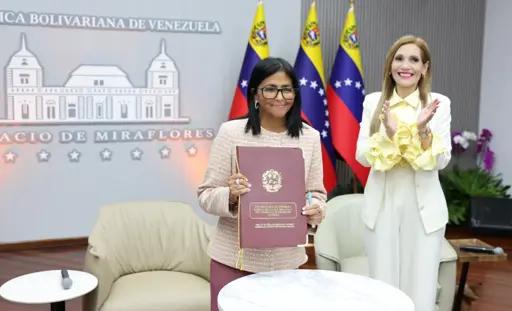
The Acting President of Venezuela, Delcy Rodríguez, presented a report on the implementation of the Law of Amnesty and Democratic Coexistence, enacted on February 19, 2026 to foster reconciliation and social peace in the country.
At a meeting in Miraflores Palace on Friday, May 22, the acting president described the process of releases that began in January with 885 releases prior to the aforementioned law. She reported that, through the Judicial Reform Commission and the Program for Peace and Democratic Coexistence, an additional 395 releases have been carried out, and the total is expected to surpass 500 in the coming hours.
The Minister of the Interior, Justice, and Peace, Diosdado Cabello, highlighted that 3,630 people have been released from judicial proceedings so far this year, surpassing the 2,244 releases in 2025. Cabello emphasized that the Venezuelan Constitution safeguards human rights, providing mechanisms for the judiciary so that people accused of crimes that do not warrant imprisonment can go through their trials without being incarcerated.
This policy applies to cases such as traffic accidents without injuries, reducing procedural delays and strengthening the role of justices of peace in the resolution of community conflicts.
The President of the National Assembly of Venezuela, Jorge Rodríguez, reported that more than 12,000 people filed for benefits of the Amnesty Law, of which nearly 9,000 were granted relief. He noted that the figure shows the Venezuelan State’s commitment to internal reconciliation amid foreign interference and far-right campaigns against the amnesty process.
Rodríguez explained that the National Assembly is working on the reform of the criminal justice system by drafting laws aimed at protecting citizens and strengthening the judicial system. The reform of the Organic Law of the Supreme Court of Justice will increase the number of magistrates from 20 to 32, in order to strengthen the Constitutional Chamber and expedite processes to combat judicial delays.
The implementation of the Justice of the Peace Law, approved a year and a half ago, establishes community justice, aimed at consolidating an efficient and self-sufficient judicial model.
The President of the Supreme Court of Justice (TSJ), Caryslia Beatríz Rodríguez, highlighted the activation of nearly 38,000 peace initiatives throughout the national territory. This measure extends mediation and conciliation mechanisms to every corner of the country, with the aim of consolidating national autonomy in the face of external destabilization campaigns.
The meeting was attended by Attorney General Larry Devoe, Ombudsperson Egleé González, the President of the Supreme Court of Justice, Caryslia Beatríz Rodríguez, and the President of the Special Commission for Monitoring the Amnesty Law, Jorge Arreaza.
With the implementation of the amnesty law, the institutions of the Venezuelan State reaffirm the objective of rebuilding the social fabric and ensuring the political stability of the country. The aim of the Law of Amnesty and Democratic Coexistence is to promote peace, create conditions for plural political participation, and favor the social reintegration of individuals prosecuted or convicted for political reasons.
Venezuela’s Jorge Arreaza: 96.1% of Those Granted Amnesty Were Not Behind Bars
National consultation for judicial reform
At the end of the meeting, the acting president announced that starting June 1, the Great National Consultation for Criminal Justice Reform will be conducted throughout the country. This democratic and participatory initiative seeks equitable justice for all, rejecting external agendas that aim to dictate the legal course of the nation.
The acting president pointed out that corruption in the judiciary is another battleground, so the reform of the criminal justice system will include control mechanisms to strengthen the system’s transparency.
She added that a third major challenge is the criminalization of poverty, exposed by the fact that 68% of the prisoners in the country belong to lower economic strata. She emphasized that Venezuela is committed to combating this form of economic and social discrimination, reaffirming its inclusive and humanist justice model, in opposition to policies that punish the most vulnerable.
Given this scenario, the acting president of Venezuela proposed the creation of a national protection system for defenders and their families that fully guarantees the human rights of everyone, including security officials.
Rodríguez stated that the nation is advancing in the construction of a new model of criminal justice centered on human rights and the constitution.
(Telesur)
Translation: Orinoco Tribune
OT/SC/SH
From Orinoco Tribune via This RSS Feed.