

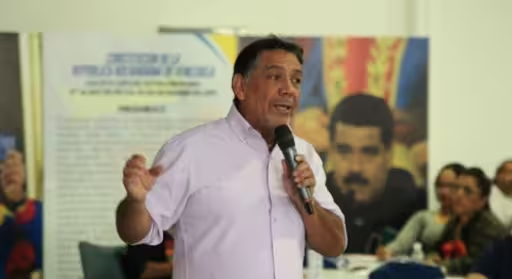
A total of 1,088 unilateral coercive measures have been imposed against Venezuela in the last 11 years. Of these, 1,040 are currently active, according to Deputy Minister of Anti-Blockade Policy William Castillo. While assessing the US imperialist economic war against the country, he called the economic warfare a “collective punishment of the entire population,” having had a significant impact on salaries, health, education, job stability, and key productive sectors.
“We have been under unilateral coercive measures for over 11 years,” Castillo said during an interview on the program De Frente con la Noticia, broadcast by the state television Venezolana de Televisión (VTV). “It began in December 2014, with a law that was enacted against Venezuela. The possibility of imposing sanctions on us had already been looming, and it continued with the Obama decree in March 2015. It has been more than a decade of aggression.”
He added that the bulk of these administrative and financial measures is directed against government authorities and public bodies of the Venezuelan State.
Likewise, he specified that 16% of the coercive measures were aimed directly at the mining and oil industries, which constitute the country’s main sources of income.
Another 16% of the measures affect the country’s private and commercial business activities.
“It is an economic suffocation, a collective punishment of the entire population that ended up affecting salaries, health, and education. It has harmed universities, forced many professionals to migrate, divided families, and generated a severe economic downturn with hyperinflation,” emphasized the deputy minister when assessing the social impact of sanctions over the last decade.
National unity and civil mobilization against sanctions
Castillo highlighted the importance of the second stage of the Great National Pilgrimage for a Venezuela without Sanctions and in Peace, which began on May 19.
He explained that the central objective of this initiative is for all sectors of Venezuelan civil society to mobilize to shed light on national realities and stories of popular resistance against the blockade.
“United, we must demand the end of the most cruel, inhumane, and illegal aggression that has been committed against our country,” stated Castillo, calling for national unity to uphold Venezuela’s international demands.
“Venezuela has the right to fully recover all its economic rights, its freedom to trade, to import and export, to sell and buy from whoever it wants,” he declared. “There are 31 countries in the world against which there are unilateral coercive measures, and this is illegal… What Venezuela needs is its right to live in peace and without sanctions. This is a great national objective, and it should unite all Venezuelans.”
Deputy Minister of Anti-Blockade Policies: Venezuela Is Recovering from 11 Years of US Sanctions
Economic pressure versus multilateralism and diplomacy
According to the Geopolitical Sanctions Map, as of April 2026, a total of 37,929 unilateral coercive measures (UCMs) are imposed on 31 countries by the US, the European Union, and other allied countries.
Of these measures, 94% (35,733) are concentrated against nine countries, and the remaining 6% are distributed among 22 nations. Russia tops the list with 75% of the total (28,573). Next is Iran, with 3,228 measures. Venezuela is the third country with the most sanctions against it (1,040, imposed in just a decade).
Following Venezuela are Syria (941), North Korea (869), Iraq (327), Belarus (255), Cuba (246), and Myanmar (206).
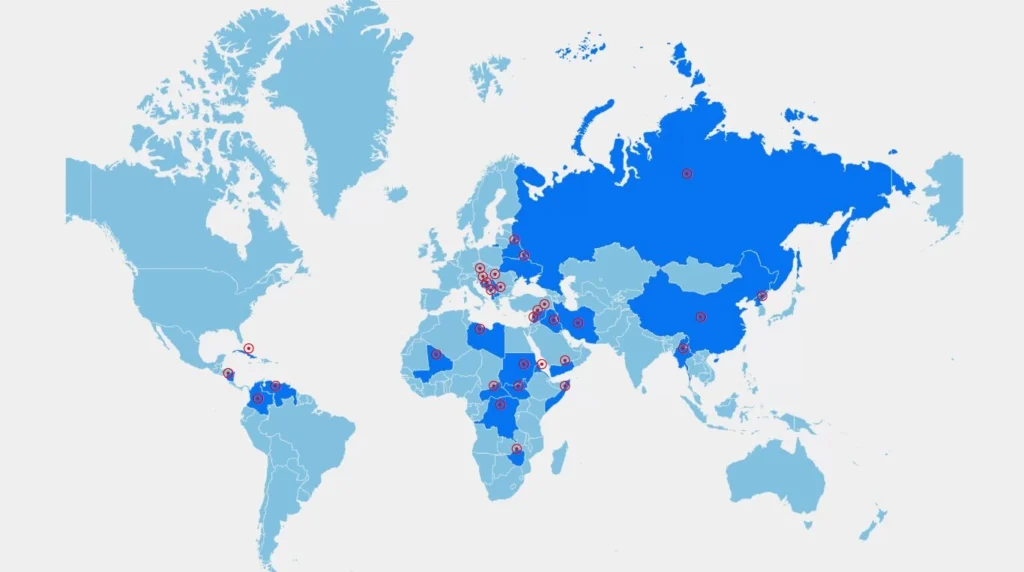
World map showing countries under unilateral coercive measures. Source: Geopolitical Map of Sanctions.
The US Department of the Treasury’s Office of Foreign Assets Control (OFAC) is the world’s leading sanctioning agency. As a flagship of economic warfare aimed at “disciplining” sovereign states, this agency has imposed 13,284 unilateral coercive measures (35%) against 31 countries.
Alongside war, the unilateral coercive measures constitute a central axis of US pressure against other nations. In light of this, it may be considered that a country that cannot achieve foreign policy objectives through good neighborliness, diplomacy, and multilateralism is a failed state.
The next-largest sanctioning agency is the EU, which has imposed 16% of total sanctions globally. This consists of 5,961 measures against various countries. It has implemented 70 coercive measures against Venezuela alone.
(Telesur)
Translation: Orinoco Tribune
OT/SC/SF
From Orinoco Tribune via This RSS Feed.