

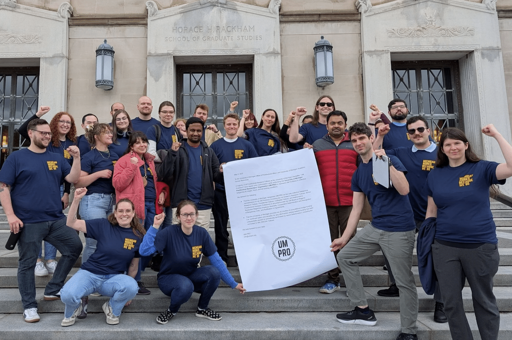
The University of Michigan Postdoctoral Researcher Organization (UM-PRO) is the newest postdoctoral researcher union to hit the academic world and the only one to be independently organized. The union was recognized by the administration in March 2026 after a successful card-signing campaign among the university’s 1,500 postdocs.
As a former UMich postdoc, I had the opportunity to sit in on an early bargaining session for their first contract.
Postdocs are a precarious-by-design role, working on one-year contracts with no guarantee of renewal. They are a “bridge” position between graduate school and faculty positions which primarily exists to extract PhD-level research without having to pay faculty wages.
The NIH minimum salary for postdocs starts at $63,480, but at UMich, most make closer to $35,000. For context, that’s almost half the U.S. median income of $67,521 whereas Ann Arbor has a cost of living 11 percent higher than the national average and an average rent of $1,600 for a one-bedroom apartment. By contrast, faculty at UMich make an average of $166,000.
Reflecting the disconnect between wages and cost of living, a recurrent theme during bargaining were family concerns. Of the nearly 30 postdocs present, all in their late 20s to early 40s, none had kids. Said one postdoc, Javat, for medical insurance “ the minimum option is around $300 a month for someone with a dependent. It has been an extreme deterrent factor for us as a family. Many of us really want us to have children. But there is no way. We don’t have savings for that. For international postdocs, the spouses are not allowed to work.”

At UMich, 60 percent of postdocs are international. Their lives are even more precarious as their visas depend on yearly contract renewals. Postdocs whose home country is on one of Trump’s capricious and racist no-go lists are functionally trapped in the United States, unable to visit family or even make necessary visa renewal trips. UM-PRO wants the University to stand up for them and help smooth the process where possible.
Adding to the precarity, postdocs are at the whims of their boss. They depend on their boss’s good will not just for continued employment and visa status, but also for all-important letters of support for federal grants and faculty job applications. A postdoc advisor can single-handedly end a postdoc’s career simply by withholding a letter.
Academic Workers Are Under Attack, but Growing Unions Push Back
As they bargain for their first contract, UM-PRO joins a small but rapidly growing collection of postdoc unions across the country, part of a nascent upsurge in higher education labor organizing.
Nationwide academic workers and higher education have come under attack. When executive orders against DEI initiatives came down, the University of Michigan administration was quick to dismantle its DEI department, laying off 14 and forcing out 36 other staff.
Cuts to federal agencies such as NIH, NSF, and even the Social Security Administration has meant hundreds of millions of lost funding, gutting entire research programs, and causing layoffs. But before you let the university cry broke, UMich’s endowment is over $20 billion and just made another $2 billion off a $20 million investment in OpenAI. The university has also been investing heavily in data centers in Southeast Michigan.
Chinese postdocs have faced increased harassment by federal agents. Postdocs and graduate students at UMich have been interrogated by DHS, with one postdoc falling to his death on campus the day after being interrogated by DHS.
These attacks highlight the need for higher education workers to organize. From adjuncts and postdocs to custodial staff, universities run on their labor. These workers have the power to shut things down and thus the power to demand better working conditions and better overall learning and research conditions. Instead of hoping the administration will look after them, workers need to fight for their own protections.
As UM-PRO fights for economic security for its members, it is raising the standards for postdocs across the country. The knock-on benefits for forming unions isn’t hypothetical. UM-PRO is itself drawing on the standards set by other postdoc union contracts such as University of California and Columbia University to argue for better compensation. Some clauses won by UMich graduate student and lecturer unions, GEO and LEO-GLAM, made for easy gains by UM-PRO such as a “ban the box” prohibition against felony charge and conviction disclosures.
The union is also taking postdocs out of isolation. About 35 postdocs from across campus turned out for bargaining. I have never seen so many postdocs in one room at the same time, especially from different departments. Work in higher education can be isolating. The structure of research and academic careers incentivizes silos and looking out for number one. In a publish or perish world, you live or die by the number of first author publications ,and there can only be one first author. The union serves a double role of providing a third space, a place that brings diverse postdocs together to find and fight for their common interests.
Bargaining is expected to continue through the summer. Follow UM-PRO on Instagram for updates and opportunities to attend a bargaining session.
The post University of Michigan Postdocs Unionize, Fight for a Living Wage appeared first on Left Voice.
From Left Voice via This RSS Feed.