

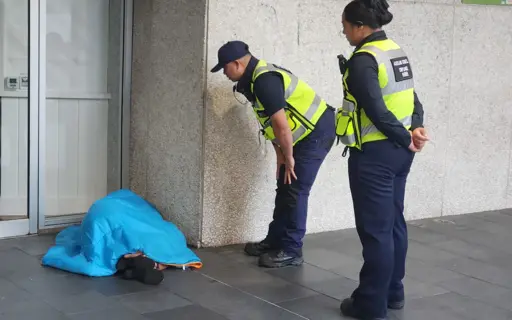

The number of homeless people more than doubled in Auckland in the space of a year, from September 2024 to May 2025, following a drop in emergency housing grants. Now, new policies will exacerbate the issue, writes Denis O’Reilly. (Photo: RNZ / Finn Blackwell)
The government is getting tough on state house tenants and homeless people. Meanwhile, a high-earning, property-owning government minister who wants to make it tougher for renters to claim the accommodation supplement is claiming $1,000 a week in housing allowances. Denis O’Reilly is stirred to offer up prayers to the patron saint of impossible causes.
I’m a recovering bureaucrat.
For more than 20 years, I walked those troubled corridors of power squeezed between the walls of what makes sense and what’s expedient. I’ve trodden the carpet of political hyperbole, while trying to avoid it sticking to the soles of my shoes — let alone souring my soul and my belief that people are fundamentally good and want to do the right thing.
I’m writing this on Friday, May 22, the feast day of St Rita of Cascia, the patron saint of impossible causes, abuse victims, and widows.
My causes are always impossible. Belief in the potential of the young people of Aotearoa, even if they chose the wrong parents. Belief that our nation’s Indigenous people and systems hold the key to unlocking our productive potential as a nation. And belief that the power of good is stronger than the power of evil.
The feminist writer Doris Lessing once said: “Whatever you’re meant to do, do it now. The conditions are always impossible.”
So, in celebration of St Rita and encouraged by Doris, I take to writing in the moment.
This morning, between the gushes of John Campbell on Radio New Zealand’s Morning Report, I learned that our government intends to increase the rent tariff and shorten security of housing tenure for those whānau living in social housing. Apparently, they are akin to Lotto winners, which explains why they’re in social housing.
Meanwhile, Louise Upston, the high-earning property-owning government minister who is seeking tougher criteria for the accommodation supplement, claims $1,000 a week in a housing allowance.
But wait, there’s more. Those who are “sorted” and own a spare dwelling or two to rent to the hapless unsorted classes look set to indirectly benefit from an increased accommodation allowance to their tenants, which will, of course, end up in their pockets. More transfer of public resource to private gain.
I also learned today that Louise Upston’s parliamentary colleague, justice minister Paul Goldsmith, promises to deliver safe streets by using police-enforced “move on” orders to rid us of the homeless folk fouling the air of downtown retailers’ doorways with the malodorous stench of their poverty. This could be a precautionary move anticipating a slew of social housing tenants seeking somewhere affordable to sleep.
The ultimate sanction for disobeying “move on orders” is imprisonment. This brings us to the revelation of a fresh discomfort — the alleged corruption in the prison service. Apparently, poorly paid prison officers have been accepting bribes from cashed-up cartels. Hell in a handbasket.
Let’s unpick a few things. First, the unmasking of potential corruption in Crown agencies comes because of the intelligent thinking of Casey Costello, who, in my view, is the first government minister since the late Jim Anderton to get her head around our illicit drug problem.
I disagree with Costello on many matters, but she has realised that one threat to our nation’s social cohesion comes from abroad. She has been able to step past the prejudices of many politicians and police and realise that foreign cartels, rather than our Indigenous gangs, drive the problem of illicit substances, namely methamphetamine and cocaine.
The huge wealth these substances generate primarily goes offshore. But some of it stays here and is fodder to feed a poorly paid prison officer who is struggling to make ends meet or is investing in the tertiary education of their children, so they don’t get stuck in the same unfulfilling job roles available to their mum and dad. I don’t support corruption, but I understand some of the drivers.
The prison officer recruitment advertisements suggest that these are fulfilling roles that can make a difference in the lives of prisoners. This is a compelling proposition promising job satisfaction over and above financial rewards.
The reality is different. There is little investment in prisoner rehabilitation. From my observation, the prison officer’s job is boring and increasingly dangerous. “I know where you live and where your kids go to school” isn’t a community-building message. Succumbing to temptation or an implied threat is understandable, if not logical.
Here’s the rub. The criminal justice industrial complex is the only uncapped budget in town. It’s build, baby, build. Lock ‘em up and squeeze ‘em in. There are few rewards for the public servants who staff the prisons, or resources to support the rehabilitation of inmates.
The poorly paid public service treatment extends to the police, too. The same derisory pay system applies to them, and this must also make them vulnerable to corruption. I want to see intelligent, well-adjusted, well-trained, and well-paid police men and women in Aotearoa. Bent cops don’t work for the community good.
I say this too to the Indigenous gang brothers and sisters, leaders of my generation of gang members. The cartels will recruit your grandchildren and beyond. The culturally vital and uplifting lives you seek for your descendants will not be enabled through temporal wealth, no matter how profitable or easy “just this once” looks. Disassociate now.
And let’s unpick the social housing issue. I enjoy papakāinga living. I enjoy watching my nieces and nephews succeed at school and graduate into professions. I enjoy that almost everyone in the papakāinga I live in is employed or involved in community contributions to the community and to hapū life.
Some of our whānau are on income-related rents. This is because they have low-income households relative to the number of children they care for. In this arrangement, they have security of tenure and stability. It has taken us a decade to get to this. It wasn’t always this way.
The social housing papakāinga policies of previous administrations are working. We know that safe, warm, dry, affordable housing is the key driver of good health. The economic advantages are plain to see. Yet, as in so many other elements of contemporary government policy, the unstitching of equity in the name of so-called equality continues unabated. Hell, it may even be accelerating.
Erica Stanford said in parliament recently: “We are not producing enough babies in this country to ensure that we have a stable or even growing population. We are going to rely on migration.” Well, our best baby-producing populations are Māori and other Pacific New Zealanders. In the face of xenophobia, the reality is that in New Zealand, a young brown workforce is going to be required to pay for the superannuation needs of old white folks.
Yet what do we do? Instead of working constructively with young brown people, as in the case of “Bikes in da Hoods”, we want to crush them, discipline them, rein in their spirit, and lock them up.
Long before we looked to AI to solve our problems in the public sector, we took a managerial approach, drawing on thinkers such as Peter Senge and the idea of “systems thinking”.
This involved recognising interconnectedness, in which all parts of a system are linked, and changes in one part can affect others. We tried to build feedback loops so we could regulate systems and shape behaviour over time. We looked for emergence, trends and responses — any properties that aren’t immediately evident. We promoted a holistic perspective that focuses on the whole system, rather than isolated events and issues.
“Sounds too much like a Māori approach, don’t you think?” The higher-ups squashed it.
Well, my karakia this evening might well include a pitch to St Rita. I’ll throw in pleas to St Philomena and St Jude, similar patrons of hopeless cases. But stirring deep in my belly is the call to action. I’m going to do my level best to ensure that every eligible whānau member in my considerable network is registered to vote, is conscious of the issues, and is ready to turn out and vote come election day.
Let’s get out and vote this year, whānau. Amen.
Denis O’Reilly lives at Waiohiki in Hawke’s Bay, where he chairs the Waiohiki Community Charitable Trust. He is a writer, social activist and consultant.
The post Unstitching equity in the name of so-called equality appeared first on E-Tangata.
From E-Tangata via This RSS Feed.