

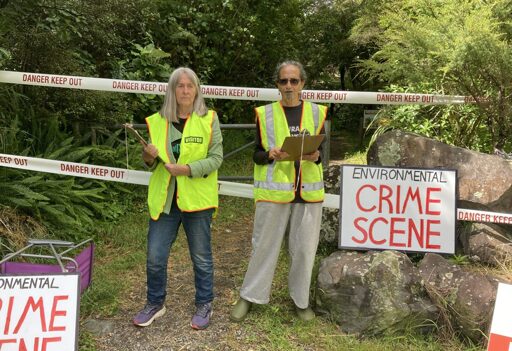

Catherine Delahunty and Denise Messiter (Ngāti Pukenga ki Manaia) at Parikiwai near the new mine site area in Coromandel. (Image supplied)
Mineral wealth in Aotearoa has been more curse than blessing, writes Catherine Delahunty.
I live in beautiful Hauraki, where gold has been part of our history since its discovery in 1852.
In other parts of the country, coalfields are still mined, and the present government is an enthusiastic proponent of exploration for so-called “critical minerals”, including rare earth metals, promoting their use in apparently “green” technologies.
The Minister of Resources, Shane Jones, calls such resources “wealth creation opportunities”. But, as we well know in Hauraki, wealth from mining has always somehow slipped past local communities, who are left with damaged land and toxic residues while the mining companies pocket the profits.
In Hauraki, the opening of the gold fields attracted desperate people, like my great-grandfather, from all over the world. Through the efforts of colonising opportunists like James Mackay, who leveraged his ability to speak te reo Māori, there was widespread land alienation to secure access to the gold.
Tangata whenua were forced off their lands by a range of laws that enabled miners’ rights and leases to be converted to freehold title. The Native Land Court pursued a ruthless policy of breaking up collective hapū ownership of land to create the individual titles that would facilitate mining.
Tangata whenua were initially paid a royalty by the Crown for gold extracted from their lands, but over the next few decades, the Crown wrested ownership of the deposits and the subsequent rights to exploit them.
This remains a point of contention. The Treaty settlements presently going through parliament do not return gold rights to the ancestral owners of the land.
There are recorded local stories about historic resistance to gold mining, from the wāhine who drove gold prospectors off Pukewa maunga (now the Martha open-cast pit in Waihi), to Mere Kuru Te Kati, a rangatira of Ngāti Tamaterā who led 20 wāhine to protest against surveyors for gold at Ohinemuri.
The story is that she threatened to throw the person who sold the land to these surveyors into the awa.
Another famous incident involved James Mackay. In the 1860s, the rangatira Aperahama Te Reiroa refused to allow miners to trespass on hapū lands at Waiotahi near Thames.
When his sons were arrested for a fight with a trespassing miner and fined five pounds each, they could not pay. James Mackay offered to settle the fine on the condition that the land be opened to mining.
Fearing the consequences of non-payment for his sons, the rangatira agreed, but only on the condition that flat arable land was protected from mining. However, in 1867, there was a new gold rush on Māori land at Waiotahi.
In the historical romanticism that surrounds old-time mining, these stories of resistance are missing. Nor is much made of the pollution that ended up in the ocean and rivers.
My great-grandfather and thousands like him gained very little from mining. The wealth went to the mining companies and the shopkeepers selling shovels, food and tents.
And so it remains today. Multinational companies are the only ones that can afford to develop large-scale mines and then process the resources.
Oceana Gold, a large multinational, now has fast-track consent to dig new open-cast and underground mines at Waihi, and to blast a vast underground gold mine beneath the forest at Wharekirauponga.
Local groups and iwi have fought these plans, but have been ignored.
For 45 years, Coromandel Watchdog of Hauraki, the group I’m part of, has worked to resist the waves of gold mining. The present political enthusiasm for mining is unlike anything we’ve seen before.
The price of gold and the promise of huge returns from mining elements like antimony for “green tech” and weapons production are encouraging new players to seek permits from MBIE to explore large areas of conservation land and private land for potential mine sites.
Meanwhile, resources minister Shane Jones is urging the cabinet to sign a Critical Minerals Framework agreement with the US.
The minerals agreement is being sold by the US as a show of western-led unity in response to China’s dominance in the minerals market, and to ensure minerals supply chain stability for what Shane Jones calls “like-minded countries”.
The term “critical minerals” refers to certain minerals and chemical elements that are used in “green tech” or renewable technologies. But these minerals and elements are also vital to modern warfare, and in some instances, their primary use is in weapons.
The cabinet papers acknowledge that tangata whenua rōpū, such as Ngā Toki Whakaruruanga and the Federation of Māori Authorities, oppose signing the agreement on the grounds that it breaches Te Tiriti. Whether the cabinet will sign up is unknown, but it could be any day.
Back at home, we continue to hold community meetings to inform local people about who wants to mine the mountains and who will likely benefit. We know we’re far from alone in our struggle, because we’re part of international networks fighting mining in forests and mountains, often led by Indigenous communities.
I have heard a wide range of tangata whenua views on mining in Hauraki and cannot speak for them, but there’s no doubt the Crown approach to mineral ownership is clearly a Te Tiriti breach.
There’s also no doubt that these resources are a curse for us. The short-term job gains don’t justify the long-term risks to the whenua and water, but in a time like this, families need to survive.
The curse is not just the environmental risks of mining — it’s what happens when people in need of money see the glitter of wealth in a time of extreme inequality.
We stand as a reminder that history is cyclical and that the question of who benefits from extracting from the earth must be asked. How many Indigenous and working-class communities have suffered the consequences of big company operations supported by capitalism? How many waterways have been polluted, and how many waste time bombs have been created?
We don’t have to bow to the resource curse. We know better and can do better.
Catherine Delahunty is a Pākehā activist in environmental, social justice, and Te Tiriti o Waitangi issues. She is a writer and a tutor on social change issues, and a grandmother. Catherine was a Green MP for nine years and lives in Hauraki.
The post The resource curse appeared first on E-Tangata.
From E-Tangata via This RSS Feed.