

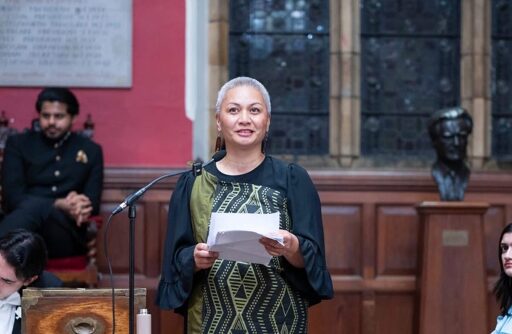

Marama Davidson addressing the Oxford Union in November last year. (Photo supplied)
Green Party co-leader Marama Davidson recently became the first wahine Māori to speak at the Oxford Union debate.
At the end of last year, she opposed the motion: “This House believes the sun should have never set on the British Empire.”
She was up against three conservative voices. Richard Ashworth, former UK Conservative Party leader in the European Parliament. Ben Habib, the current leader of the Advance UK party. And Don Brash, the former ACT Party leader.
“I was shaking. I was shit scared that I would bring shame to my ancestors,” she says. Her speech earned 163 votes in favour and 82 against to secure the win.
This is an edited version of her kōrero.
I was born to teenage parents who met on the steps of parliament, speaking truth to power about the theft of our land and our language through colonial violence. I’m a product of what we all know is a very ordinary occurrence in hearty activism — when the passion of the streets takes to the sheets.
My parents were part of an uprising of young Māori in the 1970s who had been dislocated to urban centres from their rural homelands. They questioned why their elders had denied them the poetry of their Indigenous tongue.
Why did they not know their mountains and waters? Why were they disconnected from their kinspeople? Why are generations of our people driven into poverty while our stolen pristine lands built generations of wealth for non-Māori farmers?
The brutality of empire and colonisation stole my land and my language and defiled our knowledge. Indigenous resistance is bringing it back.
So I have come to the other side of the world with my colonised ancestors and communities, to oppose the notion that “The House believes the sun should have never set on the British Empire”.
My proposition is that empires, in a broader sense, have yet to face nightfall. But the sooner the sun goes down on empire, the better. Because its gluttony has left generational ruin around the world. There needs to be accountability and redress for this wrongdoing. It is in this pathway to justice that we repair our relationships with each other and with our planet.
I bring to this debate my grandmother, Patricia Charlotte, and the trauma she took to her grave after being beaten in colonial schools for speaking the only language she knew. This silenced the Māori language in our family for the next three generations.
Returning to a contemporary context, I see my colleagues fighting right now in our parliament against laws that remove the obligation for schools to teach our native language and history. I see them right now fighting a bill that threatens the ability for Māori to challenge corporate infringement of Indigenous rights.
These are legislative attacks against my people, our culture and our sovereignty. It makes a mockery of the goodwill and relationships that Māori and non-Māori have built up over many generations, despite the divisive and false rhetoric claiming Māori have extra privileges.
The impact of empire today is ongoing injustice. It means that Māori are three times more likely to be prosecuted than non-Māori for committing the same offences. It means that Māori are disproportionately without housing, are disproportionately living in material hardship, and are unfairly denied basic services compared to non-Māori.
The arguments of those normalising the supremacy and exploitation of empire are stale and unimaginative. Peddling superiority with their full throats, and without irony.
I get why it is hard to relinquish this empire fantasy. The project of colonisation has, rather successfully, been a vessel to carry out the cruelty of capitalism. Where an economic system exploits people and our environment to hoard wealth for the few. And leaves those least responsible to bear the most harm from climate change, inequity and environmental destruction.
This is the mission of empire. A path of destruction is left behind for my people to clean up, while wealth was shipped back here to this land, but still not for everybody to share.
As this mission ran out of people and land to exploit, the hardships fell not just on my people, but also on all those now struggling to access housing, healthcare, fair pay and working conditions, and the means to support their families.
There lies the solidarity! While empire tries to turn regular folk just trying to survive against each other, people still show up in the community to support each other and reject the proposed division. This is where the hope is.
In my country, this hope looks like having a brand-new public holiday, Matariki, the Māori New Year, as a day for remembering our ancestors. It looks like diverse peoples of Aotearoa standing together against racism and corporate greed in the largest protests New Zealand has ever seen. It looks like Pukemokimoki Marae in Hawke’s Bay becoming a crucial welfare hub for locals of all backgrounds following disastrous flooding. It looks like record numbers of people, not just Māori, embracing and honouring the Māori language.
These are the stories of how empire falls.
Empires understand the power of language as a threat to their cause, which is why they target it incessantly. This very Oxford Union was founded on the idea of freedom of speech.
Well, you would have loved my nana. I dare to hope that you would have been the first to protect her right not just to speak, but to do so in her own language.
I declare, in the shadows of my ancestors, that the sun must set not just on the British empire but the whole project of empire.
Accountability, redress, and a reset of power back to the people is the only way that we will repair our connections back to each other and for our collective grandchildren.

Photo supplied.
Marama Davidson (Ngāpuhi, Te Rarawa, Ngāti Porou, Ngāti Tahinga) is the Green Party co-leader, born into a family of young, urban Māori activists. In 2020 she was appointed the first Minister for the Prevention of Family Violence and Sexual Violence. She was also Associate Minister for Housing with responsibility for addressing homelessness. Prior to entering Parliament, Marama worked for the Human Rights Commission and was the Chief Panellist for the Glenn Inquiry into Domestic Violence and Child Abuse. Marama and her husband have six children and three mokopuna. They have lived most of their lives together in Manurewa.
The post How empire falls appeared first on E-Tangata.
From E-Tangata via This RSS Feed.