

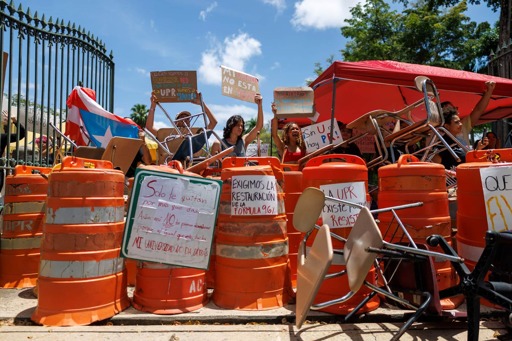
In April 2026, students at various campuses of the University of Puerto Rico (UPR) launched strikes calling for the resignation of university president Zayira Jordán Conde, protesting budget cuts outlined in the island government’s 2021 fiscal plan, and objecting to various administrative decisions. The strike has taken place at UPR’s two largest campuses, in Mayagüez and Río Piedras. The strike at Río Piedras lasted from April 27 to May 18, while the Mayagüez strike is ongoing and indefinite.
The strikers, who include students, faculty, and staff, are calling for Jordán Conde to step down because her appointment was driven by partisan political interests rather than her qualifications as an administrator or academic. She has been criticized for her efforts to introduce short-term courses and undermine the institution’s research-oriented mission. In addition, the president has refused to consider the university community’s recommendations or meet to discuss their concerns and complaints, effectively sidestepping established parliamentary processes.
Student protests spread to more campuses. The Arecibo campus held a 72-hour stoppage beginning April 22. The Río Piedras campus coordinated with the Medical Sciences campus, where students voted to hold a 48-hour strike on May 4 if Jordán Conde did not step down by May 1. The strike vote was renewed for 48 more hours on May 7. At the Humacao campus, students voted to implement a 72-hour strike starting May 4, while still permitting some sectors (like athletes, researchers, and contractors) to carry out essential activities. Students from all 11 campuses marched together on May 4 amid the university-wide strike, calling for administrative reforms, increased involvement in decision-making, and actions to address the system’s budget crisis.
The student protests were intended to send a clear message of opposition to the president’s policies, such as the dismissal in March of five campus chancellors, including former Río Piedras leader Angélica Varela Llavona. In a statement, UPR’s Río Piedras Campus General Student Council criticized the president, writing, “She has misrepresented financial data, marginalized the participation of various sectors in the University Board, and ordered the arbitrary closure of academically valuable programs with significant social impact.” The president of the General Student Council (CGE) at Río Piedras, Dyamar Cruz, noted that the removals were happening not only in the middle of an academic semester but also during critical administrative work on next year’s budget and amid the review of the fiscal plan certified by the Financial Oversight Board.
The demand for her resignation was also supported by the Asociación Puertorriqueña de Profesores Universitarios (APPU), the university professors union of Puerto Rico, and the Hermandad de Empleados Exentos no Docentes (HEEND), the staff union. Both unions supported the strike and other student demonstrations.
https://www.instagram.com/reel/DWzWuUUiXsW/
The Systematic Destabilization of UPR
In 2016, President Barack Obama signed PROMESA into law — a measure that created the Fiscal Oversight Board, whose aim is supposedly to “rebuild Puerto Rico’s economy.” In reality, its aim is to force citizens to pay the island’s crushing and illegal $74 billion debt. Since 2017 UPR has faced deep funding cuts, with fiscal plans slashing about half of its government support — dropping from more than $879 million to below $400 million by 2022.
This debacle was made possible by the contribution of the two main political parties that have been in power for decades: the Partido Nuevo Progresista (PNP; New Progressive Party) and the Partido Popular Democrático (PPD; Popular Democratic Party). In the words of María del Mar Rosa-Rodríguez, president of the Puerto Rican Association of University Professors (APPU):
“The challenges facing the UPR stem in part from partisan political interference and a complete lack of university autonomy. … Historically, both parties have treated the UPR as a source of political patronage, appointing rectors, deans, and University board members according to political loyalty instead of academic qualifications.
On April 22, Bonita Radio published a letter from the Fiscal Oversight Board to the government of Governor Jenniffer González-Colón calling for a tuition increase. In addition, the Fiscal Oversight Board proposed freezing UPR’s traditional pension system, continuing to transition new employees to 401(k)-style plans and limiting contributions to the retirement trust in order to reduce costs and ensure fiscal sustainability. This could diminish the security and stability of future pensions for UPR employees and retirees, increasing uncertainty regarding their retirement benefits.
The Fight Continues amid Administration Attempts to Curtail Student Organization Efforts
Students at UPR’s Río Piedras campus have ratified a set of preliminary agreements. This will end the strike, and classes are expected to resume by the middle of this week. Dyamar Cruz, president of the General Student Council at UPR Río Piedras, outlined some of the preliminary agreements reached with the campus chancellor: there will be no disciplinary sanctions on students who participated in demonstrations or who publicly support PC 1201 (a bill seeking a phased increase in the university’s budget), nor will the university administration take control of the student residence hall. The strike on the Mayagüez campus, however, will continue. At an assembly on May 18, the vice president of the student council denounced the administration’s attempts to sabotage it:
The Town Hall platform — part of Microsoft Teams — was initially provided by the administration itself … specifically for the purpose of holding this very plenary session. However, late in the day today (yesterday), we were notified that our access had been revoked, under the argument that the General Student Council lacks independent autonomy and that only assemblies — as opposed to plenary sessions — may be authorized. This assertion is particularly troubling given that the General Student Regulations themselves explicitly recognize the autonomy of general student councils. Article 3.7 clearly states that these councils shall enjoy autonomy in the management of their internal affairs and acknowledges their authority to establish their own internal regulations.
Despite the preliminary agreements achieved at the Río Piedras campus, the fight continues. Students are calling for a national assembly to organize next steps. In 2017 the UPR National Assembly approved a system-wide strike to fight for similar demands. The student movement is still fighting for the dismissal of the UPR president, for an end to the political and partisan interference in university governance, respect for the democratic processes of the university community, a university reform that guarantees institutional stability and autonomy, and leadership appointments based on the support of the university community.
We are seeing an upheaval in the student movement internationally. From Brazil, Argentina, and Chile to Europe and the U.S., students are fighting austerity and authoritarianism and defending immigrants’ rights and public education. Students are showing that we can fight for more. It is imperative that the working class and the student movement in the U.S. stand in solidarity with the fight at the University of Puerto Rico. Down with the Fiscal Oversight Board and austerity in Puerto Rico! For a university run by and for students and staff!
The post Students at the University of Puerto Rico Are Fighting Back against Austerity appeared first on Left Voice.
From Left Voice via This RSS Feed.