


Bullets:
China recently launched the world’s first underwater data center powered by offshore wind.
The cost of the project, off the coast of Shanghai, is less than half that of comparably sized data centers on land.
Microsoft pioneered the underwater data center, but abandoned further efforts despite successful testing.
Inside China / Business is a reader-supported publication. To receive new posts and support my work, consider becoming a free or paid subscriber.
Report:
Good morning.
There is a race on to build data centers for Artificial Intelligence. But it is running into a lot of problems in the United States and in Europe, where contractors are hard up against the lack of electricity to feed the data centers. There just isn’t enough, and local residents and politicians are mobilizing against new construction.
That is the primary driver of the political problem: the power demands for these data centers are putting strains on electric grids where households are already seeing big spikes in their utility bills, right now.
Those constraints don’t exist here in Mainland China, where construction of new data centers is a national-level objective, and electricity costs are falling. This is China’s newest data center, which is a project off the coast of Shanghai. It’s major engineering story, but getting deeper in we see how the other constraints that are slowing AI data center builds in the United States and Europe are not issues here.
This is an underwater AI data center, and this is the first in the world that is powered with offshore wind. It was launched last summer, and cost $226 million to build. It’s a partnership with power and engineering companies, and China Telecom. There are 2,000 servers at the data center, which is right next to large wind turbines offshore:
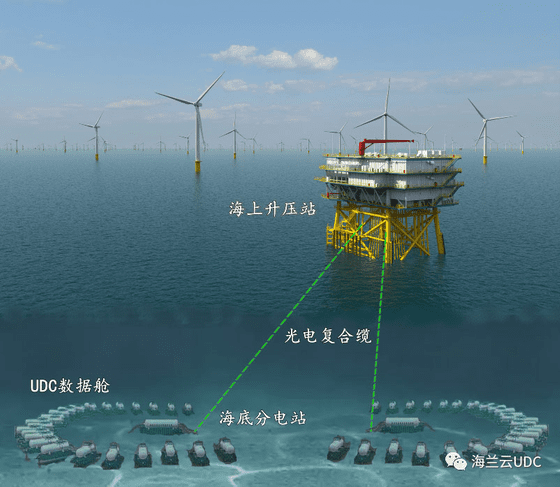
Underwater Data Centers (UDC) are cooled with seawater, which dramatically reduces the power need, and improves their Power Usage Effectiveness. The PUE of the Shanghai project is 1.15, which is about 30% lower than data centers operating on land. Overall, the electricity consumption drops by over 22%, and reduces to almost nothing the need for water, obviously, and land.
That is the thinking here, for this Chinese design. It is connected directly to the wind power plants, and the processing outputs sent to Shanghai, which is 10km away. Network latency overall is 0.5 milliseconds.
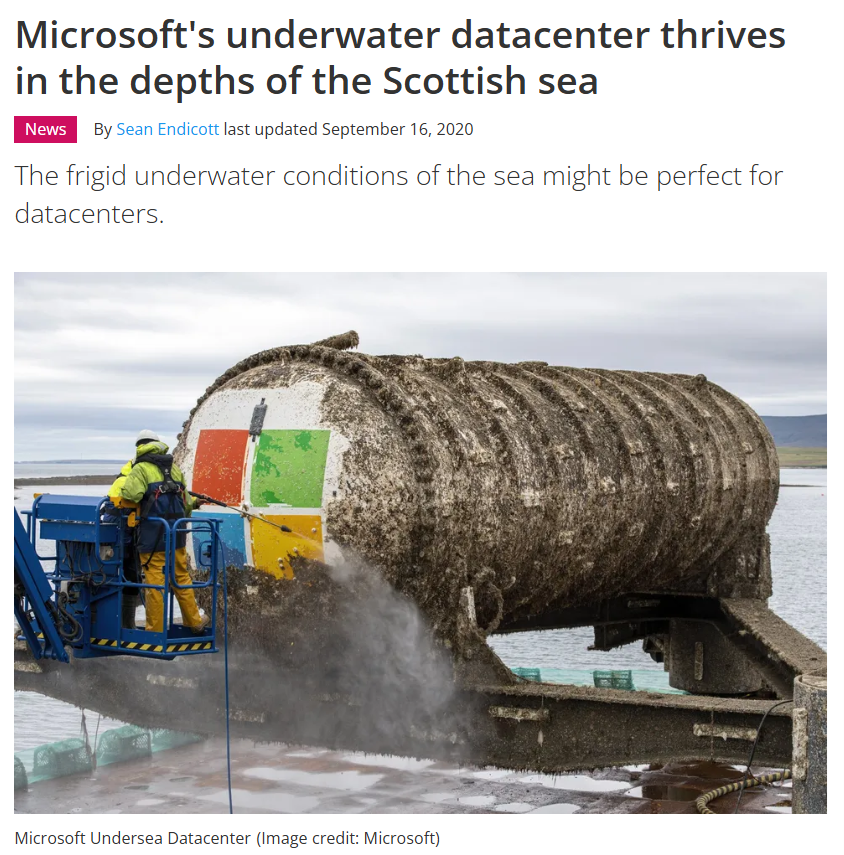
Microsoft was the pioneer of offshore data centers. Project Natick was a data center placed at a depth of 117 feet, about 35 meters, off Scotland. Researchers used nitrogen instead of oxygen. If you’ve got human researchers operating the equipment, they need to breathe air with oxygen, but oxygen is actually less optimal for computer servers. Getting rid of people gets rid of the need for big oxygen particles floating around, and that also got rid of clumsy people, who bump into the systems and spill things.
Microsoft’s water-cooled system was found to be more efficient, and the failure rate of their offshore data center was just one-eighth compared to one on land.
Microsoft also understood that putting the data center underwater next to population centers would result in the same low latency that the Shanghai project enjoys now. But nevertheless, Microsoft abandoned the plan to build more underwater data centers, and as of two years ago had no active data centers underwater.
Their Chief of Cloud Operations and Innovation said that the Microsoft program did work. Only 6 of the 855 servers on their underwater center broke down, compared to 8 out of 135 on dry land. She didn’t explain why the company walked away, only that they learned a lot about how to apply what they learned in other places.
Shanghai is the first underwater data center powered by offshore wind. But China’s first offshore data center was launched off of Hainan Island, in 2023. This, also, is 35 meters underwater, and that project followed testing that began two years prior, in Zhuhai.
Several Chinese provinces have underwater data centers in their five-year plans, which means that this is official policy, from the top down, to deploy these units at scale, in lots of coastal areas.
We were curious why Microsoft abandoned their plans for underwater data centers, even though their own research pointed out that their Natick program was a success. The Shanghai project is the only one that has shared their cost data. It’s a $226 million project, with a capacity of 24 megawatts. It is designed for AI workloads, big data, and development of large language models.
Compared to the construction and development costs for data centers as a whole, that Shanghai project comes in less than half. These are the cost data for a typical data center, worldwide:
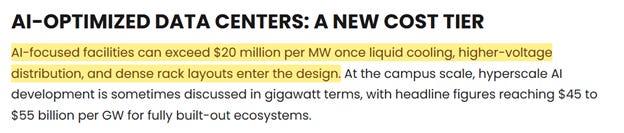
AI-intensive facilities are $20 million per megawatt, so a 24-megawatt data center, on land, would run over $480 million. Liquid cooling is one of the major cost drivers. Another driver is compute density, which is a function of power availability. Shanghai’s underwater data center solves the cooling problem, and they parked it right next to a giant offshore wind farm, so the issue of “robust power deliver” also goes away. Shanghai’s cost was $226 million, under half that of the $480 million cost of a comparably sized center, on land, in the US or Europe.
Locating these data centers nearby available power supply is more important than the cost of the land itself. But then there is this. The electrical systems make up a substantial part of the construction budget. Substations, switching equipment, and transformers are hard to come by; order backlogs are years-long in the United States.
US tech companies have all the money in the world, and seem to be committed to spending all of it to get their data centers built. But besides the political problems and power issues, there is a severe shortage of electrical components, and half of the data centers that are supposed to come online in 2026 are either delayed or were canceled outright:
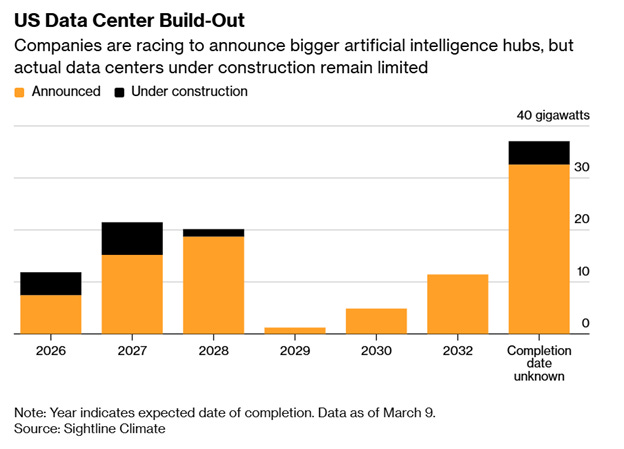
Same problem runs into future years—lots of announcements, but just a handful of construction projects underway. The power grid needs to be continually upgraded and expanded, then comes the new demand from data centers, so delivery times for transformers and switching gear are now five years.
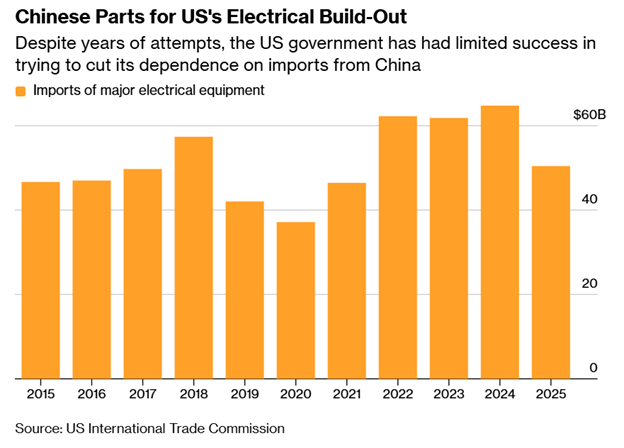
Data center contractors are reliant on imports to make up that difference, and China is a major source for that equipment. Builders are indifferent to the high tariffs on Chinese gear coming over, because those customs charges are negligible compared to the money coming in from the hyperscalers like Amazon and Microsoft.
It’s ironic, there, that Microsoft was the first to figure out how to build data centers underwater and showed the world the benefits of doing so. But Microsoft can’t plug their underwater data centers into offshore wind farms, because the United States is canceling them all.
And so Microsoft is waiting in line — with everyone else — for more electrical equipment to come over from China
Be Good.
Resources and links:
Interesting Engineering, China activates world’s first offshore wind-powered underwater data center
https://interestingengineering.com/innovation/china-offshore-wind-data-center
Microsoft confirms Project Natick underwater data center is no more
https://www.datacenterdynamics.com/en/news/microsoft-confirms-project-natick-underwater-data-center-is-no-more/
Microsoft waves goodbye to underwater data centers
https://www.windowscentral.com/microsoft/microsoft-waves-goodbye-to-underwater-data-centers
China puts ‘world’s first’ offshore wind-powered underwater data center into operation
https://www.offshore-energy.biz/china-puts-worlds-first-offshore-wind-powered-underwater-data-center-into-operation/
China launches ‘world’s first’ underwater data center powered by offshore wind energy.
https://gigazine.net/gsc/_news/en/20260519-undersea-data-center-china
Microsoft’s underwater datacenter thrives in the depths of the Scottish sea
https://www.windowscentral.com/microsoft-undersea-datacenter
Off the coast of Shanghai’s Lingang Special Area, a newly operational platform now hosts the world’s first commercial underwater data center
https://www.facebook.com/watch/?v=1543813920507409
China deploys 1,400-ton commercial underwater data center
https://www.datacenterdynamics.com/en/news/china-deploys-1400-ton-commercial-underwater-data-center/
What Does It Cost to Build a Modern Data Center in 2026?
https://www.constructelements.com/post/cost-to-build-modern-data-center-2026
America’s AI Build-Out Hinges on Chinese Electrical Parts
https://www.bloomberg.com/news/features/2026-04-01/us-ai-data-center-expansion-relies-on-chinese-electrical-equipment-imports
Microsoft’s AI Strategy Deconstructed - From Energy to Tokens
[ SemiAnalysis
Microsoft’s AI Strategy Deconstructed - From Energy to Tokens
Microsoft was at the top of AI in 2023 and 2024, but then a year ago they changed course drastically. They paused their datacenter construction significantly and slowed down their commitments to OpenAI. We called this out a year ago to datacenter model clients…
Read more
6 months ago · 240 likes · 13 comments · Jeremie Eliahou Ontiveros, Dylan Patel, Myron Xie, Wei Zhou, Jordan Nanos, Clara Ee, Daniel Nishball, and AJ Kourabi](https://newsletter.semianalysis.com/p/microsofts-ai-strategy-deconstructed)
Why are communities pushing back against data centers?
https://news.harvard.edu/gazette/story/2026/04/why-are-communities-pushing-back-against-data-centers/
New data reveals at least 48 data center projects were blocked or stalled by local opposition in 2025
https://www.thecooldown.com/green-business/data-center-opposition-local-resistance-construction-challenges/
Anti-data center measures gain traction at state, local level
https://thehill.com/policy/technology/5843665-data-center-backlash-grows/
EIA: Electricity prices to rise faster than inflation through 2026
https://www.americanexperiment.org/eia-electricity-prices-to-rise-faster-than-inflation-through-2026/
Why is China’s electricity so cheap?
Trump suspends all large offshore wind farms under construction, threatening thousands of jobs and cheaper energy
https://edition.cnn.com/2025/12/22/climate/trump-offshore-wind-suspension-virginia
Trump administration cancels $679 million for offshore wind projects
https://www.cnbc.com/2025/08/29/trump-administration-cancels-679-million-for-offshore-wind-projects.html
Microsoft Pulls Back on Data Centers From Chicago to Jakarta
https://www.bloomberg.com/news/articles/2025-04-03/microsoft-pulls-back-on-data-centers-from-chicago-to-jakarta
Microsoft’s AI Strategy Deconstructed - From Energy to Tokens
[SemiAnalysis
Microsoft’s AI Strategy Deconstructed - From Energy to Tokens
Microsoft was at the top of AI in 2023 and 2024, but then a year ago they changed course drastically. They paused their datacenter construction significantly and slowed down their commitments to OpenAI. We called this out a year ago to datacenter model clients…
Read more
6 months ago · 240 likes · 13 comments · Jeremie Eliahou Ontiveros, Dylan Patel, Myron Xie, Wei Zhou, Jordan Nanos, Clara Ee, Daniel Nishball, and AJ Kourabi](https://newsletter.semianalysis.com/p/microsofts-ai-strategy-deconstructed)
Inside China / Business is a reader-supported publication. To receive new posts and support my work, consider becoming a free or paid subscriber.
From Inside China / Business via This RSS Feed.