

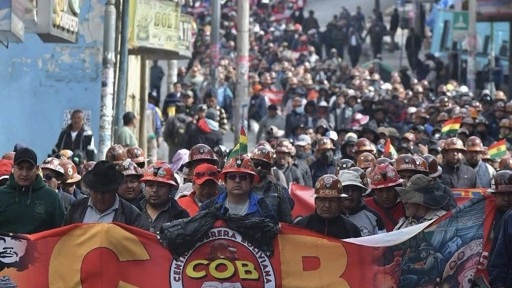
The political and social crisis shows no signs of abating in Bolivia. Constant demonstrations by the country’s major labor unions, organizing agricultural workers, transport workers, and miners, as well as Indigenous movements, among others, have caused genuine social upheaval.
The protests erupted over the neoliberal government’s attempt to eliminate the historic right, won through peasant struggles, that prevents land from being seized for the repayment of debt. Paz proposed a law allowing peasants to use their land as collateral for payment, under penalty of losing it if the debt is not repaid – a measure that has been described by several critics as a perverse mechanism designed to exploit the needs of the poorest people in order to accumulate land for the benefit of the national and international economic groups currently supporting the Paz administration. Bolivia has significant natural reserves of gas and precious metals, as well as lithium, which is essential for new information technologies.
The protests soon began to garner support among workers, teachers, and Indigenous communities, who seized the opportunity to demand improvements to their living and working conditions. In response, Paz launched a harsh military and police counteroffensive. This led the protesters to begin calling, in an increasingly coordinated manner, for the president’s resignation.
Faced with a situation that quickly spiraled out of the executive branch’s control, Paz is now proposing a cabinet reshuffle to alleviate public discontent. Indeed, just a few hours ago, Labor Minister Edgar Morales announced his resignation from the post to “pacify the country.” Morales was one of the main opponents of the Bolivian Workers’ Union (COB) during the protests. Several more ministers are expected to leave the cabinet in the coming hours.
Diplomatic crisis
The situation has escalated to the diplomatic level. A few days ago, several right-wing presidents in Latin America signed a letter of support for Rodrigo Paz and condemned the protesters’ actions. This is the same line taken by Washington, which claims that the demonstrations are part of a premeditated plan to overthrow the government, which has been in power for less than a year.
This is what US Deputy Secretary of State Christopher Landau said: “This is a coup financed by that alliance between politics and organized crime throughout Latin America … It is unthinkable that there could be a democratic process in which Paz was overwhelmingly elected by the Bolivian people less than a year ago, and now you have violent protesters blocking the streets.”
For his part, Colombian President Gustavo Petro said that Bolivia is experiencing a genuine “popular uprising” and offered to act as a mediator. The statements did not sit well with the Bolivian government. Paz said that Petro’s statements “are an attack on democracy … [Petro] has prioritized his ideology—which, it seems, lacks democratic principles—over relations and respect for the democracy of our nations.”
Following this, Bolivia decided to expel Colombia’s top diplomatic representative in the country, to which Bogotá responded by expelling the head of the Bolivian Embassy’s office from Colombian soil.
This is not the only international controversy in which the Paz administration has been embroiled during the recent protests. The Bolivian government announced that the administration of Argentina’s far-right leader, Javier Milei, had sent aircraft carrying humanitarian aid. However, Argentine Congressman Rolando Pacheco claimed that the cargo actually consisted of riot control equipment intended for the suppression of protesters.
This has prompted several Argentine lawmakers to request reports from the Milei administration regarding the alleged shipment of police and military equipment on two Hercules aircraft. This incident comes on top of the previously reported and alleged shipment of riot control ammunition by the then-administration of Mauricio Macri to Bolivia’s de facto president, Jeanine Áñez, who served as president following the 2019 coup d’état.
Thus, the Paz government has shown that it is willing to cling to power by any means necessary, whether through repression, negotiation, or foreign collaboration – whether the latter is overt or not. At the same time, however, it has shown that it is not afraid to sever ties with governments such as Petro’s. Bolivia’s future is undoubtedly uncertain and will be decided in the coming days.
The post The social crisis in Bolivia triggers diplomatic rifts and a cabinet reshuffle appeared first on Peoples Dispatch.
From Peoples Dispatch via This RSS Feed.