

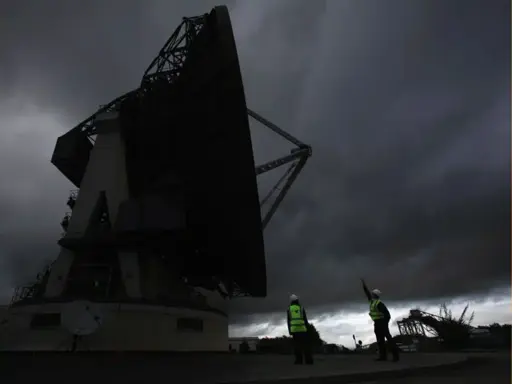

The UK has earmarked £65m to upgrade Skynet (actual name), a war satellite system once used to fly drones over Afghanistan. The system contains software run by yet another global military firm with interests in AI war systems. That is the second one this week.
A government press release once again conflated business and public safety with lucrative defence interests:
Vital emergency services, military operations and British businesses will be better protected through a new system to protect UK satellites and the services they provide from space.
20% of UK economy reliant on satellite services which are essential for military operations, navigation, money transfers and global communications.
Has anyone thought to separate them? Probably not…
Borealis satellite software
The press release said a new software called Borealis would improve the Skynet satellite system:
The new software, known as Borealis, is now operational six months ahead of schedule and will better protect the UK by improving the awareness and ability to track objects in space.
This includes debris and satellites from adversaries that might be a threat to UK satellites, with Borealis providing the military with crucial information to protect and defend space systems and assets.
Defence minister Luke Pollard said:
Space is now a contested domain. Protecting our satellites from adversaries keeps our economy moving and keeps us all safe. As we increase defence spending we are investing in new defensive capabilities in all domains, including UK space-based capabilities.
While the UK’s chief space cadet — joking, the head of UK Space Command — General Paul Tedman said:
Protecting and defending the invisible front line in space requires us to see and understand what is happening in orbit and then make decisions at machine speed.
Adding that the new technology would provide his troops with “actionable choices”.
Space minister (actual job title) Liz Lloyd added:
Borealis represents a significant step forward in the UK’s ability to monitor, protect and defend the critical space capabilities.
This joint investment by the UK Space Agency and Space Command, backed by British expertise and jobs, ensures the UK remains a world leader in understanding and protecting the space environment for generations to come.
The main winner here seems to be IT firm CGI. Whose head of death and destruction (defence and intelligence) Neil Timms claimed:
Delivering Borealis to operational readiness half a year early highlights CGI’s track record in delivering complex, secure space systems. By combining deep domain expertise with modern engineering practices, we’ve provided a scalable capability that can adapt as mission demands and the threat landscape continue to evolve.
Pure jargonese and about as clear as mud. What is clear is that CGI has global interests in defence, intelligence, oil and gas and healthcare. Sounds a bit like Palantir… hmmm
Turns out CGI has interests in sovereign AI (AI for nation-states). The CGI website says very little beyond claiming to have proven results in:
Defense and security environments with disconnected and edge AI.
We’re not sure what ‘edge AI’ is but it sounds like something Palantir boss Alex Karp does in his spare time. Joke! Please don’t sue us. We’re just a very high-spirited newsroom on a Friday!
Campaign against the Arms Trade reported in 2019 that CGI acquired SCISYS Group, another IT firm whose military activities include:
work on the Astute submarine, the Warrior infantry fighting vehicle and the F-35 Lightning combat aircraft.
Amazing how so much the ‘IT’ profession has moved from two Warhammer fans in a basement office to remotely killing people around the world. Sign of the times, we suppose…
UK NGO Drone Wars has covered Skynet and the militarisation of space for many years. The organisation reported in 2010:
The [Skynet] satellites enable RAF pilots sitting in their base in the Nevada desert to fly Reaper drones and launch their missiles over Afghanistan. Via Skynet 5’s high-bandwidth connection, information and video from the Reapers over Afghanistan is beamed to Creech USAF base in Nevada and to the UK.
So that’s another £65m fired into space, quite literally. And with space minister Liz Lloyd, First Space Lord Tedman and actual space cadet Luke Pollard at the helm of the Starship Starmer-prise, there’s no doubt we’ll all be safer and more prosperous for it.
Right? RIGHT?
Featured image via Matt Cardy/Getty Images
By Joe Glenton
From Canary via This RSS Feed.