

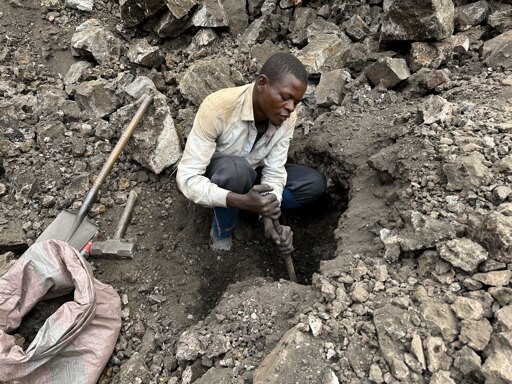
The global rush for minerals needed for the green energy transition risks repeating the same old extractive patterns that have long left communities in the Democratic Republic of Congo bearing the costs while others reap the benefits, a lawmaker from the country warns. Robert Agenong’a, a civil society leader and also politician from the Ituri Province, spoke to Mongabay at a major international cobalt meeting in Madrid earlier this month. He criticized what he described as the growing “corporate capture” of the country’s critical minerals sector. He said discussions at the May 13-15 conference — hosted by the U.K.-based Cobalt Institute and sponsored by mining giants Glencore, IXM and CMOC Group Limited, among others — focused heavily on securing cobalt supplies for electric vehicles and clean energy markets, while giving far less attention to the environmental and social fallout in mining areas. Previous Mongabay reporting has highlighted the severe impacts of mining on local communities, particularly on the health and well-being of women and youth. “The concern is that everyone is interested in getting Congolese cobalt to the world market because it is of very high quality,” Agenong’a said. “But nobody pays attention to the environmental harms, the social impacts, and the communities’ grievances.” A miner in the Democratic Republic of Congo in 2023. Image by Electronics Watch via Flickr (CC BY-NC 2.0). The DRC produces roughly 70% of the world’s cobalt, a mineral considered essential for the batteries used in electric vehicles and renewable energy technologies. As governments and…This article was originally published on Mongabay
From Conservation news via This RSS Feed.