

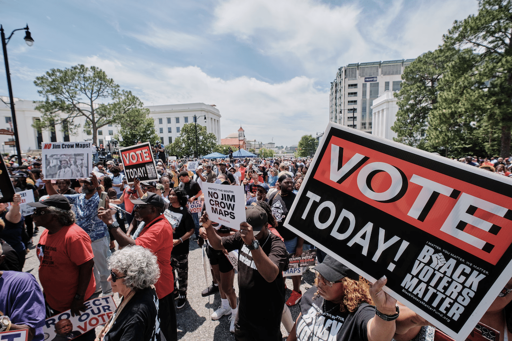
On April 29, the Supreme Court issued its 6-3 decision in Louisiana v. Callais, gutting Section 2 of the Voting Rights Act (VRA) of 1965 and setting off a chain of redistricting efforts that could radically reshape voting patterns across the country. The ruling, authored by Justice Samuel Alito, dramatically raises the bar for challenging racial gerrymandering — now requiring proof of “intentional discrimination” by state legislatures, an almost impossible standard.
The ruling is part of a systemic defanging of the limited protections afforded by the VRA over the last decade and a half that takes aim at the right to vote for tens of millions of Black and Brown people in the United States and sets the stage for new attacks on democratic rights. It builds on the Trump administration’s attempts to curb the right to vote at both the federal and state levels, including executive orders and the SAVE America Act that would impose serious obstacles for working people to vote in future elections. Importantly, the Callais decision has thrown fuel on the fire of the so-called “redistricting wars” between the Republicans and Democrats ahead of the November midterms.
Democrats and Republicans are rushing to eke out an advantage in the electoral landscape in a context of massive shifts in consciousness that question the relationship of the working class to the two parties. This poses the question of defending the right to vote as one of voting for the Democratic Party. But the redistricting wars are a bourgeois solution to a bourgeois problem, designed to preserve the rule of the two capitalist parties. Defending the right to vote against this latest racist offensive — and gaining full rights for the millions excluded under the current system, including immigrants — is a fight that the working class must take up with its own demands and methods.
Callais Shows the Supreme Court on the Offensive
The Callais decision is the third major blow to the VRA in just over a decade. In Shelby County v. Holder (2013), the Court gutted the “preclearance” requirement that forced states with histories of discrimination to get federal approval before changing election laws. In Brnovich v. DNC (2021), it raised the bar for challenging discriminatory voting rules under Section 2. Callais goes a step further, making it nearly impossible to challenge maps drawn to dilute the votes of Black and Brown communities.
The judicial logic behind each of these decisions has been that many of the VRA’s provisions became obsolete because racial disparity in voting has largely been addressed. Alito argued as much in the majority opinion for Callais, writing that “Black voters now participate in elections at similar rates as the rest of the electorate, even turning out at higher rates than white voters in two of the five most recent Presidential elections nationwide and in Louisiana.”
As The Guardian has since reported, however, this statement is based on dubious statistics published by the Department of Justice: not only has Black voter turnout trailed white voter turnout in any election but the 2012 presidential race, but the gap between is actually increasing. This is in no small part due to the slow dismantling of voting rights over the last decade and a half, including the Shelby decision in 2013. A 2024 study conducted by the Brennan Center estimates that this gap has grown twice as fast in states where preclearance requirements were lifted.
This is part of a long history of suppressing Black votes in the United States, from literacy tests and poll taxes of Jim Crow to today’s voter ID laws, voter roll purges, felon disenfranchisement, and gerrymandered maps. After Reconstruction, this was part of an effort to curb the political initiatives of the Black working class as it began to occupy a new role in the U.S. economy and society, threatening the unfettered development of U.S. capital after the Civil War and injecting energy into the fight against exploitation and oppression. The VRA itself and the limited protections it afforded were a response to class struggle during the massive upheaval of the Civil Rights movement.
The attacks to the VRA in the decades since its passage have only changed the form of these attacks on the political rights of people of color in the United States. And it will not stop with Black voters. By legitimizing partisan gerrymanders that give the Far Right an edge in the elections and setting a precedent to reject maps that create new majority-minority districts, Callais opens the door to disenfranchising broader layers of the working class and oppressed — poor, immigrant, and young voters alike.
The timing of the decision is no accident. On the one hand, it has direct implications for the November midterms, which come in a moment when Trump’s approval ratings have hit a low point at 37 percent (even as low as 35 percent by some polls) in reaction to his handling of the economy, the war in Iran, and the immigration crackdown. With the GOP at risk of losing seats in November, the conservative-led Court was pressured to put its finger on the scale in the “redistricting wars” that Trump ignited at the end of last year with demands for mid-decade redrawing of maps in Red states.
And while the first wave of primaries and midterm elections this week showed that Trump still calls the shots in the GOP, the Supreme Court’s decision and redistricting frenzy is more a sign of weakness than of strength. Forced on the back foot by broad disillusionment not only with his policies but the “change” he was supposed to represent, Trump is forced to resort to more drastic measures to push his agenda through at the national and state level.
But the Supreme Court is not just concerned with saving Trump from himself. The Callais decision represents the highest court in the country intervening in a much deeper crisis of the bipartisan regime. The redistricting rush — a push to reorganize the existing bases of the twin parties of capital — is a product of an ossified regime struggling under the weight of polarization and discontent from below that is already breaking open fissures within the two parties.
This discontent — represented in widespread distrust in the institutions of American democracy — leaves little room for the two parties to maneuver as they struggle to project a vision capable of dealing with the crises facing U.S. capitalism and “winning back” the political trust of the working class and oppressed to do so. The Supreme Court is forced to create new paths for the capitalist parties — in this case the GOP — to take the political initiative, and is moving to contain discontent and channel it back into support for the two parties.
The Fallout
The impact of the Callais decision has been almost immediate. Red states moved within hours to propose new maps ahead of the November midterms. Louisiana suspended its May 16 primary — after more than 100,000 people had already cast early votes — to redraw its map and scrap one of its two majority-Black districts. Tennessee’s GOP-controlled legislature carved up the Memphis-based 9th District, the state’s only Democratic-held seat and a historically Black district, splitting greater Memphis into three sprawling districts. Alabama appealed to the Supreme Court to vacate the 2023 Allen v. Milligan ruling that had forced it to draw a second majority-Black district. Mississippi, South Carolina, Florida, and Texas are all moving in the same direction. Analysts estimate Republicans could pick up between 19 and 27 House seats as a result of the changes to Section 2 of the VRA and consequent mid-decade redistricting efforts — not by winning votes, but by erasing majority Black and Brown districts.
In response, Democrats have chosen to fight fire with fire and escalate the redistricting game, initiating a series of legal disputes and countering with their own district maps in Blue states. Democrats are united in viewing this as an existential battle. As New York Representative Alexandria Ocasio-Cortez told reporters, “If Republicans are going to redraw North Carolina, if they’re going to redraw Texas, if they’re going to redraw and gerrymander every one of their states, then unfortunately we have to provide balance to that until we get to the day when we can all finally agree to put this behind us.” House Minority Leader Hakeem Jeffries put it more bluntly: “We are in an era of maximum warfare, everywhere, all the time.” California, New York, and Illinois are now openly contemplating retaliatory Democratic gerrymanders.
But this newfound energy among Democrats is not ultimately about protecting the right to vote as much as it is about securing their own votes. Even figures within the party are criticizing this approach. New York Times columnist and author Ezra Klein criticized both parties for using gerrymandering as a strategy: “It is an act of effective disenfranchisement, at least in House elections. The people in power are choosing their voters — rather than the voters choosing the people in power.”
The fallout from Callais further attacks a key part of the coalition that kept the Democratic Party as the only alternative to the more aggressive attacks of the Republican Party for decades. With that coalition nearly shattered in recent years, with increasing sectors of the population disillusioned with Democrats’ defense of the status quo, the Democratic Party is grasping at straws to once again try to paint a vote in their favor as a vote to protect workers and oppressed peoples from the attacks of the Far Right.
But the Democrats have not been able to stop the Far Right from steadily eroding voting rights for over a decade. The “redistricting wars” reinforce the bipartisan regime by reducing the question of guaranteeing the democratic rights of oppressed people to which capitalist party holds the pen that draws the maps. In other words, it amounts to once again pinning our hopes on the Democratic Party.
A Mass Movement to Defend the Right to Vote
The Supreme Court has paved the way for a frontal onslaught against the right to vote in a moment when the Far Right is forced to resort to ever more aggressive measures to push an agenda which is increasingly rejected by the majority of people living in the United States.
We cannot trust either party of capital to protect the right to vote or fight on their terms. This struggle must be waged by working people ourselves, from below. Thousands of people have already come out to the streets to protest the Callais decision. Thousands gathered in Montgomery and Selma on May 16. After Tennessee eliminated the only Black district in the state, protesters marched in Memphis to protest this erasure of their vote. This is a glimpse of the anger that can be channeled into a movement in the streets, workplaces, and schools to defend the basic right to vote and fight for more. But to expand, it must be freed from the vice grip of the Democratic Party and a strategy of voting Blue as the way to combat the Right or fight for the interests of working and oppressed people.
The labor movement has a particular responsibility to unite its ranks and lead this fight. It was the muscle of organized labor — Black workers’ insurgency in particular, alongside the broader civil rights movement — that forced through the original Voting Rights Act in 1965. That tradition must be revived. Unions should be in the streets in every state where Republicans are erasing Black votes, organizing workers to defend the right to vote by whatever means necessary — not just to stop redistricting efforts, but to demand an end to all racist laws that restrict the right to vote and for the right to vote for all people who live in the United States.
This means linking this fight to the struggle for the right to vote to the millions of immigrants — documented and undocumented — who live, work, and raise their children in this country but who have have no political, social, or economic rights. The demand to abolish ICE and grant full rights, including the right to vote, to all immigrants is inseparable from the fight against Callais.
If we’ve learned anything in the past fifteen years, it’s that the VRA was just a band-aid on systemic racism in the United States, one that barely covered the deeply undemocratic nature of U.S democracy. From Democratic Party stalwarts to the champions of social-democracy, Democrats are beginning to realize that big changes might be necessary to win back working-class support. But even a complete overhaul of the way we vote in the United States means nothing if it means voting within the confines of a capitalist system that will always reinforce the rule of a few over the vast majority of working and oppressed people.
Defending the right to vote points toward the necessity of building an independent political alternative of the working class — one that fights not only for democratic rights but to put the working class itself in charge of society.
The post Redistricting Wars Won’t Help — We Need a Mass Movement to Defend the Right to Vote appeared first on Left Voice.
From Left Voice via This RSS Feed.
We need to strike en masse. I’ll keep saying it because it’s the truth. To hit them where they hurt is to stop business. How? Literally stop working for a day. Everybody in DC, and everywhere else. Just stop working for a day, crowd the hell out of capitol and WH, and demand that they resign. Either wait until they decide to do it to us by firing us anyway or we can take an initiative to remove that choice from them. It’s up to us. They’ve proven the system will fail us. We must take matters into our hands. When will it be enough? How many more people need to die in ICE camps? Children dying in Iran? People dying in Ukraine? Russia? How many? Look at what happened in South Korea with Samsung. See that? We don’t have to chicken out. We can strike and it will threaten the 1% to kick them out. Corner them hard enough and they’ll turn on each other.