

By Anahí Durand Guevara – May 21, 2026
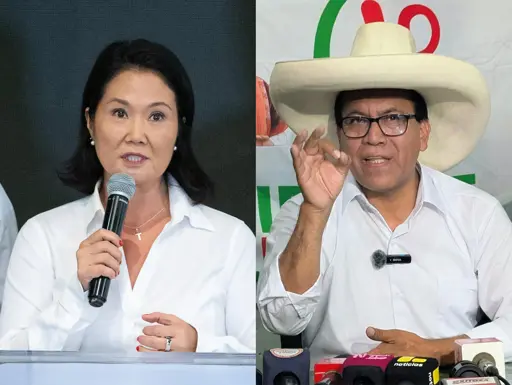
The presidential election in Peru now has its two finalists: Keiko Fujimori from the right-wing Popular Force Party and Roberto Sánchez from the leftist Together for Peru, backed by Pedro Castillo. It is an unusual electoral result given the political conditions in which the first round took place. The coup and mafia coalition that seized state power after ousting President Pedro Castillo on December 7, 2022, had rigged the electoral landscape to ensure their victory.
With the approval of puppet presidents like Dina Bolaurte and José Jerí, the coalition advanced in changing the regulations and capturing the electoral institutions, as well as in excluding parties and popular candidacies through the disqualification and/or incarceration of leaders like former presidents Martín Vizcarra and Pedro Castillo. All this took place in an adverse geopolitical context and with heightened US interference.
However, when the Peruvian right was breathing easy, confident that the electoral results would be favorable to one of its many competing options, the downtrodden nation emerged with a leading role. Like in 2021, when the nation had taken the rural teacher Pedro Castillo to the presidency, this time also the popular sectors made invisible by the pollsters chose an option for change.
In December 2022, they had mobilized in defense of their vote, despite getting massacred and criminalized. In April 2026, they went to the polls confident of getting revenge. This article addresses the principal forces in contention and the possible outcome scenarios.
Together for Peru: the telluric force of castillismo in the second round
For the 2026 elections, Pedro Castillo made a political agreement with Together for Peru, a party led by his former minister and congressman Roberto Sánchez, who was designated as the presidential candidate.
With a campaign focused on rural areas and an explicit demand for Pedro Castillo’s freedom, the presidential candidate and the parliamentary candidates were able to get a powerful and mobilized vote, which already forms a collective subject known as “castillismo.”
Castillismo is the result of the convergence of an anti-system vote and an identity vote. The anti-system vote existed as long as the neoliberal and neocolonial model has existed during the 21st century.
In previous elections, the anti-system vote opted for personalities from the urban and globalized world, such as Ollanta Humala in 2011 or Verónica Mendoza in 2016, but in 2021 it took on an identity dimension with the election of Pedro Castillo. For the first time, the sectors marginalized and excluded from the system expressed their vote by electing one of their own.
They conquered power directly, without the mediation of an “outsider” prone to class betrayal. This convergence between the protest vote and the identity vote has sealed a political proposal centered on the sectors excluded from the current model, configuring a plebeian subject: peasant, rural, peripheral urban, in precarious economic situations.
Castillismo has won in the territories abandoned by both the State and the neoliberal model. Unlike the working-class neighborhoods of the big cities, these areas have resisted the processes of atomization, with the defense of the collective persisting as a guarantee of survival.
In these rural, semi-rural, or peripheral territories, a cognitive dimension remains in force that prioritizes the collective over the individual, something completely antithetical to urban poor areas.
Together for Peru, the party of Castillismo in this election, has won in territories where the vote is often decided collectively. That is what happened in the villages of Cajamarca, the Aymara communities of Puno, or the indigenous Amazonian areas where the people massively voted “for Pedro Castillo.”
This identification with Pedro Castillo also includes a demand for public policies with a prominent role for the State and a feeling of nationalism. The collective dimension that prevails in areas supporting Castillo is reflected in a demand for greater State presence.
It is no coincidence that 62% of Roberto Sánchez’s votes in the first round came from classes D and E, that is, the poorest and the most abandoned sectors during the two decades of neoliberal economic growth. Castillismo won in 12 regions of the country, mainly in the highlands and the forests, but could not achieve positive results in regional capitals and was crushed in Lima.
At the parliamentary level, Together for Peru got 14 senators and 33 deputies. It could also get elected social leaders associated with the protests against Dina Boluarte’s usurpation in December 2022, such as Alejandro Manay, an elected deputy from Ayacucho who has been imprisoned for almost a year on charges of terrorism, or vice president Brígida Curo, accused of leading disturbances in Puno.
Yenifer Paredes, daughter of Pedro Castillo, who was unjustly accused of corruption, became the most voted deputy from Cajamarca. There is a vote of restitution that exposes a sense of historical justice, both to achieve the freedom of Pedro Castillo and to vindicate those who led the uprising, were persecuted, and can create a government of change.
Fujimorism in the second round, once again
Fujimorism has been building a community around its neoliberal-fascist project for 35 years. The central subject of this model is the “aspirational” individual from the peripheral cities, a person who adopts all the references of neoliberalism as long as the system guarantees them an acceptable status, fundamentally individualistic and without collective expectations.
At the territorial level, Fujimorism has extensive national coverage, and at the social level, it maintains a foothold both in the poorer sections and in sectors of the Peruvian bourgeoisie and the military-police apparatus.
Popular Force, the party led by Keiko Fujimori, remains the first minority in Congress, with 22 senators out of a total of 60 and 44 deputies out of a total of 130. It could not achieve a majority to approve a vacancy in case of losing the presidency, but by weaving alliances with right-wing forces like Popular Renovation, it could push forward reforms that deepen the neoliberal model that it defends.
Fujimorism is present throughout the national territory and has achieved significant institutionalization. At the territorial level, it has won in regions of the northern coast such as Piura, Lambayeque, and La Libertad. Only in Lima it was displaced by Popular Renovation.
However, unlike Rafael López Aliaga of Popular Renovation, Keiko Fujimori’s vote comes from more popular sectors. According to an IEP survey from April 2026, 68.5% of her electorate has a primary education.
Roberto Sánchez Advances to Peru’s Presidential Runoff Against Fujimori
An open ending
The second round in Peru is complex and challenging. On one hand, the deterioration of the precarious democracy and the significant political and social fragmentation remain prominent. On the other hand, it highlights the relevance of two antagonistic societal models that had already been expressed in 2021, with Fujimorism as the option for neoliberal continuity and Castillismo as a proposal for rupture coming from the popular sectors.
Yet, while there are similarities with the 2021 election, there are noticeable differences as well. In 2021, the pandemic traumatized Peruvian society and shattered the narrative that supported the economic model, leading millions of Peruvians to question its relevance.
Unlike the 2021 election, the 2026 election is marked by citizens’ demands to solve everyday problems. This concern is reflected in the relative success of middle-class candidacies that presented themselves as technical persons with a liberal-progressive stance, such as Jorge Nieto, Alfonso López Chau, and Marisol Pérez Tello.
Another difference is that in 2021, the anti-Fujimori sentiment represented a powerful force in Peruvian politics, but it suffered a major crisis during the election and subsequent presidency of Pedro Castillo. A large part of the intellectual and political elites of this movement opposed Castillo’s government, coinciding with Fujimorism.
The most emblematic figure of this evolution was the author Mario Vargas Llosa, who supported Keiko Fujimori in 2021. The promoters of “anti-Fujimorism” came from the liberal middle classes and saw their privileges and positions of power threatened by the profound change that Castillo represented.
This attitude weakened anti-Fujimorism as a political movement, calling into question its ability to rally support, to the point that now centrist sectors are calling for a “blank or spoiled vote.”
Keiko Fujimori, aware of this antagonism, is approaching the second round by moderating her image and appearing supportive of dialogue, especially when compared to the unrestrained Rafael López Aliaga. Likewise, she is committed to demonstrating administrative capacity, technical solvency, and openness to the liberal center as a guarantee of stability, so much so that the principal business unions have published statements distancing themselves from the fraudulent narrative of Popular Renovation.
In the case of Roberto Sánchez, his main challenge will be to demonstrate governance capacity and technical solvency, without compromising his principles or accepting a liberal roadmap. Sánchez faces the challenge of reconciling the “Castillista” vote with the urban progressive and middle-class world.
Achieving this rapprochement will not be an easy task as there are mutual distrusts between the popular sectors and the liberal-progressive sectors. Taking a step forward implies recognizing the other field as it is, and bringing the commonalities closer above the differences.
For the liberal sector, it means accepting that the popular sector is majority, recognizing the existence of its voters and their just demands without pretending to be the enlightened vanguard. For the popular sector, it means admitting that having a relative majority is not enough to change Peru; what is needed is to gain power.
And for that, a patriotic, multi-class, and deeply cohesive proposal must prevail despite economic, social, territorial, cultural, and even ethnic differences. This does not mean capitulating or diluting the transformative horizon, but finding strategic cohesion.
Translation: Orinoco Tribune
OT/SC/DZ
From Orinoco Tribune via This RSS Feed.