

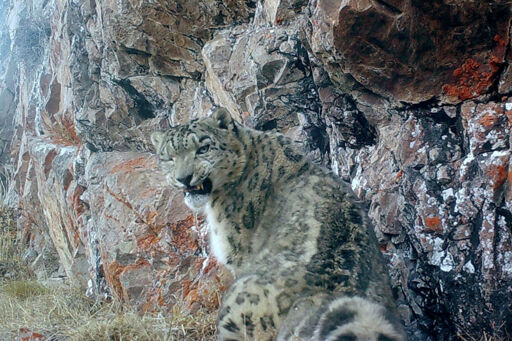
Snow leopards haunt the rocky ridgelines of Central Asia, vanishing into terrain so rugged that researchers rarely catch more than a brief glimpse on camera traps. Locals call them “ghosts of the mountains.” Their elusive nature, paired with the remote landscapes the cats inhabit, make them notoriously difficult to count. An estimated 3,500 to 7,500 snow leopards (Panthera uncia) remain across 12 countries. The IUCN, the global wildlife conservation authority, lists the species as vulnerable to extinction. Kyrgyzstan, where the snow leopard is a national symbol, is thought to be home to around 300. Now, a stretch of high-altitude terrain in central Kyrgyzstan has been stitched into an ecological corridor linking several of the country’s protected areas. The Ak Ilbirs corridor covers roughly 800,000 hectares (nearly 2 million acres) of pastureland, forest and other ecosystems across 14 rural municipalities. Ak ilbirs translates to “white leopard” in Kyrgyz. A snow leopard (Panthera uncia) caught on camera trap by Ilbirs Foundation. Set up in 2025, it’s the first corridor in the region designed with the future climate in mind, project officials say. People still live, herd and work inside it, and the rules are built around them as much as around the wildlife. “Projects like this are good for hope, because you can see changes at the policy level and changes in people’s mindsets on the ground,” Maarten Hofman, associate program management officer at the U.N. Environment Programme (UNEP), told Mongabay in a video call. “You can see people from many backgrounds…This article was originally published on Mongabay
From Conservation news via This RSS Feed.