

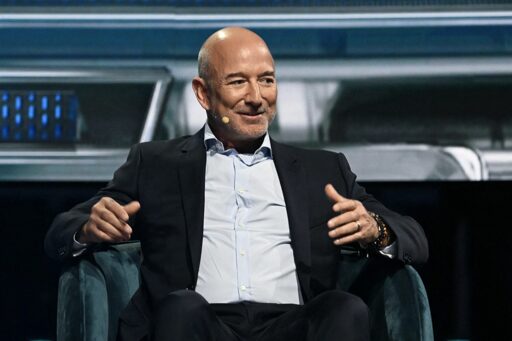
Amazon founder and Executive Chairman Jeff Bezos made news earlier this week by claiming the reason he fired 30 percent of the Washington Post’s staff and rebranded it as a more conservative media outlet is because its previous iteration was not a “profitable enterprise” and it needed to be. This is consistent with previous arguments he’s made as to why he moved the traditionally centrist—if neoconservative on foreign policy—newspaper more visibly to the right wing since Trump took office in early 2025.
SORKIN: Why lay people off at the Post? Why fire people?
BEZOS: Because the Post needs to be a profitable enterprise that stands on its own two feet
SORKIN: Does it? Some people say it should be a trust
BEZOS: Yes. It’s a measure of its relevance. If people aren’t paying for… pic.twitter.com/ENtR4t6S58
— Aaron Rupar (@atrupar) May 20, 2026
CBS News, after its parent corporation Paramount was purchased by the multibillionaire Ellison family last year, also had a similar, more overt right-wing rebrand, bringing in self-identified “zionist fanatic” Bari Weiss to run CBS News and crack down on stories deemed too critical of Trump while disciplining anything perceived as too progressive. This culminated with a much-mocked statement of “10 journalistic principles” a la Citizen Kane, followed by “5 guiding principles” for CBS Evening News, both of which read like LLM-generated marketing copy for a local Dodge dealership.
“Our foundational values of liberty, equality and the rule of law,” reads the third principle, “make us [Americans, presumably] the last best hope on Earth. We also believe in Franklin’s famous line about America as a republic—if we can keep it. We aim to do our part every night…”
The views for [the Washington Post’s] last 20 YouTube videos—combined—are less than the downloads I get for a single episode of my own podcast, which I record in my kid’s bedroom next to a stuffed elephant.
Both the Ellisons and Bezos—and their respective functionaries—framed their pivot explicitly in marketing terms. Which, of course, they would. Being ideological, or concerned with other unrelated business interests, is considered gauche and even may run afoul of securities law which requires them, at least in theory, to use business properties to expand the shareholder value of those invested in said properties, not unrelated business interests or their own ideological agendas.
But there’s only one problem with this alibi: there’s no evidence there’s a market for yet another generic, right-of-center publication pumping out Club for Growth and regime change schlock. The Post’s opinion page is now a dreary, manifestly unpopular torrent of stuffy Republican talking points with none of the vaguely populist appeal of raw MAGA-ism. Indeed, in the first year of the right-wing pivot, the Post still lost $100 million, which is roughly what it lost in 2024, the last year of its more center-left branding. Let us take a look at the sizzling view counts and viral sensationalism of their Opinion page rebrand, “Make It Make Sense”:

The Post, as I noted at the time for TRNN, purged its opinion page of its actually popular writers and replaced them with charmless Economist and Wall Street Journal also-rans so they can spew libertarian cliches, tedious anti-woke screeds and––for some reason––revisionist positive takes on Herbert Hoover.
Washington Post hip vertical content update!
- an unaccountably sweaty James Hohmann bashing Bernie’s wealth tax
- mindless cheerleading of Trump’s Iran attack
- Herbert Hoover (??) hagiography
- an unaccountably sweaty James Hohmann defending Congress trading stocks pic.twitter.com/sHV93GHjc4
— Adam Johnson (@adamjohnsonCHI) March 4, 2026
This is clearly the content kids these days are crying out for. Their X account for these videos often gets only one or two retweets, and the views for their last 20 YouTube videos—combined—are less than the downloads I get for a single episode of my own podcast, which I record in my kid’s bedroom next to a stuffed elephant.
CBS News ratings have similarly continued to decline since their anti-woke rebrand. This is most apparent with Weiss’ pet project, the revamped CBS Evening News, where she brought on her preferred company-man himbo, Tony Dokoupil, to awkwardly loiter in Real America-coded diners, Sparks and Steam factories, and other such homespun imagery, while delivering a recap of the day’s events with all the gravitas of a local plaintiff’s attorney commercial.
Dokoupil’s most notable journalistic contribution before being awarded the coveted Evening News anchor desk by Weiss was dressing down author Ta-Nehisi Coates and implying he was a terrorist because he wrote too sympathetically of Palestinians. This is consistent with Weiss’ history of promoting tabloid propaganda for Israel, and the Ellisons, who are the largest private donors to Israel’s military.
Ratings for CBS Evening News have declined by about 20 percent since Weiss’ Real American Values rebrand.
This “marketing pivot” narrative is largely repeated uncritically by US media, who all have to act like there’s nothing else going on but organic marketing concerns. “The billionaire newspaper owner, dissatisfied by years of losses, wants the newsroom to double productivity with half its budget,” read one typically credulous New York Times subheadline on his “shake up” of the Post.
This isn’t to say these oligarchs want to lose money on their ventures, but they want to be profitable within the narrow confines of very specific ideological goals that align both with other business interests and their own political agenda.
“What’s so confounding about the attempt to meddle with/potentially gut 60 Minutes is it’s arguably the one thing that’s working,” wrote Vanity Fair’s Aidan McLaughlin on social media incredulously about Weiss’ interventions. “10 – 12 million people tune into every episode. It’s the most watched primetime broadcast in America. Why destroy that audience?”
This “shaking up dying business model” framing is uniformly adopted by Weiss’ elite media peers. “For Bari Weiss critics two mull,” Axios co-founder Jim VandeHei wrote in January. “If your business is built on shows with shrinking audiences, made up of old people with shrinking years left, watching a shrinking medium w/ a shrinking future, it’s Mission Impossible. Only a revolutionary/radical shift can adjust this reality.”
But Weiss and Bezos’ right-wing turns have very little to do with ratings, clicks, eyeballs, or market demands. It’s not at all “revolutionary” or “radical,” it’s simply a more supercharged and nakedly ideological orientation of the typical pro-capitalist, pro-war media consensus the public has been fed for decades. It’s the same pro-corporate framing despite Americans growing increasingly populist on matters of economics; the same pro-Israel, pro-war schlock despite Americans becoming increasingly anti-Israel and anti-war. This dubious “market demand” framing was made most absurd when Weiss insisted last November that to win over Middle America—which she assessed had “lost trust” in mainstream media—CBS ought to hire the “charismatic” Alan Dershowitz, an 87-year-old Trump partisan best known for defending the increasingly unpopular Israel and befriending and apologizing for Jeffrey Epstein and pedophilia more broadly.
The reality is the Washington Post’s annual losses are only 0.03 percent of Bezos’ net worth. The Paramount purchase was less than 10 percent of the Ellisons’ net worth (and most of it wasn’t their money, in any event) and CBS’s right-wing turn has been essential to building political support for the Ellisons’ real prize: the purchase of Warner Bros. Discovery, which includes control over HBO and CNN. This isn’t to say these oligarchs want to lose money on their ventures, but they want to be profitable within the narrow confines of very specific ideological goals that align both with other business interests and their own political agenda. For Bezos it’s clear that means generic pro-capitalist, pro-war, more conventional Republican content. For the Ellisons, and Weiss, it’s pro-capitalist and pro-security state ideology mixed with anti-woke hobby horses like trans and college kid-bashing and, of course, defending and promoting the long-term PR goals of Israel. It’s under this rubric that these somewhat bizarre and manifestly unpopular rebrands make sense. They’re not chasing “middle America” or an increasingly cynical public turned off by mainstream media; they’re turning a relatively small part of their overall investment portfolio into an ideological playtoy, either to suck up to Trump, channel their their own right-wing grievances, shore up their massive security state investments, or—as is most likely the case—a combination of all of the above. It’s essential we understand this, or we’ll continue to misdiagnose what motivates these overt and illiberal media rebrands.
From The Real News Network via This RSS Feed.