


Sandra Hale Schulman
ICT
The latest: ‘A Question of Power’ at a centuries-old museum, top Native musicians to perform at new Springsteen Center, vintage and modern pottery
PHOTOGRAPHY: Diné women defeat massive power plant
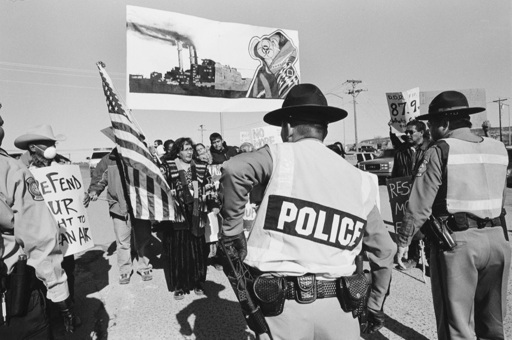
The power of protest hit the smoky air in January 2007 in Window Rock, Arizona. Diné men held signs that read, “Defend your right to clean air.” Diné women held American flags and faced off against police who had hands on their pistols.
A painted sign of a smoke-belching power plant loomed ominously in the background as a Diné woman looked pleadingly to the skies wearing a gas mask with a nuclear power logo.
The incredible scene was captured by photographer Carlan Tapp, a descendant of the Wicocomico tribe. Tapp documented the Diné struggle against power plants firsthand, and the power wielded by three Diné women to stop a giant corporation.
Tapp’s photographs and videos are now on view in “A Question of Power,” which runs through June 27, 2027, at the New Mexico History Museum in the circa-1600s Palace of the Governors building in downtown Santa Fe. Right outside the building’s walls are Native American vendors who have sold their handmade crafts under the Palace of the Governors portal for more than a century.
“I found a journalist who had been writing stories about this proposed Desert Rock power plant who told me to get in touch with Sarah White, a Navajo woman who was protesting the plant,” Tapp told ICT.

Photographer Carlan Tapp captured photos and video of efforts in the early 2000s to stop a coal-fired power plant near the Navajo Nation. His works are now on exhibit through June 27, 2027, at the Palace of the Governor’s building in downtown Santa Fe, New Mexico.
Credit: Courtesy photo
“I told her I am a documentary filmmaker and she invited me to tour the reservation area to see what was going on. Once I saw the tip of the iceberg it stunned me that this is really happening to these people and why. My moral compass knew this wasn’t right and I needed to get involved.”
Tapp followed three resilient Diné women — White, Lucy A. Willie, and Molly Hogue — who used their matrilineal power as land managers and sheep owners to keep their tribal lands safe from pollution and mining.
Over a period of several years, Tapp shot pictures and video as they defeated the construction of a coal-fired power plant known as Desert Rock Energy Facility within a stone’s throw from the Navajo Nation.
The exhibition features 40 photographs and interviews with Diné people. Between 2004 and 2011, Tapp documented in photographs, videos, and audio interviews the protests, the meetings the women had with tribal government, and the toll the pollution was taking on the people, land, and animals.
The women eventually defeated the plant and new laws were passed, phasing out coal in favor of clean energy.
MUSIC: Native musicians sing for The Boss
Top Native musicians will be the featured performers at the opening of the Bruce Springsteen Center for American Music June 3 at Monmouth University in Long Branch, New Jersey.
The Bruce Springsteen Center and Hard Rock International announced “The Native American Music Experience,” a free concert that celebrates the history and legacy of Indigenous music in America.

The Osceola Brothers are among the Indigenous musicians performing in a June 3, 2026, concert at the Bruce Springsteen Center for American Music at Monmouth University in Long Branch, New Jersey. Also performing are Spencer Battiest, Doc Native, Gary Farmer and the Dish and Spoon Band, Pura Fe’, Levi Platero, and the Julia Keefe Mildred Bailey Project. Credit: Photo courtesy Hard Rock International
The $50 million, 30,000-square-foot Springsteen Center will include a concert hall, an extensive gift shop and memorabilia from Springsteen and The E Street Band, as well as donated items from other musicians.
The center will serve as an archive for Springsteen, but will also explore American music with exhibitions, concerts and educational programming. Two additional concerts will be held on June 4 and June 5 featuring mainstream performers including Roseanne Cash and Jackson Browne.
Indigenous musicians performing in the June 3 concert include Spencer Battiest, Doc Native, The Osceola Brothers, Gary Farmer and the Dish and Spoon Band, Pura Fe’, Levi Platero, and the Julia Keefe Mildred Bailey Project.

Musician Levi Platero is among the Indigenous musicians performing in a June 3, 2026, concert at the Bruce Springsteen Center for American Music in New Jersey. Also performing are Spencer Battiest, The Osceola Brothers, Doc Native, Gary Farmer and the Dish and Spoon Band, Pura Fe’, and the Julia Keefe Mildred Bailey Project. Credit: Photo courtesy Hard Rock International
“Indigenous music is foundational to the story of American music,” said Robert Santelli, founding executive director of the Springsteen Center, in a statement.
“This concert kicks off our relationship with Hard Rock International and reflects our mission to explore the full breadth of American music. Our aim is to ensure that the voices and musical traditions of Indigenous artists are recognized, celebrated and better understood.”
Jim Allen, chairman of Hard Rock International, said in a statement that the concert will bring new attention to Indigenous music.
“On behalf of the Seminole Tribe of Florida and Hard Rock International, we are proud to partner with the Bruce Springsteen Center for American Music to increase awareness and understanding of Indigenous music,” Allen said.
“Seminole music and Native American music in general play a major role in the history and culture of America and the world.”
The Osceola Brothers are donating items for a permanent display — a guitar, a bass and a drum head with their logo on it. Cameron Osceola is donating a leather jacket worn for the cover of their album, “Remember to Remember.”
Battiest and Osceola said they were delighted to participate.
“We feel very honored to be a part of the event,” Cameron Osceola told the Seminole Tribune. “It’s really special to be acknowledged and that Native American musical contributions are coming into the mainstream. To have so many of these artists performing is really special. I feel like sometimes the underdog has to get the win.”
Battiest agreed.
“They asked us to join the all-star lineup for opening week,” Battiest said. “It’s a thrill to be on stage with some of our idols and I’m glad the museum has included the Seminole in their archives.”
Hard Rock International, which is owned by the Seminole Tribe of Florida, is supporting the Bruce Springsteen Center for American Music through financial contributions and memorabilia donations.
Tickets to the concert are free, though registration is required on the Springsteen Center’s website.
ART: Women Pueblo potters
A spotlight on women potters of the Southwest is the focus of The National Museum of Women in the Arts new exhibition, “Burnished: Pueblo Pottery at NMWA,” featuring 24 vessels created between 1939 and 2025.
The exhibition, which opened May 8 and will be on view through Sept. 27 at the Washington, D.C., museum, includes traditional pots such as bowls and seed jars with sculpted motifs, juxtaposed with museum acquisitions that reach across generations.

This natural clay pot by artists Lisa Holt and Harlan Reano bridges generations of Pueblo pottery with its natural clay and modern acrylic paint. It is among the featured pieces in an exhibition of Pueblo women potters at the National Museum of Women in the Arts in Washington, D.C. that runs through Sept. 27, 2026. Credit: Photo courtesy of National Museum of Women in the Arts
“‘Burnished’ honors Pueblo women potters and their multigenerational legacy,” Orin Zahra, associate curator at the National Museum of Women in the Arts, said in a statement.
“Painstakingly hand-coiled clay, painted and carved motifs, and stone-firing techniques point to an enduring and living tradition of pottery-making. This exhibition affirms Pueblo pottery as a vital expression of women’s creativity across time.”
A statement sent out by the museum notes that “for more than two millennia, Pueblo potters living in the southwest region of North America created clay jars and bowls for gathering, storage, gardening, farming, and for ceremonial purposes.”
It notes, “These works are not only functional objects but also carriers of cultural identity, community memory, and artistic sovereignty. Women makers are at the forefront of this work, often imparting their knowledge and practice to their female family members.”
The vessels featured in the exhibition include a 2025 jar by Cochiti artist Lisa Holt and Santo Domingo artist Harlan Reano, with brightly colored acrylic paint that blends traditional clay pottery with contemporary design.
The post INDIGENOUS A&E: Protest power, Natives meet Springsteen, women potters appeared first on ICT.
From ICT via This RSS Feed.