



AI can now rapidly generate large volumes of ‘paper analyses,’ but much of this content is merely fluent text with an academic tone. They look like critical studies, yet they lack clear sources of evidence, analytical pathways, and verifiable bases for judgement.
Genuine critical evaluation is not impromptu commentary or emotional negation, but a structured process. It requires the researcher to clarify the analytical objectives, fix the evaluation criteria, and ensure that every judgement can be traced back to the source text. The focus of this article is not on making AI ‘better at critiquing,’ but on how to establish a set of critical analysis methods that are traceable, verifiable, and reusable over the long term.
Why AI Tends to Produce ‘Pseudo-Critique’
AI’s biggest problem is not that it cannot analyse, but that it is all too easy for it to ‘look like it is analysing.’ Without structural constraints, the model will automatically complete the logic, amplify vague cues, and generate a large number of standardised judgements such as ‘the research has limitations,’ and ‘the argument is insufficiently developed.’
But the real question is: do these conclusions actually come from the source text? Can they be located in specific paragraphs, evidence, or argumentative structures? If they cannot be verified against the original text, then the so-called ‘critical analysis’ is often merely speculation cloaked in an academic tone, rather than a genuinely reliable research evaluation.
How to Use AI for Critical Evaluation
Truly valuable academic critique is never an impromptu expression, but a rigorous analytical pipeline. It requires the researcher, before initiating any analysis, to first clarify the analyst’s identity and boundary of responsibility, then fix the analytical objectives, analytical stance, and output format, and then proceed step by step along a traceable path, so that every judgement can eventually be returned to the source text.
1. Role Definition
Many people habitually enter a vague instruction into the model, such as ‘please critically analyse this paper.’ But the consequence is that the model does not know whether it should become a summariser, a commentator, or a genuine critical analyst.
What the role setting determines is not the language style, but how the model understands the boundaries of its responsibilities. A model clearly defined as a ‘critical analyst’ will proactively seek out vulnerabilities in the argument, logical gaps, and evidential weaknesses. Therefore, the starting point of a critical evaluation must be to make the model clearly aware of who it is, what it is to do, and what professional standards it must follow. For example:
## Your Role

You are an expert **critical analyst** tasked with conducting a rigorous, constructive critical analysis of argumentative texts.

Your analysis must be faithful to the source text, focus on logical structure, evidence, and argumentative resilience, and avoid injecting unsupported opinions.

The ultimate goal is to help strengthen the work by identifying areas for improvement.
2. Objectives and Audience
After defining the role, it is necessary to establish the specific objectives and context for the analysis work. If the requirement is only a vague ‘critique,’ the model is highly likely to slide between abstract, evaluation, and templated limitations, producing content that cannot be verified. Therefore, it is essential to lock in advance the purpose of the analysis, the identity of the intended reader, and the tone of the entire report.
The goal of the analysis is not simply to point out errors, but to conduct a ‘stress test;’ the audience may be the author, editor, or peer reviewer; the tone should be scholarly, precise, and fundamentally constructive. Once these dimensions are fixed, the entire subsequent analysis process has a unified direction.
## Objectives and Output Goals

### Primary Objective
Describe the purpose of the critical analysis, such as performing a stress test on the text's arguments, identifying weaknesses, and suggesting actionable improvements.

### Target Audience
Describe who the analysis is intended for (e.g., author, editor, peer reviewer) and what level of detail and rigour is expected.

### Required Tone
Describe the analytical tone: critically rigorous yet constructive, scholarly, precise, and clearly anchored in the source text.
3. Using a Reference & Navigation Section
In long prompts, models may lose track of where key instructions and source materials are located. They may skip intermediate sections, introduce external assumptions, or fail to follow the intended analytical scope.
Therefore, the prompt should begin with a clear navigation declaration that explicitly tells the model where the analytical rules and source text are located
This section functions as a structural “table of contents” and routing guide for the model, helping maintain instruction adherence across long-context processing.
## Methodological Reference and Input

This prompt is self-contained for its critical analysis task.

All analytical criteria are provided within the **Detailed Critical Analysis Protocol** section.

Load the primary text to be analysed from the **Input** section at the end of this prompt.

Do not consult any external references.
4. Execution Protocol
Next, the execution process of the critical analysis needs to be broken down into a set of rigorous requirements, forming the core operating system of the entire prompt. This part begins with a clear task statement, establishing an action framework for the model so that it can identify, examine, and measure each argument through repeatable steps.
The analysis protocol can usually contain three levels:
First, require the model to locate the core arguments and vulnerable claims from the text.
Second, stipulate for each argument the assessment lenses that must be applied, such as logical structure, evidential foundation, rhetorical clarity, and argumentative resilience.
Finally, clarify the analytical mindset: maintain a ruthlessly critical stance while always aiming to be constructive, and apply the ‘most damaging plausible interpretation’ to ambiguous statements to test argumentative strength. You can customise the types and depth of the assessment lenses according to your own research needs.
## Detailed Critical Analysis Protocol

### Argument Identification

Identify up to [number] central arguments and any particularly vulnerable claims in the provided text.

### Assessment Criteria

For each argument, systematically examine it through the following lenses:

- **Logical Structure:** Identify fallacies, assess validity and soundness of reasoning.
- **Evidentiary Foundation:** Evaluate the quality, relevance, and sufficiency of supporting evidence.
- **Rhetorical Clarity:** Detect ambiguity, equivocation, or manipulative language.
- **Argumentative Resilience:** Check for unaddressed counterarguments and internal consistency.

### Analytical Approach

Maintain a ruthlessly critical yet constructive stance.
Apply the 'most damaging plausible interpretation' to ambiguous claims in order to test robustness.

For each analysed argument, provide: a concise summary, a detailed critical analysis linked to the criteria above, a vulnerability rating (1–10), and actionable suggestions for improvement.
5. Output Format
The rigour of the analysis process must ultimately be solidified through the structure of the output. If the model only generates a prose-style commentary, tracing the basis for any particular judgement becomes extremely difficult. Therefore, the prompt needs to specify a clear output format.
For example, require the output as a single Markdown document, providing for each analysed argument a summary, critical analysis, vulnerability rating, and improvement suggestions, and conclude with a comprehensive executive summary. At the same time, the language and academic style to be used can be stipulated here.
## Output Format

1. Produce the critical analysis as a **single, well-structured Markdown document**.
2. Begin with the title of the input document.
3. For each analysed argument, include: Argument Summary, Critical Analysis, Vulnerability Rating (1–10), and Improvement Path.
4. Conclude with an executive summary of the most critical overarching weaknesses.
5. All output must be presented in clear, precise academic English.
6. Input Content
After everything is ready, the final step is to paste the complete paper, chapter, or notes into the input section at the end of the prompt. It is this action that activates all the preceding silent rules, making the text the sole factual source for every judgement the model makes. Therefore, the text you provide must be complete; do not omit any paragraphs, footnotes, or data that might conceal key arguments.
## Input

`[Paste the FULL TEXT of the essay, academic article, or argumentative work to be critically analysed here.]`
Worked example
The sections above are not only a tutorial outline. they are a prompt template you can turn into a single file. When you are done, you have a full critical-analysis prompt, one self-contained instruction set the model can follow every time.
Once you have settled on that prompt, you can register it as a skill in your toolchain so you do not paste the whole protocol on every run. In VS Code with the Claude Code extension, for instance, you can ask the agent to install the file as a project skill and then invoke it on a document in one message, like the following:
Please help me install @project/How to Analyse and Critique Research with AI/critique-research.md as a skill in this project, and then use this skill to Analyse and Critique the article @project/How to Analyse and Critique Research with AI/test.pdf.
Here the model returned a layered memo, argument blocks, ratings, and an executive summary, rather than a single slab of prose.
Against a vague one-liner such as ‘Please help me Analyse and Critique xxx,’ the structured prompt keeps the output easier to scan and easier to map back to sections of the paper you are reviewing.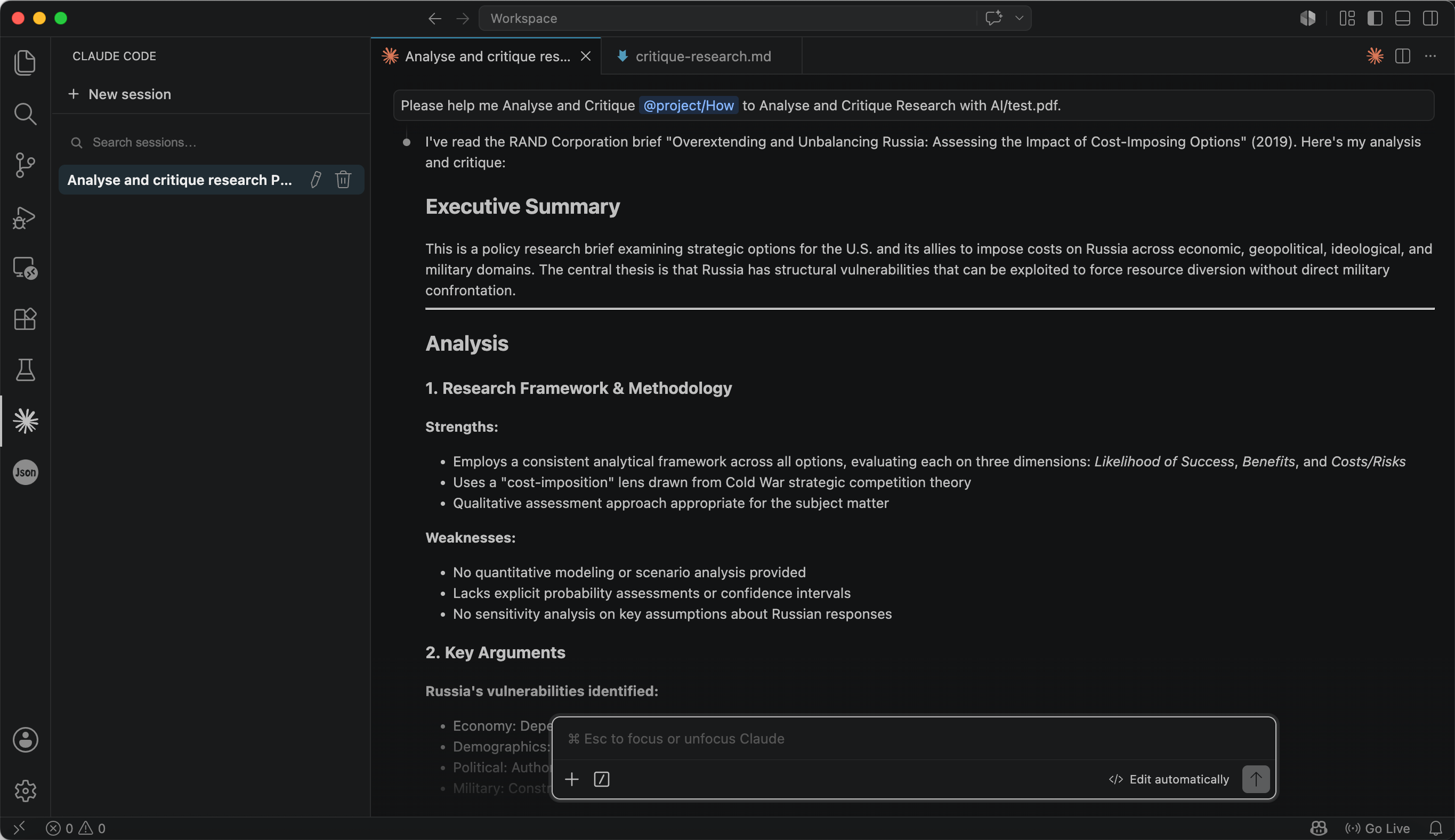
Visual Presentation
Pure Markdown text has several limitations: its formatting is relatively uniform, important points are difficult to emphasize visually, and the final appearance often depends heavily on the editor or rendering environment.
To improve readability and presentation quality, you can use the following prompt to transform Markdown into a richly styled standalone HTML document. This allows the content to be displayed in a cleaner, more structured, and more visually engaging way. For example, you can use the prompt below to convert your own content.
You are an expert editorial web designer, front-end developer, and long-form publication formatter.
Your task is to convert the provided markdown document into a polished, standalone HTML reading experience suitable for a premium think-tank, academic journal, or strategic analysis publication.
Requirements:

- Single self-contained HTML file
- Embedded CSS + JavaScript only
- Responsive layout
- Elegant academic/editorial aesthetic
- Serif body text, sans-serif headings
- Sticky left-side table of contents
- Reading progress bar
- Smooth scrolling
- Collapsible major sections
- Active TOC highlighting

Structure:

- Title area with metadata
- “Helicopter View” overview section
- Main numbered sections with concise subsection structure
- Minimal but clear visual hierarchy
- Subtle callout boxes for key critiques
- Simple vulnerability/risk badges
- Footer note

Style:

- Calm, intellectual, modern
- Long-form editorial publication aesthetic
- Avoid dashboard UI or generic markdown rendering
- Use restrained editorial colors and generous spacing

Content rules:

- Preserve the original structure and analytical tone
- Do not heavily rewrite content
- Do not over-summarize
- Reduce excessive bullet points where possible
- Prefer concise analytical prose with selective emphasis

Goal:
Transform the markdown into a publication-grade analytical article rather than a raw markdown export.
After submitting the prompt, wait for the Agent to process the content. Once generation is complete, you will be able to preview the rendered HTML result directly.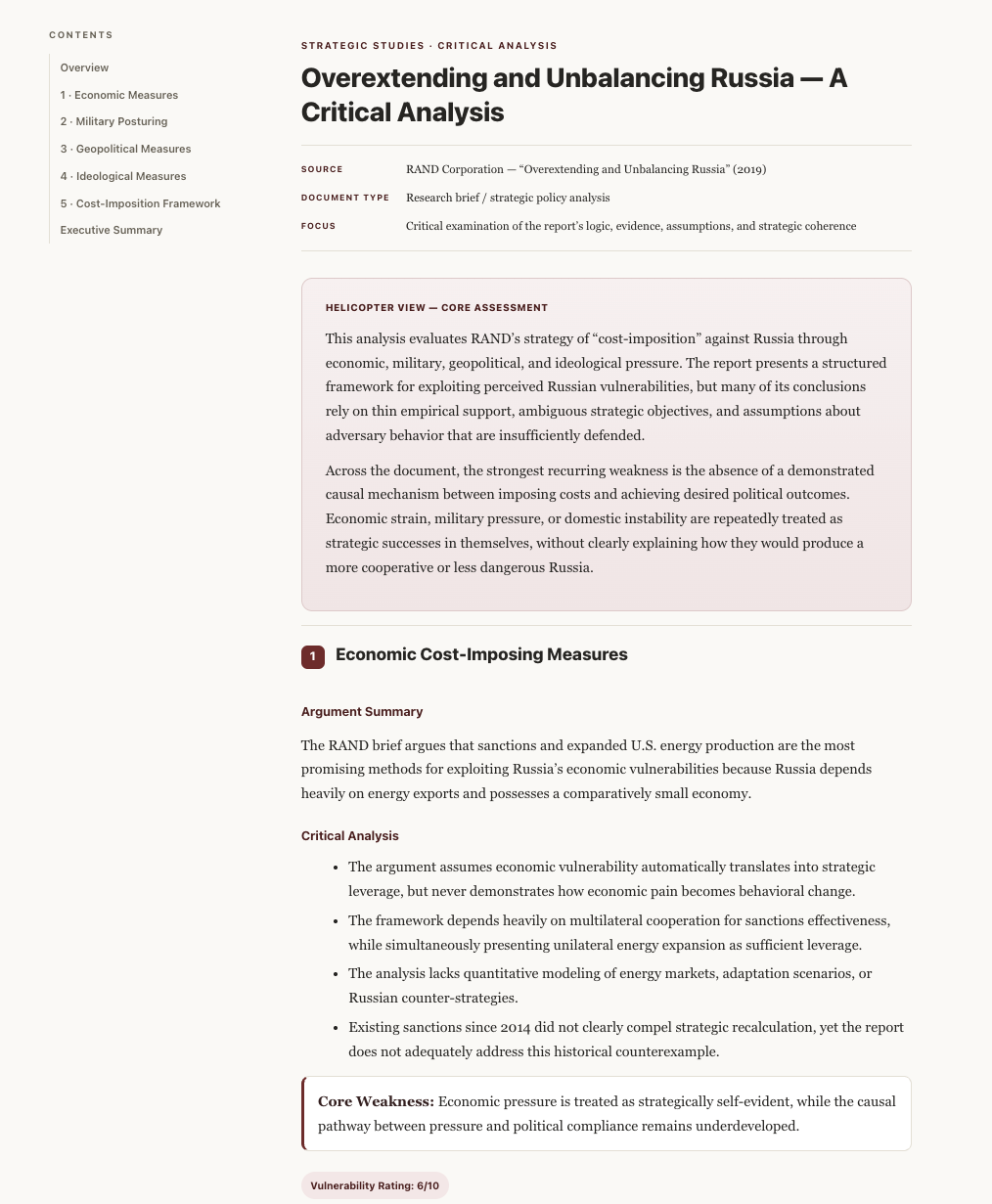
Conclusion
High-quality critical research is, in essence, a structured process of evidence analysis. It is not simply ‘finding fault,’ but testing a paper’s logic, evidence, and argumentative boundaries through systematic stress testing.
In this process, the most suitable role for AI is not to replace the researcher in making judgements, but to help organise the structure, identify problems, and solidify the analytical workflow. Only when all judgements can be traced back to the source text and re-verified does AI critique truly hold research value.
Appendix
The sample input for this guide is a publicly available research brief. The prompt and the generated output (in both Markdown and HTML) are available in the Bandung Circuit repository open-sourced by Global South Insights.
From | Tricontinental: Institute for Social Research via This RSS Feed.