

About six years ago, law students at the University of the South Pacific convinced the government of the small island nation of Vanuatu to take the harms wrought by climate change all the way to the International Court of Justice, the world’s highest legal authority. Vanuatu, along with the students, waged a campaign to convince the court that climate change was a human rights issue and that countries have a legal duty to protect the planet for future generations. In 2025, the court sided with them unanimously. In a legally nonbinding advisory opinion, it ruled that the failure of countries to tackle climate change is a “wrongful act” and that other nations harmed by a warming planet may seek reparations.
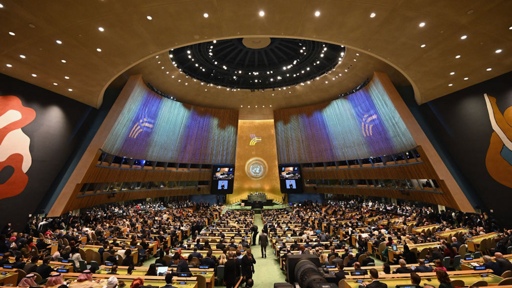
Now, the effort has notched another win. On Wednesday, an overwhelming majority of countries in the United Nations voted to adopt a resolution backing the court’s ruling. The historic decision signals the political support behind the court’s finding that countries have a legal responsibility to address climate change, reduce its impact, and offer reparations to those it has harmed. More than 140 countries voted in favor of the resolution. Just eight — including the United States, Iran, Israel, Saudi Arabia, and Russia — voted against (28 countries abstained from the vote).
“This must be a turning point in accountability for damaging the climate,” said Vishal Prasad, director of the Pacific Islands Students Fighting Climate Change and one of the law students who campaigned to take the case to the International Court of Justice, or ICJ. “The journey of this idea from classrooms in the Pacific to The Hague and the United Nations gives us continued hope that when people organize, the world can be moved to act.”
The near-unanimous decision is a strong signal that multilateral cooperation on climate change has not completely unraveled. Over the past year, global unity on reducing greenhouse gas emissions has proven shaky. After Donald Trump’s administration announced it would withdraw from the Paris Agreement, the United States has actively opposed climate action. Last year, it derailed countries that were close to setting a carbon tax on the shipping industry, which is responsible for about 3 percent of the world’s carbon emissions. A deal to regulate the industry’s emissions now seems uncertain. The U.S. has also helped kill a cap on plastics production and berated the International Energy Agency into projecting future energy demand under a scenario that climate action will stall out.
“The unity and clarity expressed by the vote was striking,” said Nikki Reisch, director of the Center for International Environmental Law’s climate and energy program. Reisch said the resolution puts “political weight behind legal norms” and will help translate the international court’s conclusions into practical action. “It will become another pillar and proof of political backing for action and accountability.”
The Trump administration also mounted a campaign to block the United Nations from adopting the landmark international court ruling. In February, the State Department sent a missive to all consulates and embassies noting that it “strongly opposed” the U.N. resolution and that its adoption “could pose a major threat to U.S. industry.” In remarks ahead of the vote, Tammy Bruce, a former conservative radio host and now deputy representative to the U.N. in New York, said that the resolution is “problematic” and that “the United States continues to have serious legal and policy concerns” about it.
“The resolution singles out certain groups for preferential treatment and makes alarmist political statements, such as the idea that climate change is an unprecedented challenge of civilizational proportions,” Bruce said. “Such hyperbolic statements are not appropriate in a resolution on an ICJ advisory opinion.”
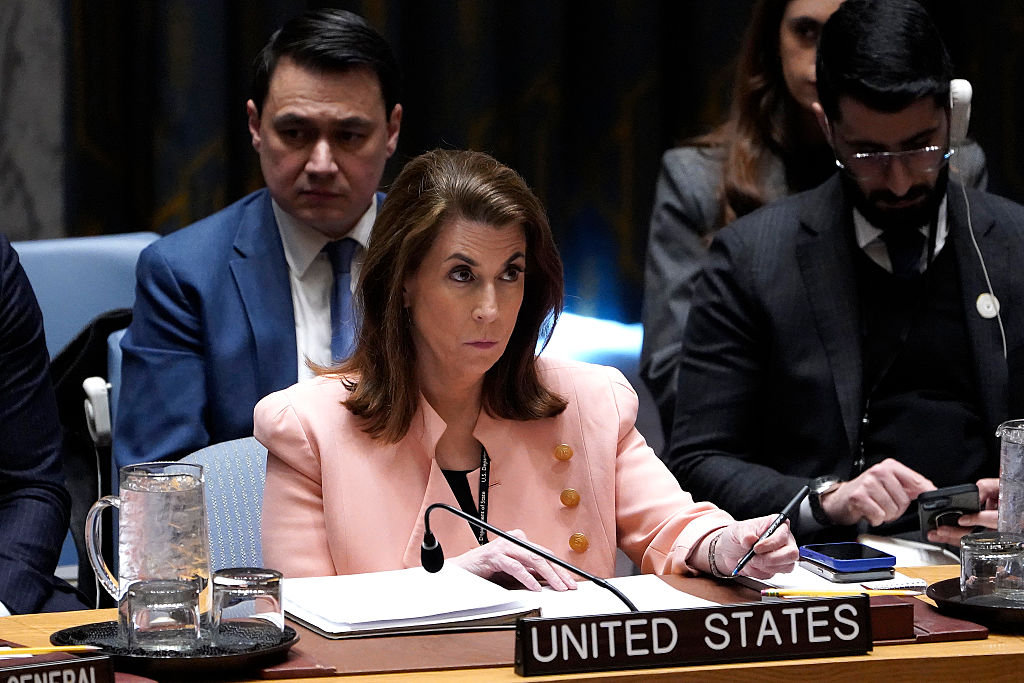
Tammy Bruce, deputy representative of the United States to the U.N. in New York, said the resolution is “problematic” and “makes alarmist political statements.” John Lamparski / Getty Images
The resolution reiterates the International Court of Justice’s core findings and calls on countries to implement measures to keep global temperature rise to 1.5 degrees Celsius (2.7 degrees Fahrenheit) while transitioning away from fossil fuels. It also affirms that nations must fulfill their climate obligations and that those countries harmed by others’ inaction are entitled to seek redress. Finally, the resolution calls on the United Nations’ secretary-general to submit a report next year on ways to comply with the international court’s findings. The resolution, like most U.N. resolutions, is not legally binding; rather, it’s intended to signal political priorities or views.
The U.N. vote comes as countries are cracking down on climate activism and litigation. In Aotearoa New Zealand, the government moved to amend climate laws to limit civil court proceedings against major greenhouse gas emitters for climate-related harm.
Māori climate advocate Mike Smith is among those whose cases could be affected. Recent reports have found that land theft and colonization have exacerbated the effects of climate change on the Indigenous Māori people, who are more likely to be affected by extreme weather events. Smith is currently pursuing high court proceedings against six of Aotearoa New Zealand’s largest greenhouse gas emitters, and he describes the U.N. vote as a “major shift,” arguing it reflects a changing understanding of climate change not just as environmental damage, but as something with legal consequences.
“We know as Māori that the islands are part of our journey across the Pacific that’s led us here to Aotearoa,” he said. “New Zealand has a responsibility to stand with Pacific countries like Vanuatu, Kiribati, Tonga, and Tokelau. Not just symbolically, but in supporting stronger legal and international action on climate harm.”
Although the U.N. vote is a victory for Indigenous activists from the Pacific and beyond, they believe that many countries still must be pushed to uphold their climate obligations.
“The law is clear that climate action cannot sit on the shelf, it must be turned into action,” Prasad said.
The Indigenous News Alliance contributed reporting to this story.
This story was originally published by Grist with the headline In a rare show of global unity, countries adopt landmark climate ruling on May 22, 2026.
From Grist via This RSS Feed.
Its a funny world