

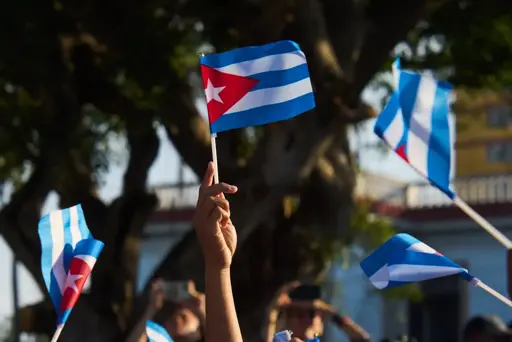
President Trump has ratcheted up imperialist aggression against Cuba. On May 20, the United States issued an indictment against former leader Raúl Castro, a move many analysts see as a pretext for a military intervention. On May 21, a U.S. aircraft carrier, USS Nimitz, arrived in the Caribbean.
Trump’s foreign policy has been marked by his attempt to aggressively reassert U.S. dominance over Latin America and the Caribbean, a part of his “Donroe Doctrine.” Cuba, and the example of resistance from its 1959 revolution, is now the main target of Trump, as well as longtime anti-communist hardliner, Secretary of State Marco Rubio. The recent escalations come after months of the administration fueling a humanitarian crisis by cutting off oil to Cuba. As La Izquierda Diario editor, Diego Dalai told Left Voice in a recent interview:
there have been major blackouts across the country — some even occurring simultaneously throughout the entire territory — lasting many hours, day after day, which causes very serious hardships for the population. It’s not just about being without power at night. Being without power for 20 hours means perishable food spoils; it means water tanks stop working to supply neighborhoods where water doesn’t reach by gravity. Hospitals, for example, remain only partially operational using electric generators that are far less efficient than the general power grid. In fact, thousands of scheduled surgeries have had to be canceled, including for children.
Patients who rely on medical devices have had to be supplied with an electric generator or solar panels in their homes. Universities have switched to online classes, affecting the entire academic year; in fact, there have been protests by students who realize they will fail the year. Every aspect of daily life is affected.
In addition, there has been an increase in U.S. surveillance planes around Cuba, similar to activity that preceded the U.S. kidnapping of Venezuelan president Nicolás Maduro and the start of the U.S./Israeli war on Iran. It is possible that the kidnapping of Maduro, which has enabled the United States to quickly turn Venezuela into a U.S. protectorate, is the model of intervention that Trump hopes to recreate in Cuba.
Though the ruling bureaucracy in Cuba acts as an obstacle to defending the Cuban revolution, with its pursuit of capitalist restoration and suppression of any independent activity of the working class, the United States has no right to meddle in Cuban affairs. U.S. imperialist penetration into the country can only bring greater misery for the Cuban people.
Imperialist Arrogance
The indictment against Castro is a case of peak imperialist arrogance. It alleges that Castro ordered the downing of two civilian aircraft flown by Cuban exiles in 1996. What the indictment doesn’t mention is that these exiles were invading Cuban airspace as part of a CIA-backed regime change effort. The Trump administration has the nerve to issue this indictment while the U.S. military continues to bomb civilian fishing vessels it accuses (with no proof!) of drug trafficking.
The indictment against Castro is part of a larger pattern of the United States violating other nations’ sovereignty by doing whatever Trump sees fit to neutralize adversarial political figures, whether that’s kidnapping (in Venezuela), assassination (in Iran), and lawfare (in the case of Castro as well as former president, Evo Morales in Bolivia). The revelations of Hondurasgate, which unearthed a plot by Trump and far-right allies to interfere in Latin American elections, show just how far U.S. imperialism will go to control the region long seen as its backyard.
All of these developments make it increasingly likely that a U.S. military intervention in some form is a matter of when, not if. It’s possible that the only reason Trump hasn’t attacked Cuba yet is because he’s been bogged down by his failed attempt at regime change in Iran. But it is also because Trump humiliated himself and the entire United States in Iran that he may be even more inclined to attack Cuba, attempting what he sees as an easier foreign policy win ahead of the midterms.
Turning Opposition into an Anti-War Movement
An attack on Cuba might play to the reactionary Cuban exile community in Miami (an important base of support for Trump), but it won’t play to the U.S. public which understands how rising fuel prices are a direct result of Trump’s failed war on Iran. Americans increasingly oppose constant military interventions, and this is the case even among sectors of the Republican Party. This shift can be seen in Trump’s plummeting approval rating and a recent symbolic vote in the Senate where, for the first time, a War Powers Resolution was passed after four Republicans broke with their party.
Passive opposition to Trump’s warmongering, however, is not enough. Congress cannot be trusted to curb Trump’s interventions. Republicans and Democrats alike support U.S. imperialism and fund the war machine, even if they have tactical disagreements with how Trump carries out U.S. foreign policy.
To stop the endless warmongering, socialist organizations, unions, and the student movement which mobilized against the genocide in Gaza need to build mobilizations against Trump’s interventions in Latin America. These forces uniting and championing strong, anti-imperialist demands can turn the widespread passive opposition to intervention into a powerful anti-war movement. We can also draw inspiration from the general strike and Indigenous-led protests that are growing in Bolivia. These protests are an important reminder that class struggle is the way to resist imperialism. Trump’s aggression can be defeated, but it will take the unity of workers and broader anti-imperialist and anti-war sectors uniting across the Americas, from La Paz to Havana to the streets in the heart of imperialism. That is what solidarity with Cuba must look like.
The post Trump’s Latest Escalations against Cuba Show the Urgency of Building an Anti-War Movement in the Streets appeared first on Left Voice.
From Left Voice via This RSS Feed.