

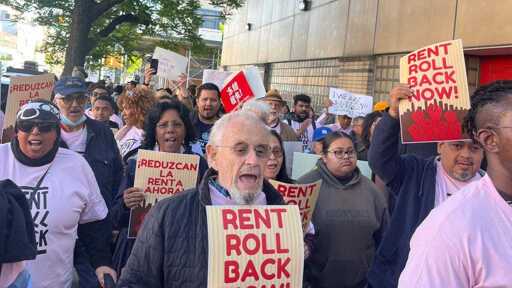
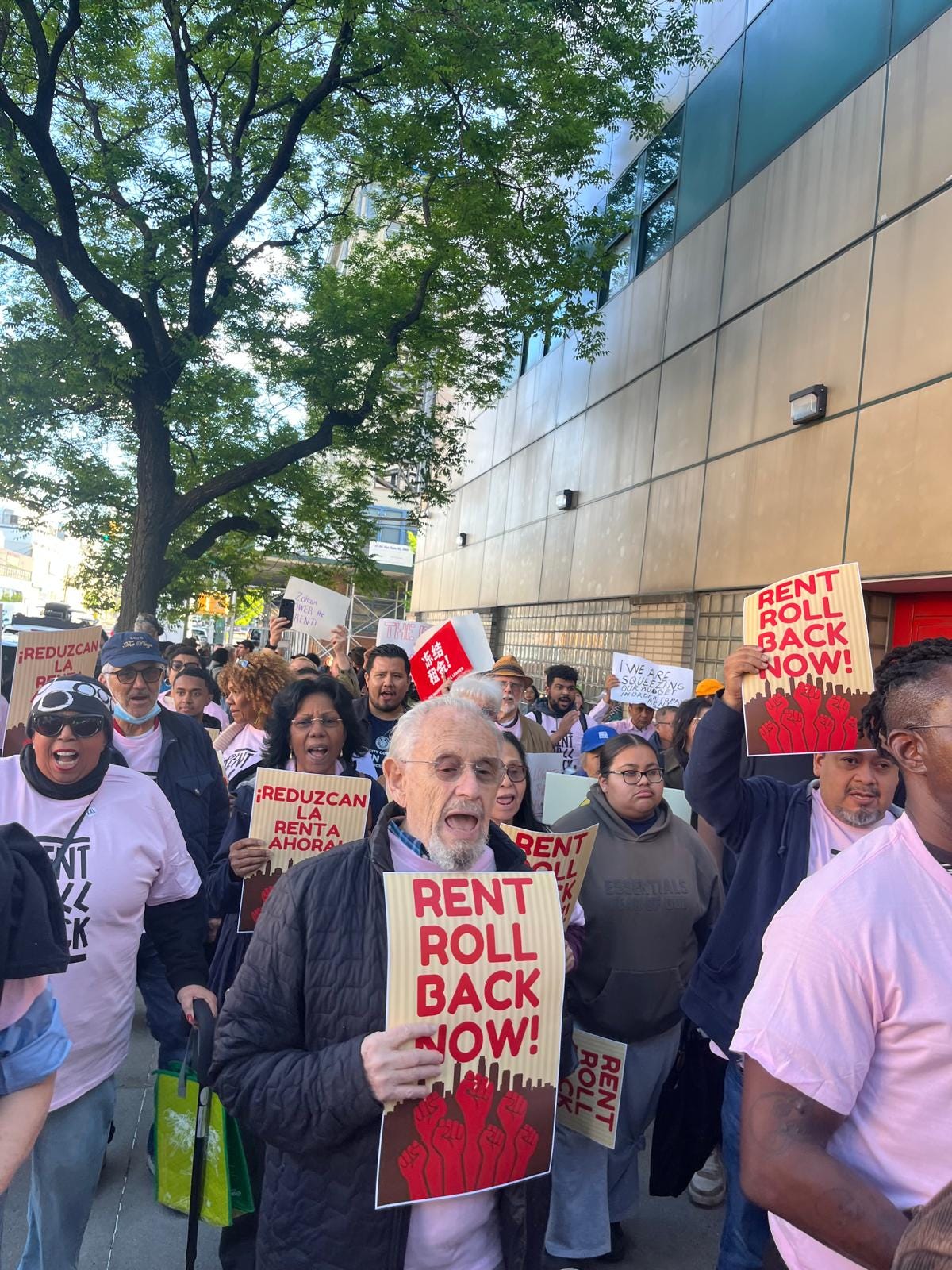
Tenants advocating for the rent to be rolled back before the 2026 Rent Guidelines Board’s preliminary vote
The following is an internal circular I wrote for NYC-DSA’s Tenant Organizing Working Group (TOWG).
Context: The Rent is Too Damn High
Thursday, May 7th was the preliminary hearing and vote of the much-anticipated 2026 Rent Guidelines Board, held at CUNY’s LaGuardia Community College. The nine-person board–of which five are Mamdani appointees–is, ostensibly, an independent body, tasked with adjusting the rents of rent-stabilized apartment units according to maintenance costs, landlord profits, and tenant hardship, as determined through quantitative analysis and testimony. As socialists, we know that a state body mediating class conflict can never be ‘independent,’ but instead that claims and intentions of independence have their own consequence and therefore inform nuanced interventions by us, as class partisans. Famously, Zohran ran on a platform of freezing the rent. The board voted on Thursday to set a preliminary range–which is subject to overrule–between 0 and 2% increases for 1-year leases and between 0 and 4% for 2-year leases, opening up a pathway for the meeting of the mayor’s campaign promise.
A comrade said that these results (settled on after proposals for both a higher increase and a reduction–that is, a rent rollback–were voted down) reveal that there are only “3/9 votes that are categorically opposed to rent hikes.” And that otherwise, the board, despite our socialist mayor and significant mobilization from the movement, remains committed to the “iron laws of neoliberal economics.” The extent to which the RGB can be wielded to effect populist reforms and the degree of its intransigence in maintaining (moderating, perhaps, but also reproducing) class conflict are very active questions. Can we progressively transform the Board towards our socialist politics, or must we more dutifully attack it as a bastion of technocratic class rule? Somewhere in between, perhaps?
Many news outlets covered the preliminary vote, but sharing one article from Reuters helps highlight my next point: the competing demands within the tenant movement.
The Tenant Movement’s Two Tendencies
The RGB doesn’t just serve to mediate class conflict and determine rent-stabilized rents; as friend of the movement, Greg Baltz wrote the other day, “the RGB’s public hearings are not just a forum for tenants to exercise influence or make themselves heard. They provide a predictable, recurring platform for sectoral mobilization: for tenants to unite with tenants from outside their own buildings, develop leadership capacity, and join in broader political fights.”
And with sectoral activity comes inevitable (though not unhealthy) factionalism–different groupings within the movement, operating within this bounded arena, driven by different analyses, politics, and composition, producing distinct, possibly conflicting goals. This year’s RGB is exemplary: on Thursday, before the hearing, there were two press conferences held by competing–though by all accounts comradely–factions of the broader tenant movement. The first, led by NYC-DSA and TenantBloc (sister organization of the statewide coalition, Housing Justice for All), proclaimed their demand for a Rent Freeze. TenantBloc’s rent-freeze campaign preceded, and in many ways legitimized, the mayoral campaign of Zohran Mamdani. This press conference was, in comparison to the one that followed, better resourced (with a band and a full professional audio setup), had slightly more people in attendance, and featured a much less referential agenda in that the press conference that was to follow was not mentioned at all.
Following this, the Rent Justice Coalition (RJC) presented the demand for a Rent Rollback. RJC, including members from independent tenant unions such as the Union of Pinnacle Tenants and the Crown Heights Tenant Union, as well as organizations like Youth Alliance for Housing and Chhaya, argued that tenants deserved a rollback. Eric Adams raised our rent by 12%. Conditions in that time have not improved by 12%, nor have wages. RJC has been the coalitional body through which the tenant movement has engaged the Rent Guidelines Board for the last three decades. But this year, RJC voted for a rollback, whereas the newcomer on the scene, TenantBloc voted to push exclusively for a freeze, bucking the longstanding trend of RJC functioning as the tenant movement’s sole RGB vehicle. There is much overlap between the two formations and in the lead-up to Thursday’s hearing attempts were made to negotiate a shared press conference, but this, for both logistical and political reasons, fell flat.
The political calculus here is quite interesting, though the differences between the two haven’t–to my mind–been properly elucidated; these are tactical differences that are, in fact, rooted in distinct political theories and analyses of the moment. On one hand, in pushing for a rent freeze, TenantBloc is making three claims: (1) that tenants have voted, in the form of Zohran, for a rent freeze and it’s the movement’s responsibility to follow that through; moreover, activists pushing this demand have described to me how the movement is so often lacking in ‘wins’ and winning this would embolden and grow the base. (2) Related to the first, that the movement is responsible for the mayor’s election; this faction of the movement has–their leadership at least–regular meetings with the administration and direct contact with Zohran’s housing officials, and as such see themselves in a position of ‘co-governance.’ This compels a general reticence to criticize or oppose the mayor (or to risk seeming to do so). What exactly this co-governance means in practice is an open, active question. (3) Lastly, there is a sense among this faction that, while landlord and real estate overreaction to real and perceived threats is evergreen, a rollback, if voted forward by the board, would face an even more severe response and might lead to a drawn-out and possibly constitutional legal battle. The latter of which might, they claim, given Supreme Court composition, call into question the very legal framework of the 2019 HSTPA reforms and rent stabilization more broadly (an ongoing dream of the landlord lobby). Additionally, the closure of the Strait of Hormuz, they fear, will drive up landlord oil costs and the ostensibly independent RGB (mandated to consider such costs) might be less amenable to a freeze and therefore its demand requires pinpoint focus.
Possibly the best articulation of the broader program of this faction was put forth by Cea Weaver just a few days before Zohran’s election(and Weaver’s move from HJ4A director and NYC-DSA leader into the administration is similarly a good illustration of points 1 and 2). In this piece, Weaver envisions a city government that could “intervene to stabilize volatile markets and act as a counter-cyclical force that puts housing quality first and property values second. It can use this power—to acquire rent-stabilized housing as a market actor—to drive down costs for operators and improve housing quality across New York.” This is the gradual project of developing city capacity–both in terms of administration and capital–so as to function not only as an interventionary force but eventually (again, still) as a social housing developer in its own right; this approach places the development of municipal capacity at the center of its project, subordinating much else. As such a confrontation with the state in its class-conflict mediating character or a project to transform or abolish aspects of it (like the RGB) are adjacent if necessary at all. Moreover, this program sees the empowerment of the municipal government as the means to succeed in the class struggle between tenants and landlords, rather than a particular terrain on and through which that struggle takes place.
In contrast, RJC’s rent rollback demand rests on three competing claims: (1) that while, yes, tenants would love a rent freeze, they would love–and deserve and moreover need–a rent reduction that much more; the election of Zohran was not merely a mandate for a freeze inasmuch as it represented a declaration of tenant power. (2) That the movement’s role is to push the status quo, the powers that be, further. The most recently effectuated rent freezes–under De Blasio–were preceded by RJC rollback demands. This reflects a clear orientation of political independence. (3) That landlords have been making tremendous profits, both over the long-run and in the more recent past; RJC, as articulated clearly in their demand letter, is arguing here that the actual longstanding logic of the board merits interrogation and transformation; as the letter puts it: the RGB’s normative function has created “a circular calculation in which landlord income growth is discounted using an index partly driven by that same growth. Adjusting for inflation in this way understates the real increase in landlord profitability.”
Here, the rollback faction assesses the municipal government as a non-neutral terrain of class struggle and mediation–where the legal form of the state, here the RGB, is itself a condensation of class antagonisms. The ‘entrenched neoliberal logic’ alluded to above speaks to this: as the practical constitution of the RGB–its mandate to ‘balance’ landlord costs and profits with tenant wellbeing–is itself paradoxical, inimical to tenant democracy, and constitutes a veil for landlord profiteering–and as such calls for radical restructuring. The demand for a rollback is accompanied by another for “the City and RGB to commission a study on landlord profits and tenant budgets that examines the extent to which existing RGB metrics systematically overstate landlord cost burdens and understates tenant financial hardship, thereby providing a clearer empirical basis for future RGB decisions.” The programmatic approach of RJC seems to prioritize rent control over the development of municipal capacity. Rent control is a tool that can be wielded by the tenant movement rather than a city capacity employed by the city to intervene into the struggle between landlord and tenant classes. While social housing and rent control are generally compatible demands and socialist projects, in hinge points such as this, where their prioritizations come into conflict, deeper political distinctions are revealed.
NYC-DSA and the Tenant Movement
Now the Tenant Organizing Working Group (TOWG) has as its mandate the building, supporting, and cohering of independent tenant unions across the city; we build and fight for independent, democratic, working-class tenant organizations. We have done much work to this end. We’ve helped start tenant unions and many of our organizers are active members of independent tenant unions in the city. We’ve helped socialists become tenant organizers and vice versa, and we’ve helped organize citywide tenant assemblies to connect these unions toward more cohesion and higher terrains. But the chapter we are a part of, NYC-DSA, particularly its right-wing and its leadership, has very close ties with Housing Justice 4 All and TenantBloc. It’s in this context that we can better understand the recently passed campaign proposal–authored by this leadership faction–for a rent freeze; this proposal, interestingly, makes no mention of the competing rent rollback campaign. All the same, in the days following its passage, and just as the rollback letter linked above started circulating, the chapter’s Steering Committee–never too communicative with our working group–reached out to our OC to remind us that the chapter had passed the rent freeze campaign and therefore our working group was forbidden from signing onto the rollback demand. We in TOWG were only consulted on the rent freeze proposal after it had been drawn up, a curiosity, seeing as though the campaign concerned tenant organizing almost exclusively; we gave suggestions on the proposal, most of which were rejected, a select few of which were incorporated, these being our inclusion in aspects of the campaign, and helping direct interested rent freeze activists toward tenant organizing.
What was most frustrating about this proposal’s quick passage was that the competing demands were not allowed to be debated or deliberated on by the rank-and-file of the chapter. The rent rollback demand contains legitimate political arguments that were not allowed to be heard. This was, to some degree, our (TOWG) own fault; we had just elected a new organizing committee and were, in my estimation, caught flat-footed by the rent-freeze proposal. But also, it was a product of a more ingrained working-group culture that borders on do-the-workism, where we sometimes strip our work of its many-sided political nature and shy away from proactive engagement with higher-level (internal and external) politics; this orientation has been further entrenched after the Anti-War Working Group saga. But just as much, it was the product of our chapter’s more general democratic deficit; connected, entrenched leadership are able to push through initiatives quickly and ruthlessly; the chapter rank-and-file is left largely unaware of political maneuvering and political arguments that dictate where and how chapter capacity is directed.
Nonetheless, our working group suddenly faced a peculiar constraint: we work with the city’s independent tenant unions, and understand our political project to be intertwined fundamentally with that of these TUs; and the city’s independent tenant unions are, almost to a tee, in favor of a rollback. But because of our location, we could not (and cannot) outwardly or explicitly, as a formation, support the rollback demand. And, because our project is also one of building a bastion of tenant power within NYC-DSA, this also means we are now actively engaging with–with the best of intentions–a demand that the tenant unions we ostensibly support are unanimously counter to.
This conundrum brought about some existential questions for the working group. Some in the working group have questioned what our role and value are, wholesale, if our solidarity with independent tenant unions was not a clear given. Others pushed back on this, saying that solidarity is never assumed, always a work-in-progress. I emphasized that these contradictions, tensions, and cleavages have existed long before this year’s RGB campaign: that the interlocking landscape of NYC’s socialist left and tenant movement is complex and that Zohran’s election has intensified the stakes and brightened the spotlight on the many contours of this ecosystem. That being said, it is clear that the political reality of a socialist mayoral administration has not only raised the stakes of political debates but has also deepened the political logics on various sides.
So what do we do? Mostly, continue on: building out the sort of protagonistic tenant unions and formations that we do; building relationships and organizations that can sustain and flourish, that put tenants together in control. But also, it behooves us as a working group and as socialist tenant unionists to develop our political analysis of what we do and of the many-sided landscape in which we organize. One of my favorite things about the tenant union movement, and one of the true hallmarks of this protagonism that we so celebrate, is the constant connecting of our daily work (the fleshy, messy stuff as Cindi Katz would say) to the heights of high politics, and recognizing and making meaningful the movement between the two. We like to say that politics happens in the building lobby, in the stairwell, on the stoop. But we also ought to recognize that politics is happening in our chapter, around us, is structuring our possibilities as a working group, is also happening in how we relate, as a working group, to the various tenant organizations and unions across the city, as well as to the new mayoral administration. This (now longwinded) email is one attempt at helping us flesh out our sense of the many layers and I encourage replies, critiques, etc.
From The Socialist Tribune via This RSS Feed.