


One Manchester-based grassroots campaign group has spent over a year pressing Siemens PLC on its role in sustaining Israel’s occupation. It says Siemens’ pained responses and denialism amount to little more than corporate stonewalling. The group shared the full correspondence trail with the Canary.
Didsbury for Palestine (D4P), a community campaign group based in Manchester, has issued a series of increasingly urgent demands to Siemens PLC. Siemens has been a BDS target for many years.
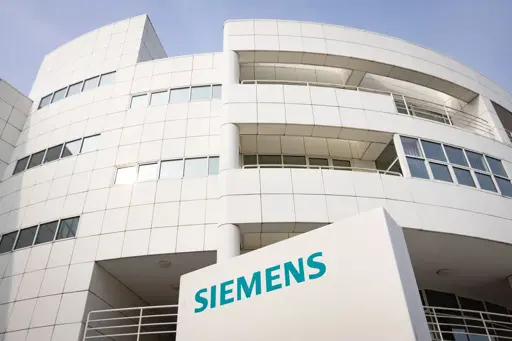
Siemens’ UK headquarters sit on Princess Road in Didsbury, south Manchester. Separately, pro-Palestine direct actionists targeted Siemens’ Cambridge offices in October 2024
D4P calls on the multinational technology giant to end all business activities which the group says contribute to human rights violations in occupied Palestine. It faced twelve months of correspondence, held peaceful protests, and made repeated requests for a face-to-face meeting — all rebuffed or ignored.
D4P says Siemens has failed to provide a single piece of concrete, citable evidence that its operations comply with international human rights law.

Didsbury for Palestine standing strong in the rain — via D4P’s Instagram
One year of stonewalling
The campaign launched on 21 May 2025, when D4P delivered its first letter by hand to Siemens’ Didsbury head offices, addressed to the company’s CEO Dr Carl Ennis.
The letter set out a damning catalogue of concerns:
- Siemens’ supply of rolling stock for Israel’s A1 railway line, which crosses into the occupied West Bank on confiscated Palestinian land;
- Potential complicity in the Great Sea Interconnector energy project, which D4P says will supply electricity to illegal settlements; and
- The provision of surveillance equipment — including radar, control systems, and night vision technology — to the Israeli Prison Service for use in Israeli facilities. These include Ktzi’ot Prison, where Palestinian detainees — including children — are reportedly held without charge, tortured, and starved.
Ennis did not respond.
On 30 July 2025, D4P wrote again. This time, the group warned that a peaceful public protest would follow if Siemens continued to ignore them. D4P noted that Manchester City Councillor Richard Kilpatrick of Didsbury West (Lib-Dem) had offered to facilitate and mediate a meeting. Still, no meeting was offered.
On 5 August 2025, more than two months after the original letter, Siemens’ Head of Communications, Karen Fenwick, finally replied.
Partial admission of complicity
Her letter expressed “deepest sympathy” for those who had suffered casualties and referenced a €1m donation to the International Red Cross. (The same IRC repeatedly targeted by Zionist munitions.) Fenwick announced that Siemens was “applying heightened due diligence” in relation to the occupied territories.
According to international law, any commercial activity in illegally occupied territories, especially co-ordinated with the illegally occupying entity, which Israel is, should not take place and is considered illegal.
Fenwick confirmed that Siemens was supplying Double Deck Electrical Multiple Unit (DDEMU) trains to Israel Railways and maintaining them under a long-term contract from 2018. She denied involvement in the Israeli Prison Service. She also dismissed the Great Sea Interconnector as being “Siemens Energy project,” calling it a “separate entity.” Siemens is named as a “preferred contractor” on the energy project’s website.
D4P was not satisfied. In September 2025, the group wrote again, thanking Siemens for finally responding but pressing for the promised meeting. No meeting was offered.
Eight questions Siemens couldn’t answer
On 24 February 2026, D4P sent its most detailed letter yet.
D4P cited eight specific, evidenced questions covering every aspect of Siemens’ activities in Israel and the Occupied Palestinian Territories. The group renewed its request for a meeting during March 2026.
D4P’s letter concerned the following activities, each subheading substantiated with endnote citations:
- Siemens’ Human Rights Due Diligence
- Israel Railways Double Deck Electrical Multiple Units (DDEMU)
- Siemens’ Supply Chain and Use of Extal
- Siemens and the Israeli Prison Service
- Siemens Software Licensed for Military Use
- Great Sea Interconnector
- General Questions on Siemens’ Operations in Israel
- Siemens’ Sponsorship of the ADS Group Arms Industry Dinner
The questions were grounded in documented findings from the ICJ, Amnesty International, Human Rights Watch, B’Tselem, and UN bodies. D4P asked for dates, methodology, copies or summaries of due diligence reviews, and direct responses to findings of apartheid. No meeting took place.
Siemens finally replied in May 2026; the Canary has seen the response in full.
The corporation’s response, again signed by comms head Karen Fenwick, was an assessment of D4P’s own critical analysis:
brief, generic, and avoids engaging with the majority of the substantive questions.
Conversely, Fenwick’s letter concluded:
We believe we have comprehensively addressed your questions and have no additional information to provide.
D4P’s point-by-point rebuttal tells a different story.

Israeli Light Rail in Occupied East Jerusalem, from the PLO’s Negotiation Affairs Department — via PLO NAD website
Siemens enables railways on stolen land
D4P’s concerns target Siemens’ contract with Israel Railways, with which it admits commercial involvement.
Siemens confirmed it is supplying 141 DDEMU trains (60 plus 81) under a 2018 contract that includes 15 years of maintenance with an option to extend to a total of 29 years, potentially running until 2046 or beyond.
The A1 line, the Tel Aviv to Jerusalem fast rail route, runs through the occupied West Bank, on privately owned Palestinian land. The ICJ, Amnesty International, Human Rights Watch, and B’Tselem have all concluded that Israel operates a system of apartheid against Palestinians.
Palestinians are, in practice, if not (yet) in law, excluded from using this railway as full citizens.
Siemens’ response? That:
an internal and external legal review at the time concluded that this business was in line with our human rights due diligence obligations.
Fenwick added:
We are not aware of any negative impacts related to human rights in connection with our delivery.
Under UN Guiding Principles, which Siemens supposedly obliges, companies have an obligation to be aware of whether their logistical operations or services are being used in war-crimes or human rights abuses.
D4P’s own analysis of this pishy response, in turn, is astonishing:
- No dates were given for the reviews;
- No external reviewer was named;
- No methodology was provided;
- No documentation was shared;
- Siemens refused to say whether it accepts the ICJ’s apartheid findings;
- Siemens refused to acknowledge Palestinian exclusion from the line;
- Siemens avoided any (over-)due assessment of whether the trains carry military personnel or serve settlement-supporting functions; and
- Siemens offered a geographical defence that D4P considers legally irrelevant: that only “short sections” of the A1 run through disputed territory.
Under international humanitarian law, D4P’s assessment notes, the length of the encroachment is entirely immaterial. Any and all use of confiscated private Palestinian land is unlawful under international law.
Siemens – ‘We are not aware’ – the Prison Service question
Regarding the Israeli Prison Service, Siemens’ position is particularly striking.
D4P raised documented reports of torture, starvation, and the detention of children without charge at facilities including Ktzi’ot Prison. Israeli human rights group B’Tselem labelled the prisons “living hell.”
D4P had asked whether Siemens has ever supplied surveillance equipment – radar, control systems, night vision, etc. – to these prisons. Siemens’ response in May 2026 read:
We have not been serving prisons in Israel for the past 15 years. We are not aware that we have been serving prisons (e.g. via partners) prior to this period.
The phrase “we are not aware”, rather than “we have not”, is not lost on D4P:
- The company provided no dates for when any such supply may have ceased;
- No audit confirming that its technology is no longer operational in these facilities; and
- No answer to whether it has investigated indirect supply through partners or subcontractors.

From a recent Human Rights Watch report into Israeli torture camp prisons — via HRW
Software, settlements and an arms dinner
D4P also pressed Siemens on reports that its software is licensed via a company called McKit Systems to the Israeli Ministry of Defence, Elbit Systems, RAFAEL, and Israel Aerospace Industries. McKit’s own website states explicitly that it “represents the leading global compan[y] SIEMENS PLM Software”.
Elbit, Rafael, IAI, and, of course, the Israeli state are all entities well-documented for their wilful involvement in war-criminal Zionist military operations, including the ongoing genocide in Gaza.
Siemens’ response? That:
Siemens does not comment on relationships with third parties.
Understandably, D4P describes this part as the “least transparent section” of Siemens’ response:
- Siemens did not deny their plausibly complicit licensing activities;
- Siemens provided no due diligence information, on background or whatsoever; and
- Siemens also offered no assessment of whether such licensing was compatible with its commitments under the UN Global Compact.
Then there’s the EU-co-funded Great Sea Interconnector. It’s a power cable project intended to link Greek and Cypriot grids to Israel, with supply to illegal settlements in East Jerusalem and the occupied West Bank.
Siemens once again sought to distance itself through corporate structuring. Fenwick noted that Siemens AG holds only approximately 6% of Siemens Energy and therefore it:
cannot and does not control management decisions.
The conglomerate declined to address whether the project would supply settlements, and provided no evidence of brand-protection or supply-chain safeguards.
Perhaps most strikingly, D4P noted that Siemens sponsored the ADS Group arms industry dinner on 27 January 2026 at the Marriott Grosvenor House. The event was well-attended by companies knowingly supplying weapons to Israel amidst its multiple bloody and illegal wars.
When asked to explain this decision, and how it was reconciled with Siemens’ purported “human rights commitments,” the company replied that:
all sponsorship activities undergo due process in accordance with the provisions of our Business Conduct Guidelines.
More corporate social responsibility dress-up. Once again: no rationale, no assessment, no reconciliation.
‘Comprehensively addressed’: a claim D4P rejects
The Canary stresses that, across all eight questions in its May 2026 response, Siemens provided no dates, no documents, no assessments, no external evidence, and no specifics.
D4P’s own critical analysis concludes that the response “does not meet the standards of transparency, specificity, or due diligence disclosure” required under the UN Guiding Principles on Business and Human Rights. This is despite the UNGPs being a framework which Siemens itself repeatedly invokes.
The group notes a fundamental contradiction at the heart of Siemens’ position:
- The company cites its commitment to the UNGPs as evidence of its good conduct; but
- The UNGPs themselves require companies to properly demonstrate – not merely assert – that they have carried out comprehensive due diligence.
Thus went a year of letters, peaceful leafleting campaigns at Siemens’ Didsbury gates, and repeated offers of mediated dialogue facilitated by an elected councillor.
Siemens met D4P, at every turn, with delay, deflection, and the same formulaic reassurances. Karen Fenwick’s position, repeated across multiple letters, is that Siemens has already said everything it has to say.
Didsbury for Palestine disagrees. It will continue pressing the company until it can answer, with evidence, whether its trains, its software, its energy infrastructure, and its presence in Israel are contributing to what the ICJ has described as an unlawful occupation of Palestinian land.
D4P mobilises at 12pm–2pm on Friday 22 May outside Siemens and calls on all supporters to join the group at:
The junction of Barlow Moor Road / Princess Parkway, Didsbury, Manchester, M20 2ZA
Didsbury for Palestine can be contacted at d4palestine@gmail.com
Featured image via Siemens website
From Canary via This RSS Feed.