

From 2018 to May of this year, Mexico has sent the United States 269 extradition requests concerning individuals implicated in crimes committed in Mexico—among them a former governor of Tamaulipas and other alleged criminals of high relevance to Mexican authorities—but Washington has not handed over a single one.
In 36 cases, the United States has flatly refused to extradite to Mexico, reported Mexico’s Foreign Minister Roberto Velasco at president Sheinbaum’s Tuesday press conference. Another 233 cases remain “pending.”
Of those, 183 are formal extradition requests currently being processed, including before judicial authorities, and the remaining 50 are provisional detention requests for the purposes of extradition.
In 47 of the 50 provisional detention requests, the US government has asked for additional information—something Velasco described as common practice between the two countries and not outside the bounds of the treaty, as some have suggested.
Among those named for extradition by Mexico is former PAN governor of Tamaulipas Francisco Javier Cabeza de Vaca, accused in Mexico of illicit use of powers and authority, organized crime and operations with proceeds of illicit origin. That request was submitted on August 8, 2025, but the United States has asked for additional information.
Other cases include individuals accused of invoice fraud, two people implicated in corruption at Infonavit, and two key figures in the case of the enforced disappearance of the 43 student teachers from the Ayotzinapa rural normal school in Guerrero on September 26-27, 2014.
Velasco issued this account days after the US Attorney’s Office for the Southern District of New York requested Mexico’s provisional detention, for extradition purposes, of Sinaloa’s governor on leave Rubén Rocha Moya, senator Enrique Inzunza, Culiacán’s mayor on leave Juan de Dios Gamez, and seven other current and former state officials—two of whom, the former state secretaries of security and finance, voluntarily surrendered to US authorities over the weekend.
Regarding this case, president Claudia Sheinbaum has stated that both the Foreign Ministry and the Attorney General’s Office reviewed the information sent by the New York prosecutors but did not find sufficient and conclusive evidence to support the detention of Governor Rocha, Senator Inzunza, and the others named in the indictment.
Velasco noted that Articles 11 and 12 of the Extradition Treaty establish the possibility of requesting additional evidence when a provisional detention request is made, while Article 17 establishes that two elements must be demonstrated when precautionary measures such as provisional detention are requested: a description of the offence for which extradition is sought and confirmation that an arrest warrant exists.
He also highlighted that under Article 9, which covers nationals requested by the United States, the treaty specifies that neither state is obliged to extradite its own nationals—it is a discretionary power. Mexico is therefore required to carry out an exhaustive review of all elements and arguments before surrendering a Mexican national.
Velasco noted that in the United States, for complex offences such as corruption and enforced disappearance, authorities systematically request additional information, setting a high standard of review even for provisional detention requests. “This is the practice both countries have followed,” he stated.
Regarding Mexico’s own process, the minister explained that the Foreign Ministry carries out a diplomatic review, after which the case is referred to the Attorney General’s Office for judicial review by a district judge.
Sectors in the United States seek to damage MexicoThere are sectors in the United States that are not seeking to help Mexico combat organized crime or drug trafficking organizations but rather to damage the Mexican government and the political processes taking place in Mexico, president Claudia Sheinbaum said at her morning press conference.
She argued that if these sectors genuinely wanted to help Mexico, they would focus on combating drug demand and the country’s serious drug consumption problem, as well as the flow of weapons crossing daily from the United States into Mexico.
“Now it is as if nothing exists over there, and all eyes are on Mexico—with what aim?” She asked. “To damage what we are living in Mexico.”
She also criticized the Mexican opposition for embracing the narrative that the government is linked to criminal groups. “The right, all the media people, they all jump on the bandwagon—since they have no support here, since they have no national project, they say: ‘let’s climb aboard the barrage against the movement we represent,'” she said.
“It is a matter of certain interference sectors in the country,” said President Sheinbaum. “That does not mean we are covering for anyone. The prosecutor’s office conducts its own investigations, and if there are responsibilities, alow it to do its job. However, we cannot be blind to what is happening and to the ultimate objective, which is to go against what is occurring in our country, against the people of Mexico. That is clear.”
Limits of the US EmbassyThe president emphasized that ambassadors must abide by the Vienna Convention, restricting themselves to diplomatic functions and support for their nationals, without interfering in domestic politics or national operations. Any attempt to influence political narratives or engage in operational activities outside national security law, she said, exceeds permitted boundaries.
Human rights in the Global Sumud FlotillaThe Mexican government demanded that the Israeli colony respect the human rights of and provide dignified treatment to Mexican nationals Sol González Eguía, Violeta Núñez, and Paulina del Castillo Poblano, whose vessels were intercepted. Mexico invoked international law and freedom of navigation in international waters and is managing their immediate release through consulates in the region.
Ebola travel alertMexico’s Health Secretariat issued a travel alert for people travelling to the Congo and Uganda due to local outbreaks of the virus, which has a fatality rate of 40%. Although it does not constitute a global emergency, Mexico is maintaining active epidemiological surveillance, medical guidelines and laboratories prepared to detect and isolate any imported cases, reported Health Secretary David Kersenobich.
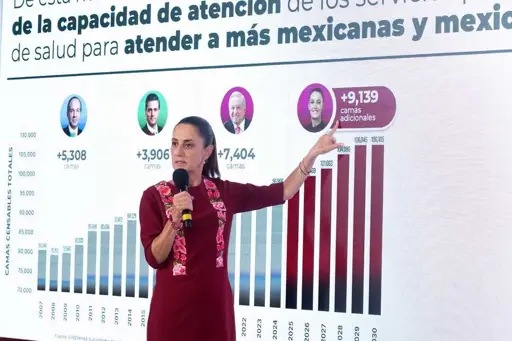
Hospital infrastructure planThe national plan envisages the creation of 9,139 additional hospital beds through the construction of 50 new hospitals, 47 expansions, and 55 replacements of ageing facilities. With an investment of 181 billion pesos, the aim is to reduce inequalities in healthcare access, prioritising states with the greatest shortfalls such as Oaxaca and Chiapas, explained Deputy Health Secretary Eduardo Clark.
(Diario Red) by Ricardo Pérez Trejo
Translation: Orinoco Tribune
OT/CB/SL
From Orinoco Tribune via This RSS Feed.