

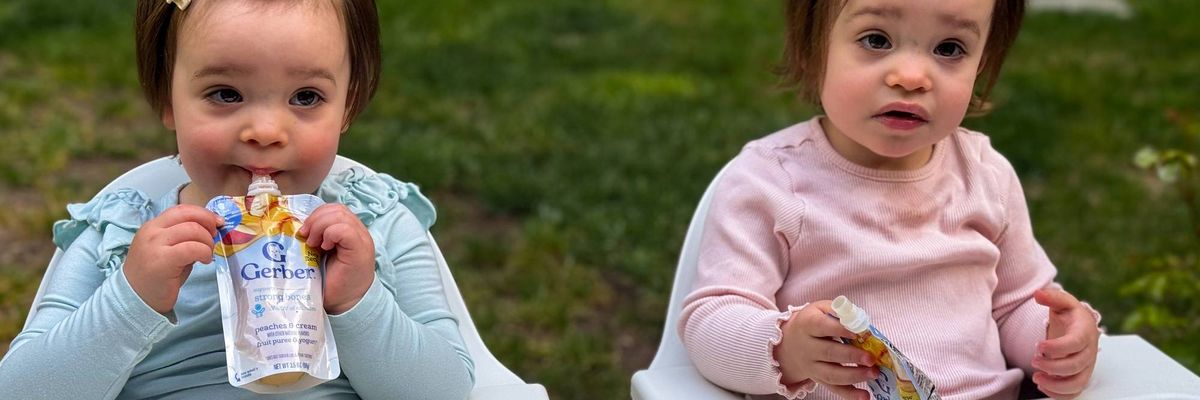
Parents often reach for squeeze pouches of baby food to feed little ones on the go or because they aren’t likely to break if dropped from a high chair, but research commissioned by Greenpeace International and released Thursday raises concerns about how the convenient packaging is exposing children to microplastics and plastic-associated chemicals, with potential health risks.
“In supermarkets worldwide, shelves are now lined with these soft plastic squeeze pouches of pureed baby food, promoted with safety and environmental claims such as ‘BPA-free,’ ‘non-GMO,’ ‘pesticide-free’ and ‘organic,’” notes the group’s new report, “Tiny Plastics, Big Problem: The Hidden Risks of Plastic Pouches for Baby Food.”
“In the US alone, it has been reported that sales of baby food pouches skyrocketed by approximately 900% between 2010 and 2023, becoming a dominant format for baby nutrition,” the report continues. Given the rising popularity of pouches, Greenpeace had SINTEF Ocean conduct laboratory testing of Danone’s Happy Baby Organics and Nestlé’s Gerber pureed baby food.
The researchers found up to 54 microplastic particles in Gerber yogurt pouches and up to 99 particles in Happy Baby Organics fruit pouches, on average—or as many as 270 microplastics per teaspoon in the former and 495 in the latter. They estimated that a full pouch of Gerber contains more than 5,000 particles, while Happy Baby has over 11,000 particles.
“Spectral analysis identified polypropylene (PP) and polyamide (PA), as well as tentatively identifying polyethylene (PE),” the report explains. “Particles tentatively identified as PE microplastic were the most abundant, occurring at similar levels in both products. This suggests that abrasion or degradation of the inner PE lining in contact with the food may contribute to the microplastic content in the food.”
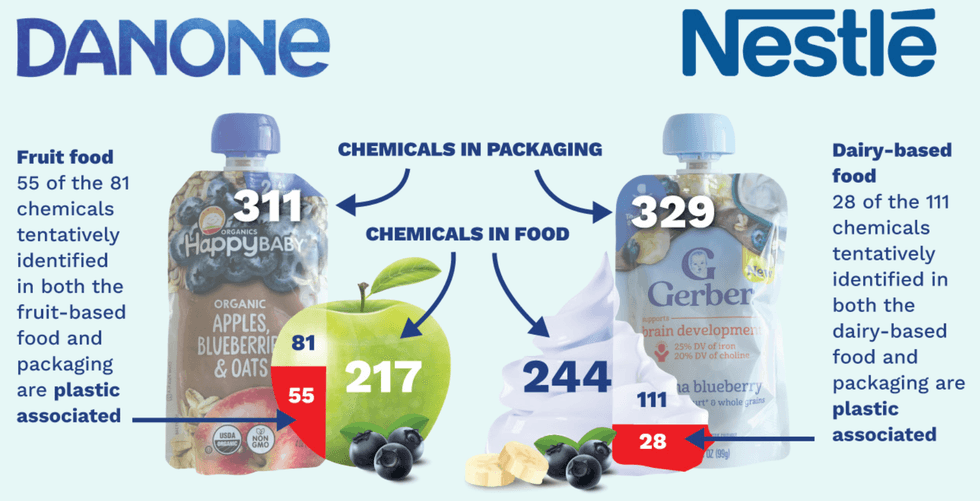
The experts also examined chemicals in the pouched food, and “tentatively identified 81 chemicals in the Danone fruit puree and 111 in the Nestlé dairy-based puree, which were also detected in the respective packaging materials,” according to the report.
“Cross-referencing with the PlastChem database, an inventory of chemicals known to be used in or found in plastics, revealed that 55 of the substances found in the fruit sample and 28 in the dairy sample were identified as plastic-associated chemicals,” the publication notes. “One chemical found in both the packaging and the yogurt was tentatively identified as 2,4-di-tert-butylphenol (2,4-DTBP), a chemical of concern. It is recognized as hazardous to human health and the environment, has been associated with endocrine-disrupting effects, and could also act as an obesogen.”
 (Image by Greenpeace International/“Tiny Plastics, Big Problem: The Hidden Risks of Plastic Pouches for Baby Food”)
“Our findings are not occurring in isolation,” the report emphasizes, citing other research on baby food pouches, infant bottles, and other plastic packaging, including breast milk storage bags. “Wherever we look with the right tools, we find the fingerprints of plastics permeating baby foods.”
The document also acknowledges that “besides the potential health risks of microplastics and plastic chemicals on babies, concerns have been raised by public health nutritionists about the growing market for spout pouches and their nutritional impact on babies and toddlers, specifically the high levels of sugars and low mineral and vitamin content in many products.”
“Overreliance on spout pouches is starting to be associated with growing levels of dental decay and obesity amongst young children,” the report adds, pointing to warnings from the World Health Organization and the United Kingdom’s National Health Service that “babies can eat too fast when they suck directly from the pouch.”
Considering the findings, “delaying action is not just ill-advised, it’s unethical,” Greenpeace argued. “Governments must work nationally and globally to secure a strong global plastics treaty that dramatically reduces global plastic production, eliminates hazardous plastics and associated chemicals, and drives a justice-centered, at-scale transition to reuse-based systems.”
Several rounds of negotiations on crafting a United Nations treaty to combat plastic pollution have been largely fruitless. In March, the chair of the talks, Chilean diplomat Julio Cordano, released a roadmap to renew the global push for a deal. Following that release, another round of talks is expected later this year or next year.
What #Nestlé & #Danone are feeding to babies will shock you. A Greenpeace International report found microplastics in the plastic-pouched baby food of 2 popular Nestlé & Danone brands, Gerber & Happy Baby Organics.❌ No amount of #microplastics should be in a CHILD’S FOOD. Share if you agree.
[image or embed]
— Greenpeace International 🌍 (@greenpeace.org) May 21, 2026 at 4:45 AM
The Greenpeace report doesn’t just put pressure on governments. It also says that “all companies that rely on plastic packaging must reconsider their business model, prioritizing baby food, baby products, and food contact packaging. Nontoxic, plastic-free, zero-waste, reuse-centered product delivery systems and packaging alternatives already exist in communities around the world.”
“Nestlé and Danone, and other major consumer goods companies and supermarket chains must take responsibility by swapping flexible packaging for healthier alternatives and supporting policies that accelerate reuse system expansion,” it stresses.
Graham Forbes, Greenpeace USA’s global plastics campaign lead, declared that “this study is a wake-up call for parents everywhere, who trust these brands to put their kids first. Plastic-dependent companies like Nestlé and Danone owe families a clear answer: What are they doing to eliminate microplastics and chemicals from the products they sell to babies?”
“Plastic pollution is not just wrecking our environment, it’s entering our bodies, starting from infancy,” Forbes added. “How our food is packaged is designed for profit, not for people’s health. Cutting plastic production and eliminating harmful chemicals is essential to protect human health, especially the health of our children.”
From Common Dreams via This RSS Feed.