

Bullets:
The European Union plans to “rip-and-replace” Chinese telecom gear from their systems, across the continent.
Regulators estimate the cost of the program at around 4 billion euro, and hope that member countries switch to Nokia and Ericsson to build 5G telecom systems.
But the United States has been trying to ban Huawei and ZTE for decades, and Congress also budgeted $4 billion to rip and replace Huawei gear from civilian networks.
Only a small percentage of companies have done so, and even the Pentagon requests annual waivers from laws that require them to use contractors using non-Chinese gear.
China’s monopolies on gallium, and massive R&D investments allow Huawei and other Chinese equipment makers to grow, despite Western bans.
Inside China / Business is a reader-supported publication. To receive new posts and support my work, consider becoming a free or paid subscriber.
Report:
Good morning.
The European Union has plans to get Chinese-built electronics gear out of their telecommunications networks. Earlier in the month, a key legal advisor said that member states are allowed to ban Huawei equipment on national security grounds. Policymakers in the EU are “ready to crack down” on countries in the EU that still allow China to sell 5G network equipment. The new law will restrict Chinese companies from building equipment for European telecom, and also for the energy, security, and transportation industries there.
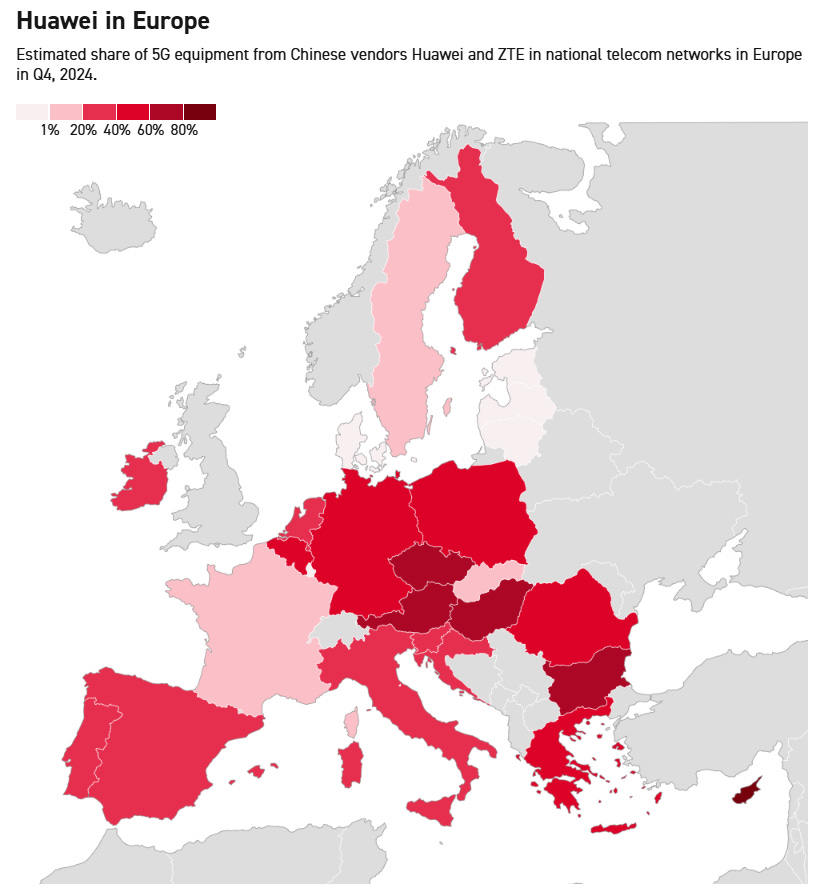
Here is the problem as they see it. For most countries in the EU, Huawei and ZTE are over 40% of the telecom hardware market. Sweden is one of the light pink countries on that map, with less than 20% of its networks reliant on Chinese vendors.
Back in 2020, Swedish regulators banned the use of telecom equipment from Huawei and ZTE in its 5G systems, and said that they would rely on Ericsson—which is headquartered in Sweden, and Nokia from next door—to provide the continent with 5G. “The new installations . . . must be carried out without Huawei or ZTE.”
Immediately following that announcement, Ericsson was basically put out of business here in China. Ericsson had won contracts to build 5G for the three biggest mobile phone carriers in China, then in the year immediately following the Swedish ban on Chinese companies, Ericsson’s revenues fell by half.
Fast-forward to now, and cutting Chinese vendors out of networks Europe wide would cost between three and four billion euro, and we will circle back to that shortly. Huawei and ZTE are deeply entrenched in the European system, and the new law there would compel European telecom companies to buy more equipment from Nokia and Ericsson. Countries who complain about replacing low-cost Chinese equipment with higher-priced European made gear will just have to pay for everything themselves, instead of asking for funds from the EU general budgets to cover it.
The problem with that idea is that when we go deeper into the numbers, it’s a fantasy that the union-wide cost will come in at €4 billion. KPMG and industry groups did their research and estimated that it would cost over 100 times that–$430 billion. Just the part of removing Chinese components and replacing them with European equipment would cost €146 billion, plus costs from downtime and employment problems. The researchers went on to include other costs that push the annual losses to be €39 billion euro for this year, and climbing to about €90 billion annually in three years.
We’ve seen this movie before. The United States did a own version of the same thing. This is a Congressional report from 2022. The United States “has raised national and economic security concerns about Huawei for two decades.” In 2017, the US government started imposing sanctions and restrictions on Huawei, restricting the use of Huawei equipment in Department of the Defense, and prohibited federal funds from being used to buy Huawei gear.
Their conclusion: The US government has taken steps to remove Huawei from American networks, and to restrict Huawei from having the tools the company needs to grow and expand across the world.
The Federal Communications Commission followed up with rules to “rip and replace” equipment from Huawei and ZTE from telecom systems in the US, and set up a $1.9 billion fund to compensate companies for cost of replacing Chinese equipment.
President Trump, then Biden later, was also pushing US allies to also ban Huawei. Mike Pompeo was Trump’s Secretary of State, and before that was director of the CIA. He says that Huawei and other Chinese tech firms are “Trojan horses for Chinese intelligence” services. Later they realized $1.9 billion wasn’t enough, so Congress kicked in $3 billion more.
But two years after that law was passed, only 12% of American companies had replaced their Chinese equipment, and it was obvious by then that the wheels were coming off the whole thing, and that the “assassination attempt on Huawei” was backfiring. Huawei sales grew.
That was civilian companies. The problem with the rip and replace idea is on the “replace” part. There’s not enough money in the United States – or in the EU, or in the Milky Way – to replace Chinese telecom equipment, because there are no replacements.
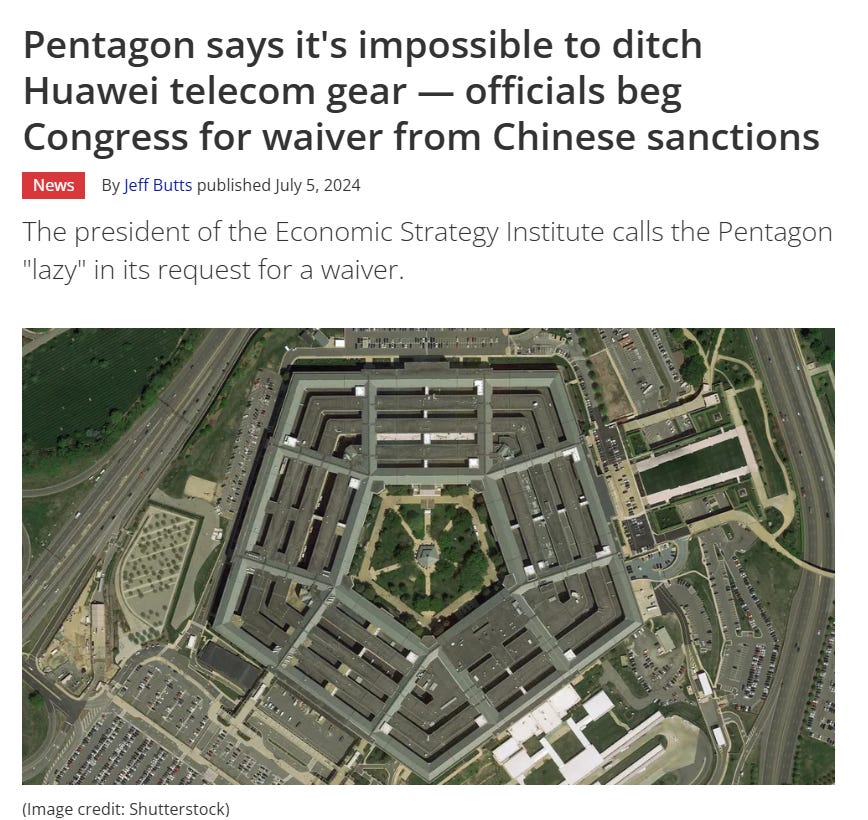
The Pentagon is in the national security business, and nobody has more money than the people there in that building. But ever since 2019 the Pentagon has been barred from doing business with anyone who uses Huawei equipment. And every year since then the Pentagon begged for a waiver so they could continue doing so. Huawei is so deeply entrenched across the world that setting up alternative vendors is impossible:
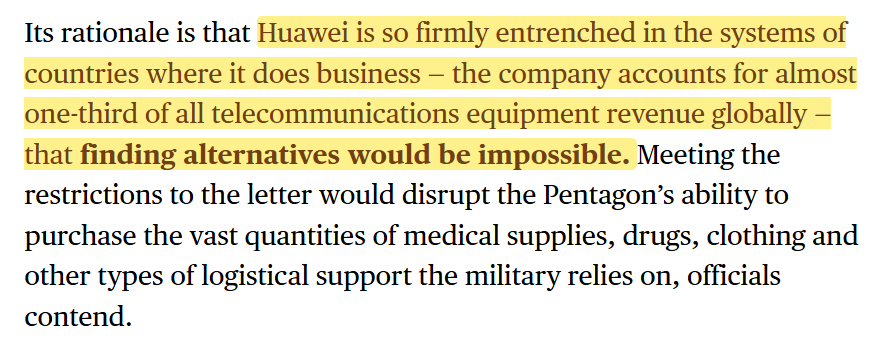
They’re saying here that if the Pentagon followed American law, they couldn’t buy medical supplies, drugs, clothing, fuel, parts, transportation. Resupply missions in large parts of the world where the DoD operates wouldn’t get off the ground. Without those waivers, nothing moves. The Pentagon literally cannot get away from Huawei. American allies in the Middle East and South America literally cannot get away from Huawei. US troops stationed outside the US use Huawei gear themselves, and literally cannot get away from Huawei.
So here again we see a huge disconnect between the rhetoric of policymakers in the United States and Europe, compared to the real world of supply chains and manufacturing. This is a nice summary of all the laws and executive orders and rulings from US government agencies.
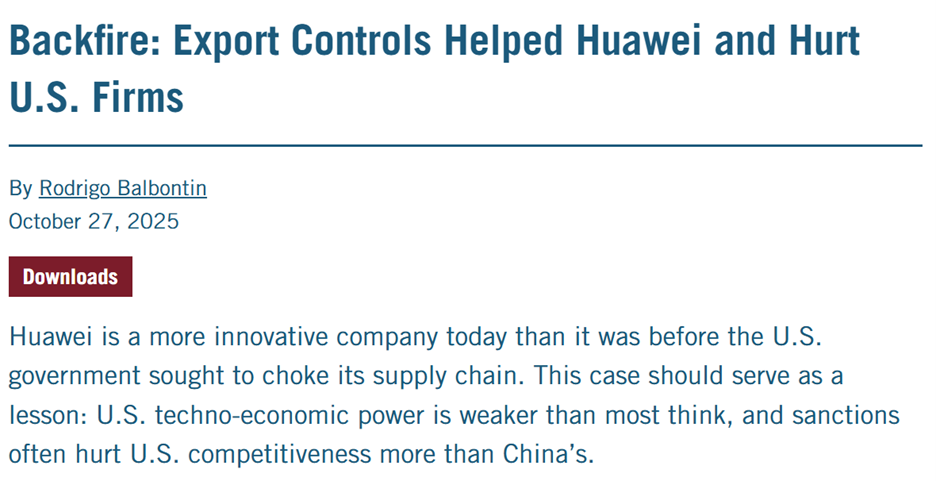
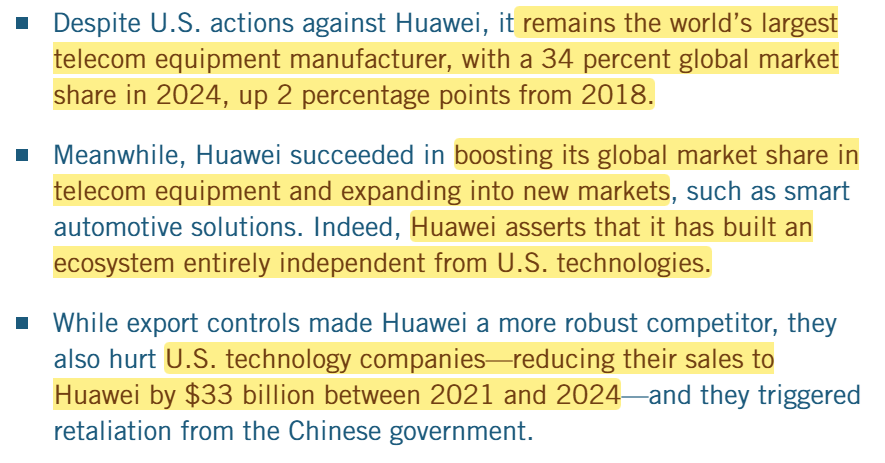
But despite US actions against Huawei and the other Chinese firms, Huawei is stronger than ever. Their market share is higher today than when it all started, and now they are developing new markets, and doing so without the help anymore of companies like Ericsson, or US firms.
Here is a strong example of that, and what our group sees every day: private 5G networks for mines and factories. Localized networks are driving factory automations, local logistics, and robotics. Almost all the growth in that industry comes in places outside North America and Europe:
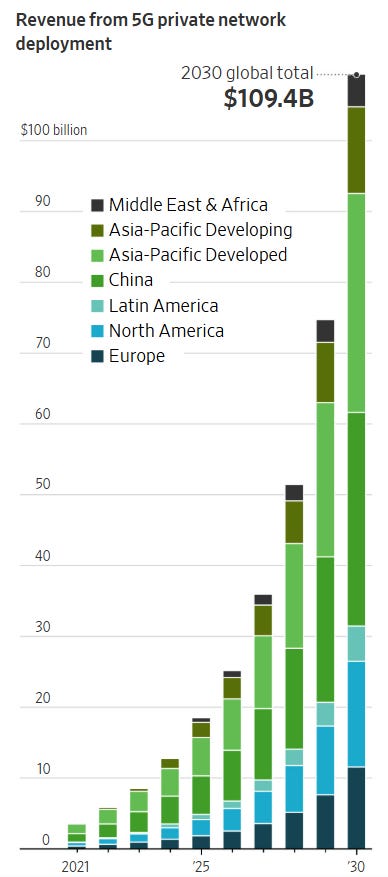
Huawei is still the most prevalent provider of 5G infrastructure in the world, and especially in the parts of the world most of the people live. They are the places that are growing fastest, and where this technology is going to make the biggest difference.
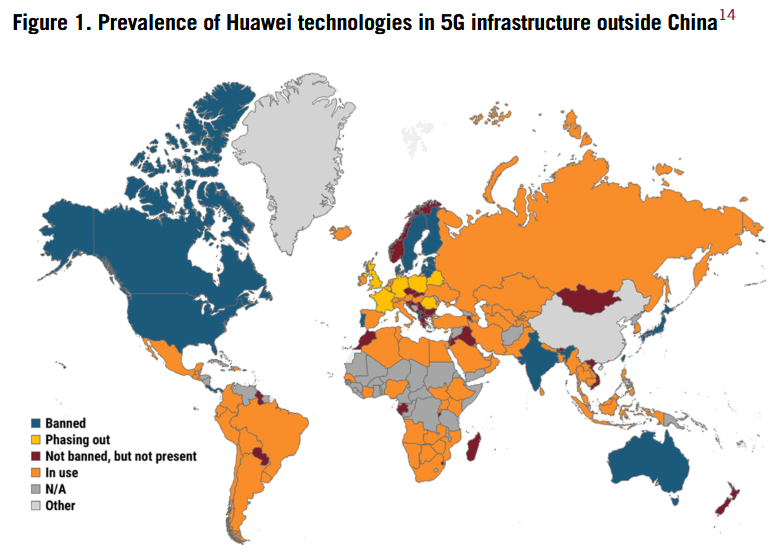
All the orange countries on that map use Huawei. And think of the problem in this way: using Huawei means that these countries can develop faster, at lower cost. Local 5G networks can be built using Chinese equipment, and serve areas that national carriers haven’t reached yet. There are hundreds of thousands of warehouses and mines and industrial parks across the world, and they can get 5G right now, without waiting for Ericsson or Nokia to show up, someday, and bid on the job.
Chinese telecom companies’ dominance come from mastery of the supply chain, and Research and Development. 5G networks rely on gallium to make them go. Gallium nitride enables faster data transfer. It allows hardware companies to build lighter and smaller systems that are more energy efficient. It’s used in amplifiers and power supply.
Those are the advantages to using gallium, and China has all the gallium. Last year China produced 95% of the world’s total supply of gallium, and Huawei has over 2,000 patents related to gallium nitride. Nokia and Ericsson also have filed a lot of patents for gallium, but Nokia and Ericsson don’t have any gallium. Ericsson’s website admits as much—they don’t have it.
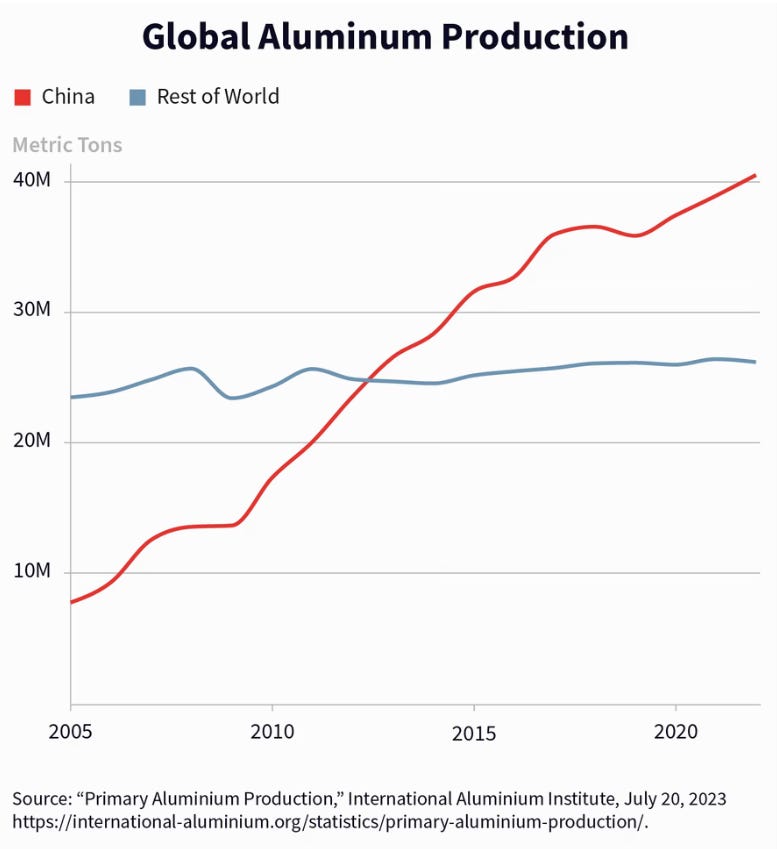
Gallium is a by-product of aluminum mining. China increased their aluminum production by ten times in 20 years and today supplies over half of all the aluminum in the world. There’s Chinese production of aluminum, compared to everyone else. And gallium, compared to everyone else:
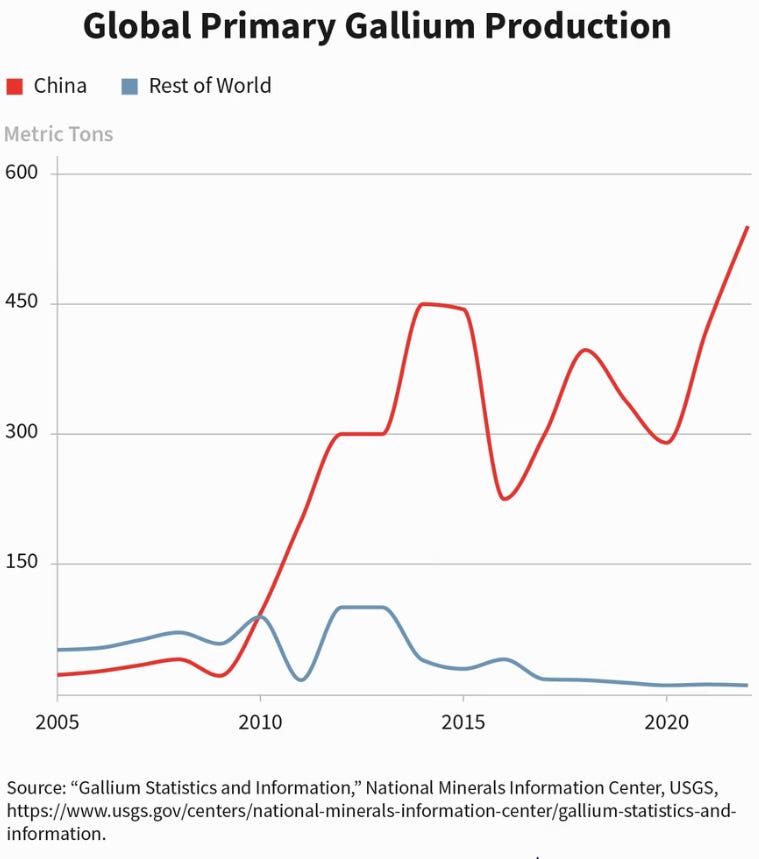
And that Chinese monopoly on gallium means that Chinese companies can build better communications systems, and nobody else can.
Be Good.
Resources and links:
EU cyber plan barring Chinese suppliers will cost US$430 billion: report
https://www.scmp.com/economy/china-economy/article/3352610/eu-cyber-plan-barring-chinese-suppliers-will-cost-us430-billion-report
Wall Street Journal, China Leads the Way With Private 5G Networks at Industrial Facilities
https://www.wsj.com/business/telecom/china-leads-the-way-with-private-5g-networks-at-industrial-facilities-11647163802
Ericsson.com, Critical minerals supply chain
https://www.ericsson.com/en/about-us/sustainability-and-corporate-responsibility/responsible-business/responsible-sourcing/conflict-minerals
Ericsson and Nokia see their sales in China fall off a cliff
https://www.lightreading.com/5g/ericsson-and-nokia-see-their-sales-in-china-fall-off-a-cliff
Ericsson and Nokia can’t gain in Europe what they lose in China
https://www.lightreading.com/5g/ericsson-and-nokia-can-t-gain-in-europe-what-they-lose-in-china
Sweden bans Chinese firms Huawei and ZTE from 5G networks
https://www.euronews.com/2020/10/20/sweden-bans-chinese-firms-huawei-and-zte-from-5g-networks
EU’s plans to reduce dependency on high-risk vendors
https://eutechloop.com/eus-plans-to-reduce/
Brussels plans to force governments to block Huawei from 5G
https://www.politico.eu/article/brussels-plans-force-governments-block-huawei-zte-5g/
Reuters, EU plan to phase out Chinese tech could cost bloc over $400 billion, Chinese study says
https://www.reuters.com/world/china/eu-plan-phase-out-chinese-tech-could-cost-bloc-over-400-billion-chinese-study-2026-05-06/
ICB, The Pentagon and FCC have a big Huawei problem: there are no substitutes, and there’s no more money
Bloomberg, Pentagon Has a Huawei Dilemma Congress Doesn’t Want to Solve
https://www.bloomberg.com/news/articles/2024-07-03/pentagon-has-a-huawei-dilemma-congress-doesn-t-want-to-solve
The US is moving very, very slowly away from Huawei
https://www.lightreading.com/security/the-us-is-moving-very-very-slowly-away-from-huawei
FCC Designates Huawei and ZTE as National Security Threats
https://www.fcc.gov/document/fcc-designates-huawei-and-zte-national-security-threats
ICB, US price tag for China’s gallium export ban: $602 billion and new monopolies for Huawei
Huawei has one 5G power that is hard for the US to hurt
https://www.lightreading.com/5g/huawei-has-one-5g-power-that-is-hard-for-the-us-to-hurt
Gallium: China is increasing its influence on the miracle metal as Huawei is working on promising applications beyond 5G
https://en.institut-seltene-erden.de/gallium-china-verstaerkt-seinen-einfluss-auf-das-wundermetall-da-huawei-an-vielversprechenden-anwendungen-jenseits-von-5g-arbeitet/
Fortune, Even the Pentagon can’t completely freeze Huawei out of its operations
https://fortune.com/asia/2024/07/03/pentagon-huawei-ban-national-defense-authorization-act/
Pentagon says it’s impossible to ditch Huawei telecom gear — officials beg Congress for waiver from Chinese sanctions
https://www.tomshardware.com/tech-industry/pentagon-says-its-impossible-to-ditch-huawei-telecom-gear-officials-beg-congress-for-waiver-from-chinese-sanctions
Gallium Nitride Semiconductors in 5G Networks
https://www.azom.com/article.aspx?ArticleID=22494
China’s gallium monopoly a red flag for US & its allies. 5 steps to de-risk supply chains
https://theprint.in/opinion/chinas-gallium-monopoly-a-red-flag-for-us-its-allies-5-steps-to-de-risk-supply-chains/1710814/
Brussels reissues its Huawei warning, six years on, and prepares to make it stick
https://thenextweb.com/news/eu-huawei-zte-connectivity-infrastructure-recommendation
EU recommends member states to not use Huwaei, ZTE in connectivity infrastructure
https://www.reuters.com/sustainability/boards-policy-regulation/eu-recommends-member-states-not-use-huwaei-zte-connectivity-infrastructure-2026-05-04/
EU legal opinion opens door to Huawei ban in telecoms networks
https://euperspectives.eu/2026/03/eu-legal-opinion-opens-door-to-huawei-ban-in-telecoms-networks/
U.S. bans new Huawei, ZTE equipment sales, citing national security risk
https://www.reuters.com/business/media-telecom/us-fcc-bans-equipment-sales-imports-zte-huawei-over-national-security-risk-2022-11-25/
Backfire: Export Controls Helped Huawei and Hurt U.S. Firms
https://itif.org/publications/2025/10/27/backfire-export-controls-helped-huawei-and-hurt-us-firms/
U.S. Restrictions on Huawei Technologies: National Security, Foreign Policy, and Economic Interests
https://www.congress.gov/crs-product/R47012
Inside China / Business is a reader-supported publication. To receive new posts and support my work, consider becoming a free or paid subscriber.
From Inside China / Business via This RSS Feed.