

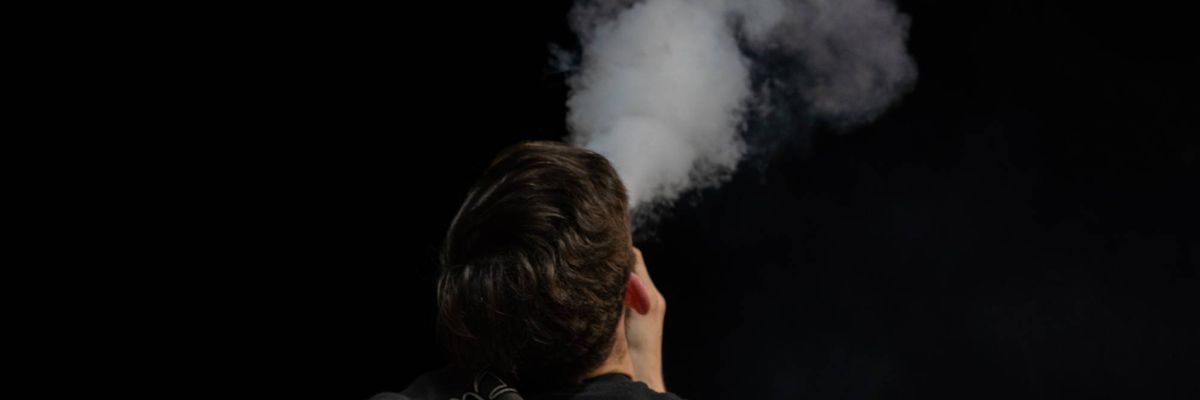
It was already known that President Donald Trump pressured top health officials to allow flavored vapes to hit the market after being leaned on by Big Tobacco executives earlier this month.
But The New York Times has revealed that the decision came just over a week after a massive super political action committee (PAC) donation from one of the cigarette companies looking to have the regulations lifted.
Kenneth Vogel and Christina Jewett reported for the Times that on April 30, a subsidiary of the tobacco company Reynolds Americans—which owns Camel and Lucky Strike cigarettes—donated $5 million to the Trump-backed super PAC MAGA Inc., according to a financial report filed on Wednesday. It brought the total amount donated to the PAC up to $8 million.
The donation came just two days before tobacco industry executives held their sit-down with Trump at his golf club in Jupiter, Florida, where they told the president they were displeased with the FDA’s ban on flavored vapes, which was enacted in light of evidence that they were driving an epidemic of youth vaping.
According to a youth survey by the Centers for Disease Control and Prevention (CDC), the vast majority of middle- and high school-aged e-cigarette users prefer fruit and candy-flavored vapes.
The Times reported earlier this month that immediately after receiving an earful from executives at Reynolds and Philip Morris owner Altria, Trump rang Secretary of Health and Human Services Robert F. Kennedy, Jr., and Centers for Medicare and Medicaid Services head Mehmet Oz to complain about the FDA’s ban on e-cigarettes.
In the days that followed the meeting, Trump reportedly berated then-FDA Commissioner Marty Makary, who hesitated to reverse the policy due to the potential impact on children. Makary ultimately resigned less than a week later, along with RFK Jr.'s chief spokesperson, Rich Danker, citing disagreement about the e-cigarette policy change as the ultimate reason.
Within a week of the meeting with executives, the FDA announced it was dropping the ban on fruit-flavored vapes and authorizing the sale of mango and blueberry flavors by the Los Angeles-based company Glas Inc., which could pave the way for major cigarette makers to launch their own products on store shelves. It also allowed companies to add greater amounts of nicotine to pouches, which smokers often use in order to quit the habit.
Kush Desai, a spokesperson for the White House, told the Times that Reynolds’ $5 million donation to the MAGA Inc. PAC had nothing to do with the administration’s sudden shift in policy surrounding flavored vapes. He said “the only guiding factor behind the Trump administration’s health policymaking is gold standard science,” as well as "recent evidence that has found [vapes] can help adults quit smoking.”
A spokesperson for MAGA Inc. said his organization “is pleased to accept legal contributions from those who agree with President Trump’s America First agenda and his goal to make America great again.”
The $5 million donation is far from the only contribution Big Tobacco has made to Trump. As Common Dreams reported earlier this month:
Trump, who ran in 2024 on a pledge to “save vaping” as part of an effort to appeal to young voters, has raked in huge sums of money from the tobacco industry. According to data from OpenSecrets, his inaugural committee took over $3 million from vaping special interests, including $1.25 million from the Vapor Technology Association, and $1 million apiece from Altria and Breeze Smoke.
Altria, which owns Marlboro maker Philip Morris, and Reynolds American, which owns Lucky Strike and Camel, have also offered donations to Trump’s $400 million White House ballroom project. Reynolds, the biggest producer of menthol cigarettes, also gave $10 million to the super PAC backing Trump in 2024.
The Times also reported on Wednesday that a Reynolds executive was invited to a dinner hosted by Trump at the White House in October for donors who gave $2.5 million or more.
The open, shameless grift.www.nytimes.com/2026/05/20/u…
[image or embed]
— Wajahat Ali (@wajali.bsky.social) May 21, 2026 at 1:21 AM
Critics described the $5 million donation as effectively a legal “bribe” to Trump and the latest example of the White House’s “open, shameless grift.”
It comes amid what seem to be endless reports of blatant self-dealing by Trump allies, most recently exemplified by the Trump-controlled Department of Justice’s settlement of a lawsuit from Trump against the Internal Revenue Service, which handed the president $1.8 billion in taxpayer funds that he plans to disperse to his allies as part of a so-called “weaponization fund,” which critics have dubbed a “slush fund.”
It’s also the latest example of Trump appearing to take actions in direct service of rich corporate donors—particularly in the fossil fuel, artificial intelligence, and cryptocurrency industries—or members of his family or personal inner circle.
Rep. Seth Magaziner (D-RI) also described the FDA’s policy change on vaping as a betrayal by the administration’s overseer, Kennedy. Though the HHS secretary has built his brand on pledges to “Make America Healthy Again” by decoupling corporate interests from health policy, he has been accused of bending to industry pressure on everything from food regulation to cancer-causing pesticides.
“In the Trump administration,” Magaziner said, “money beats MAHA every time.”
From Common Dreams via This RSS Feed.