

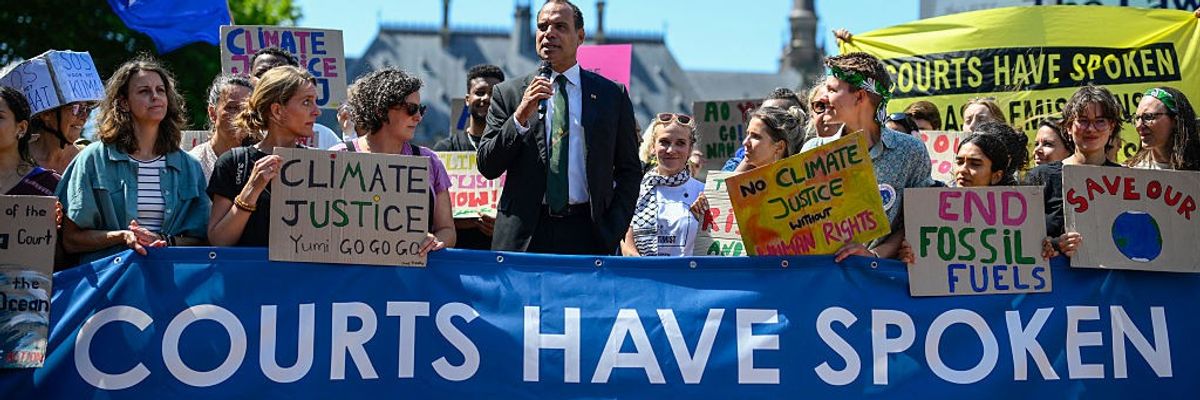
Despite efforts by the United States government to block and water down the effort, the United Nations on Wednesday, in a 141-8 vote, backed a resolution that confirms member states have a legal obligation to address the planetary climate crisis by mitigating greenhouse gas emissions.
With nearly two-thirds of the global body voting in favor, the eight countries that voted against the resolution were: Belarus, Iran, Israel, Liberia, Russia, Saudi Arabia, the US, and Yemen. Twenty-eight nations abstained.
The adopted resolution, brought to the UN by the low-lying island nation of Vanuatu, codifies the Advisory Opinion of the International Court of Justice on the Obligations of States in Respect of Climate Change, which the ICJ issued last year. As UN News reports:
The resolution calls on all UN Member States to take all possible steps to avoid causing significant damage to the climate and environment, including emissions produced within their borders, and to follow through on their existing climate pledges under the Paris Agreement.
Governments are urged to cooperate in good faith and continuously coordinate efforts to tackle climate change globally and ensure that climate policies safeguard the rights to life, health, and an adequate standard of living.
Rebecca Brown, CEO and president of the Center for International Environmental Law (CIEL), was among those celebrating the vote as a significant win.
“The science is clear: fossil fuels are the principal driver of the climate crisis. The path to climate justice runs through a rapid, just, and equitable transition away from fossil fuels towards renewable energy.”
“Today, the UN General Assembly affirmed what the International Court of Justice made clear — that climate action is a legal obligation," Brown said. “With this resolution, countries carry the ICJ’s historic ruling forward as a roadmap for climate action and accountability in the years to come. This resolution demonstrates that multilateralism works, and that the global majority stands resolute in defense of the rule of law, demands meaningful accountability, and real climate action. By acting together, we can prevent further climate harm, in line with science and the law, by speeding up a just and equitable transition away from fossil fuels, protecting climate-vulnerable communities, and advancing climate justice.”
In a statement following the vote, UN Secretary-General António Guterres welcomed the outcome as called passage of the resolution “a powerful affirmation of international law, climate justice, science, and the responsibility of states to protect people from the escalating climate crisis.”
Guterres thanked the leadership of Vanuatu and the broader coalition of island nations and others who led the fight for the resolution and demonstrated “moral clarity” on the issue for all the world to see.
“Those least responsible for climate change are paying the highest price. That injustice must end,” he said. “The science is clear: fossil fuels are the principal driver of the climate crisis. The path to climate justice runs through a rapid, just, and equitable transition away from fossil fuels towards renewable energy.”
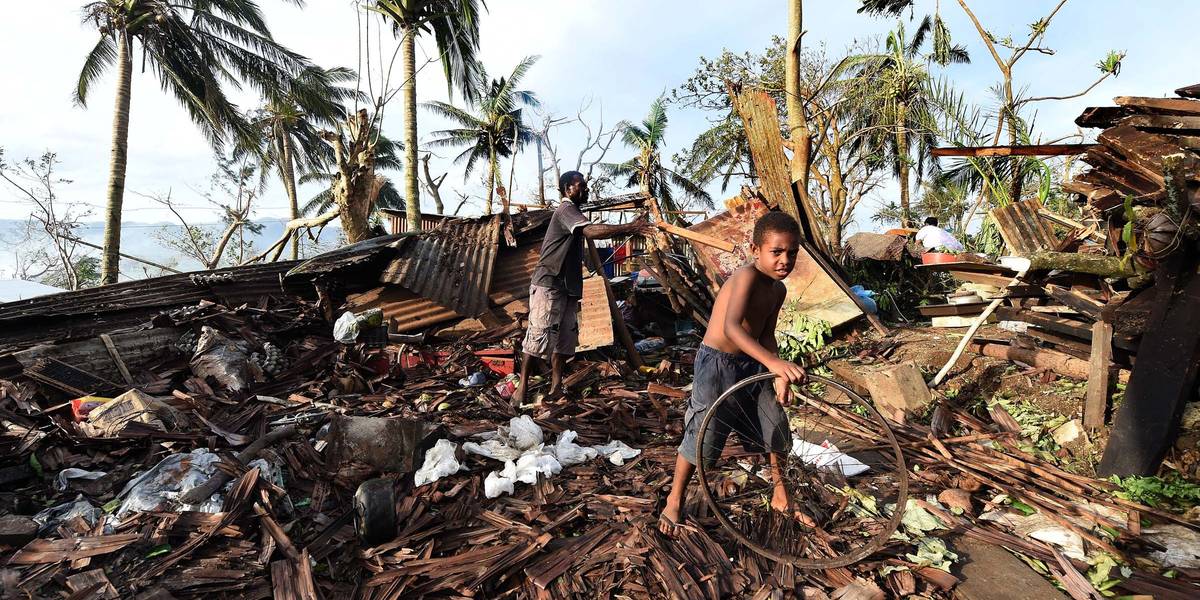 Samuel (L) and his father Phillip search through the ruins of their family home on March 16, 2015 in Port Vila, Vanuatu. Cyclone Pam has hit South Pacific islands on Saturday with hurricane force winds, huge ocean swells and flash flooding and has caused severe damage to housing. Aid agencies say it could be one of the worst disasters ever to hit the region. (Photo by Dave Hunt-Pool/Getty Images)
As Guterres championed the need for a redoubled effort to supplant fossil fuels with cleaner, more renewable forms of energy, environmental and human rights groups also championed the resolution’s passage—especially in the face of opposition from the fossil fuel lobby and governments taking their side like the US, Russia, Israel, and others.
In February, the Associated Press reported that the Trump administration—which has pulled out of the international Paris Agreement established in 2015 and continues to act overtly in the interests of the fossil fuel industry which helped bankroll his 2024 campaign—was pushing members at the UN to mount a pressure campaign against Vanuatu to drop the resolution.
While US deputy ambassador to the UN Tammy Bruce claimed this week that the resolution included “inappropriate political demands relating to fossil fuels,” groups like Amnesty International, 350.org, the Pacific Islands Climate Action Network (PICAN), and many others heralded its passage precisely because of the pressure it rightly places on the oil, gas, and coal industries.
“At a time when fragmentation between nations feels more visible than ever, the UN resolution endorsing the ICJ climate ruling offers a renewed path for international cooperation," said Amnesty’s Camile Cortez, a senior climate justice campaigner for Amnesty. “Political and authoritarian choices by some world leaders, like rolling back climate protections or revoking phase out regulations, have weakened global progress just when we need stronger climate action. Fossil fuel infrastructure alone poses risks for the health and livelihoods of at least 2 billion people globally, roughly a quarter of the world’s population.”
“Today, the international community has affirmed that climate justice is not charity but is anchored in accountability.”
Fenton Lutunatabua, the Pacific and Caribbean lead for 350.org, said the UN vote represents a “critical next stage” for the ICJ’s landmark ruling that “was not meant to sit on a shelf,” but instead lead to action in line with international law and the obligations of member states.
“This vote shows the vast majority agreed there is an absolute obligation to stop runaway climate change,” said Lutunatabua. “Today we get closer to that goal, and our children get closer to a safer, more secure future. Our communities also get closer to receiving justice for the suffering the fossil fuel industry has caused, and the havoc wreaked upon our shorelines as we pay with our lives and our pockets to rebuild after yet another cyclone, yet another flood.”
PICAN director Dr. Rufino Varea said the victory at the UN on Wednesday “belongs to every community that refused to let their future be written off” by those who have disregarded the damage that has been done by the climate crisis driven by the fossil fuel industry and broader corporate greed.
“From the Pacific to the world, this vote is a recognition that those who did the least to fuel this crisis should not be left to carry its heaviest burdens," said Varea. "For generations, Pacific peoples have protected our oceans, our lands, and our cultures while facing rising seas, loss, and displacement caused by others. Today, the international community has affirmed that climate justice is not charity but is anchored in accountability. Accountability to frontline communities, to future generations, and to the shared responsibility we hold to protect life, dignity, the environment, and our collective future. This moment belongs to every community that refused to let their future be written off.”
From Common Dreams via This RSS Feed.