

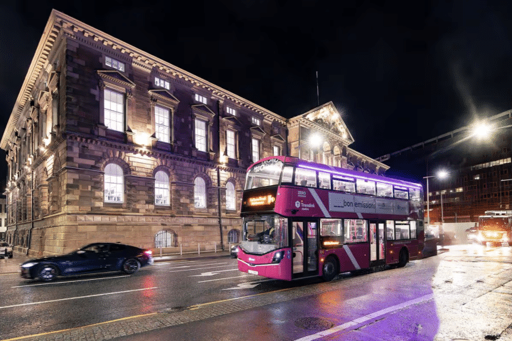

As cities around the world move towards expanded public transport free of fares, the north of Ireland is going backwards. The boss of Translink, the north of Ireland’s public transport operator, has told MLAs that he is targeting service cuts and an end to some fare discounts. Chris Conway blamed Stormont for failing to hold up its end of the deal in funding the public corporation.
Translink is funded by fare revenues and by subsidies from the Department of Infrastructure (DFI), the latter under a deal called the Public Service Agreement (PSA). Conway told a Wednesday May 20 Committee for Infrastructure meeting that:
Unfortunately this agreement has not been funded by DFI over the last couple of years. And actually subsidy per passenger is well below other regions in the UK and Ireland.
Stormont has been mandating concessionary fares, and repeated fare freezes, including one most recently in April 2026. The Infrastructure Minister Liz Kimmins said:
In the current context of rising fuel and oil prices, I do not believe it would be right to increase public transport fares and place further pressure on workers and families. Many people rely on buses and trains every day and keeping fares stable helps provide some certainty at a very challenging time.
Conway said five fare freezes in nine years had “cost us over 20 million pounds of revenue”. However, overall Stormont budget constraints mean no extra money has been available to Translink. So, it has not been able to cope with the resulting decrease in money coming in.
Forget balancing the books on public transport
Parties across the board have appealed to Keir Starmer for additional funding. Labour has provided some additional money, but not enough to meet the needs of one of the most impoverished regions under Westminster control.
Conway described Translink’s poor financial situation, saying:
We have made a loss of 23 million pounds in 25/26 financial year and we made a loss in the previous year as well. And as I said at the previous committee utilising our reserves to manage these losses is clearly not sustainable and Translink have highlighted this into previous committees.
Of course, it is misguided for government to expect public transport to be seen in this narrow way. That is – siloed off, purely looking at its own monetary flows in and out, without consideration of the wider benefits of public transport.
Running an inexpensive, high quality public transport system at a significant loss would still see society far better off overall. There would be less pollution and better health outcomes due to people walking more. In addition, there would be greater efficiency of movement due to less traffic on the roads. It would also ensure greater inclusion for marginalised groups, such as poor and disabled people.
That’s why places like Montpellier in France allow free travel across their entire bus and tram network. Meanwhile, in the north of Ireland, Translink are scrabbling around to find which services to cut to save a relatively measly £10 million.
Conway told the committee that “an equality screening process” is being conducted to minimise the impact on vulnerable groups. He said more lightly used services, such as those running Monday-Wednesday were likely to be hit. The CEO also said they were looking at reducing late evening services.
This is at a time when Belfast only recently introduced occasional night-time buses, the norm in many European capital cities. Those were brought in to help boost the night-time economy, another reason for having effective public transport.
Future of major rail upgrades uncertain
Social Democratic and Labour Party (SDLP) infrastructure spokesperson Justin McNulty described the effect cuts will have, saying:
This is a direct result of the Executive’s failure to properly invest in public transport and Translink in particular and now it will be the public that pay the price. Worryingly it will be the most marginalised who will be disadvantaged including students, disabled and elderly people, and rural isolated communities.
Conway was cagey when it came to how funding constraints would hit major capital projects, such as the All-Ireland Strategic Rail Review (AISRR). That project is a major upgrade to Ireland’s rail network that will run until 2050. The aim is to expand the network with around 700km of new track and decarbonise large swathes of it. Also, it aims to increase rail speeds to a relatively modest 200km/h.
The Translink boss said:
We also try to keep a small percentage [of capital budget] to keep the longer strategic projects going as well, even if it’s only a small amount of work to continue feasibility work.
So things like the All-Island Strategic Rail Review and electrification, we’d like to try and keep a small amount of our capital budget just to keep those projects going because that’s about an investment for future generations and we don’t want to cut that off. But it will all depend on how the capital budget is finally allocated, and that isn’t clear yet.
As HS2 fumbles and Translink scrimp around for crumbs, China storms ahead with a state-led model laying down vast amounts of high-speed rail. Meanwhile, Britain and Ireland continue with a failed, Americanised car-centric mentality. They also view public transport authorities like businesses that ought to be fixated purely on their own internal profits and losses.
From Canary via This RSS Feed.