

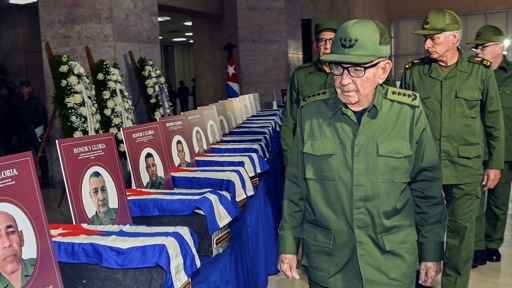
On May 20, the US Department of Justice filed formal charges against Raúl Castro, 94, a general in the Cuban Army and former president of the island. The Department of Justice has accused Raúl Castro of conspiracy, murder, and destruction of aircraft for the downing of two aircraft in Cuban airspace in 1996.
The indictment filed by Prosecutor Todd Blanche, which must still be approved by a grand jury, seeks a life sentence for one of the top leaders of the Cuban Revolution, which began in 1959, and of which Raúl, Fidel Castro’s younger brother, is one of the principal architects and political-military leaders.
The accusation is based on an incident in 1996, in which two small planes belonging to the organization Brothers to the Rescue were shot down by the Cuban Revolutionary Armed Forces. According to the United States, Raúl Castro, then Minister of the Armed Forces, is responsible for the deaths of the crew members of those planes, who, according to Washington, were merely seeking to assist Cuban migrants attempting to reach the US by sea.
Cuba condemns indictment as pretext for US aggression
In this regard, Cuba’s ambassador to the US Ernesto Soberón Guzmán, told The New York Times that the charges against Castro aim to justify a military attack by Trump against Cuba, even though his government has sought to engage in dialogue in response to US threats and the tightening of the blockade.
Cuba has maintained that the downing of the planes was carried out in self-defense, as both aircraft – which, according to Havana, were piloted by terrorists – were flying over Cuban territorial waters.
The Cuban government also recalled that before the planes were shot down, a dozen warnings were issued to Washington during successive incursions led by CIA agent José Basulto (accused of infiltration, acts of piracy, and plans for attacks, among other crimes), but these were ignored by the US which allowed the planes to fly.
The incident served as justification for the administration of then-President Bill Clinton to intensify the economic blockade in place since the 1960s by signing the Helms-Burton Act, which further complicated Cuba’s situation following the collapse of the USSR.
The indictment, which is part of a series of economic and political pressures by the Trump administration, has also been filed against other Cuban military leaders, such as Emilio Palacio, José Gual, Raúl Simanca Cárdenas, Luis González-Pardo, and Alberto Pérez-Pérez.
A political maneuver
Cuban President Miguel Díaz-Canel said the alleged indictment “highlights the arrogance and frustration felt by the representatives of the empire due to the unwavering resolve of the Cuban Revolution and the unity and moral strength of its leadership.” The measure is political in nature, lacks any legal basis, and only serves “to justify the folly of a military aggression against Cuba,” said the president.
Regarding the events of 1996, Díaz-Canel stated that there is well-documented evidence that “no reckless action was taken nor was international law violated” during the downing of the small planes belonging to the “narco-terrorist organization” Brothers to the Rescue. He contrasted this with the “openly publicized extrajudicial executions of civilian vessels in the Caribbean and the Pacific” by US military forces in recent months.
In addition, Díaz-Canel expressed his support for Raúl Castro and his leadership in the Cuban Revolution: “The ethical stature and humanistic spirit of his work refute any slanderous accusations leveled against Army General Raúl Castro. As a guerrilla leader and statesman, he earned the love of his people, as well as the respect and admiration of other leaders in the region and around the world. Those values are his best defense and a moral shield against the ridiculous attempt to undermine his stature as a hero.”
For his part, Cuban Foreign Minister Bruno Rodríguez condemned the US government’s “farce” against the leader of the Cuban Revolution: “It is an act based on lies that conceals well-documented historical truths about the events that led to the downing, in Cuban airspace and in self-defense, of two aircraft belonging to the terrorist organization Brothers to the Rescue.”
Cuba asserts its right to self defense as solidarity grows in the US
Insisting on the right to self-defense in the face of US aggression, Rodríguez emphasized that the US has consistently “been complicit in the organization and execution of terrorist and violent acts against Cuba from its territory”. He also cited the 200 “extrajudicial executions” in international waters in the Caribbean and the Pacific, for alleged links to drug trafficking operations.
“Cuba will not renounce its inalienable right to self-defense.”
In the United States, the Party for Socialism and Liberation called on all those who respect international law to “reject this indictment as the political instrument it is”.
“Charging a 94-year-old former head of state for an act of territorial defense that occurred thirty years ago, after Cuba exhausted every diplomatic channel, is not justice. Raúl Castro acted within his sovereign rights and in a manner consistent with Cuba’s obligations under international law. The U.S. government, not Cuba, bears responsibility for failing to stop flights that its own officials knew would lead to tragedy. The people of this country do not want another war.”
The post Cuba condemns US indictment of Raúl Castro as pretext for aggression appeared first on Peoples Dispatch.
From Peoples Dispatch via This RSS Feed.