

The deteriorating conditions of the working class are becoming an undeniable reality. According to a PNC Bank report, 67 percent of workers say they are living paycheck to paycheck. The U.S. Bureau of Labor Statistics reports that 9.3 million Americans — or almost 6 percent of the total workforce — reported working multiple jobs in 2025, the highest level since the BLS began tracking this statistic in 1994. This is the reality for the working class: insufficient wages that do not keep pace with rent and expenses, astronomical healthcare costs, all while there’s always money for wars and tax breaks for the ultrarich. The growing hatred of billionaires who continue to profit despite the massive assault on the working class — from inflation and low wages to cuts in Social Security and rising energy bills — must be channeled into fighting for a program that truly makes the capitalists pay for the crises they have created. Taxing the rich is not enough as long as taxes on workers’ wages remain in place.
Indeed, if we need to locate the root of these growing crises, we need look no further than the decadence of the American bourgeoisie.
The richest 1 percent of Americans now hold more than 30 percent of the nation’s wealth. Of the $162 trillion wealth pie, the bottom half of the country, or about 65 million households, hold just $4.1 trillion. Meanwhile, the 938 billionaires hold a staggering $7.8 trillion, which is twice as much as the bottom 50 percent of the entire country. The top 0.01 percent has seen its share of national wealth nearly double since 1989, rising from 8.7 percent to nearly 14 percent, while real wages for workers have either stagnated or fallen.
The consequences color every aspect of working-class life. Since August 2020, consumer prices have risen by 24.6 percent. Work has become increasingly precarious as workers take jobs that often lack benefits and offer variable income. The gig economy now accounts for one in four jobs in the United States, with 70 million people engaged in some form of freelance or contract work. According to a study by the Ludwig Institute for Shared Economic Prosperity (LISEP), nearly one in four Americans — around 24 percent — is considered “functionally unemployed,” meaning that despite having jobs, they struggle to find full-time work or are stuck in poverty-wage positions.
This war on the working class is increasingly inseparable from what is happening on a global scale. It coincides with the return of an era of renewed wars between great and emerging powers — sparked by the situation in Ukraine and now evident in the recent war in Iran. U.S. hegemony is no longer unchallenged, and military means are increasingly a way to resolve geopolitical disputes. The ongoing intervention in Ukraine, support for the genocide in Palestine, and the war in Iran not only illustrate that the United States is struggling to achieve easy victories abroad. but also reveals a troubling reality: there is a bottomless pit of resources for wars, genocide, and repression, but nothing for the working class.
Working People Know Who the Enemy Is
The working class is becoming increasingly clear eyed about who is truly responsible for this crisis. Poll after poll shows that people perceive billionaires as having an outsized influence on social and political life, leading to overwhelming bipartisan support for making the rich pay. Over half of Americans view the gap between the rich and the poor as a significant problem, with 80 percent — including 67 percent of Republicans — saying that the rich hold too much political power. An analysis by the Excessive Wealth Disorder Institute revealed that most Americans, according to over 50 national and statewide polls, support higher taxes on the wealthy. Another study, by Navigator Wealth, found that about four in five Americans, including 63 percent of Republicans, favor raising taxes on the rich.
This sentiment is increasingly manifesting in daily life. From the widespread rejection of billionaires like Elon Musk and Jeff Bezos to the celebration of Luigi Mangione as a folk hero, to young people are increasingly turning away from capitalism and embracing socialism, they are all manifestations of the anger at a social, economic and political system that os bursting at the seams. It is this anger that has fueled a surge in union organizing in recent years, as seen in the unionization efforts at Starbucks and Amazon and the UAW’s historic contract fight against the Big Three auto manufacturers. Massive days of mobilizations like No Kings and May Day saw tens of thousands take to the streets, expressing not just their anger against Trump and the Right but also their repudiation of endless wars and imperialist ambitions abroad, the genocide in Gaza funded in their name, and the billionaire class whose interests ultimately drive it all.
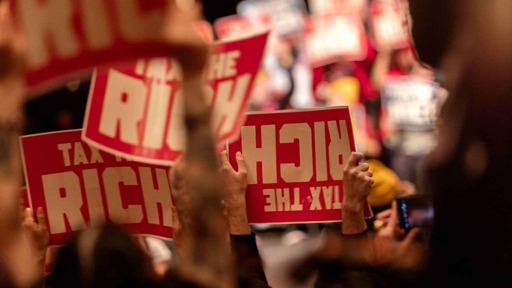
It is this anger that also found expression in Zohran Mamdani’s explosive popularity last year. With “Tax the Rich” as a rallying cry, Mamdani emerged as a national figure by calling for the rich to pay their “fair share” to fund public services like free universal childcare, rent freezes, and free bus service. Hundreds of thousands of young people canvassed neighborhoods, and millions saw their aspirations reflected in his campaign. On the campaign trail, he proposed raising the state corporate tax rate to 11.5 percent and adding 2 percent to New York City’s income tax for anyone making more than $1 million a year.
Mamdani is not alone in trying to thread this needle. At the federal level, Bernie Sanders and Ro Khanna introduced the Make Billionaires Pay Their Fair Share Act in early 2026, proposing a 5 percent annual wealth tax on anyone with a net worth exceeding $1 billion. In California, SEIU United Healthcare Workers West filed a ballot initiative for a onetime 5 percent tax on billionaire net worth to fund health care and public education — a proposal that has already prompted tech giants like Peter Thiel and Larry Page to threaten to leave the state if it passes.
The Actual Problem: A Tax Code Built to Tax Labor, Not Capital
While these proposals would mark some advance in the effort to make billionaires pay, they overlook a fundamental issue: the tax code is structurally designed to tax workers, not the rich.
To understand this, we need to examine the primary sources of federal revenue. Just this year, individual income taxes — which include taxes on wages, on paychecks, or any sort of earnings from a job — accounted for 53 percent of total federal revenue, while other payroll taxes, such as Social Security and Medicare taxes, made up 32 percent. Together, taxes on work fund 85 cents of every federal dollar collected. In contrast, corporate income taxes, which are levied on corporations’ net profits, have been slashed over decades and now represent about 6 percent of total revenue.
Moreover, the owners of capital don’t make their fortunes from wages in the first place… Take Bezos, for example: since 1998, he has earned $81,400 a year from Amazon. Yet his actual wealth, which is now estimated at over $223 billion, comes almost entirely from his ownership stake in the company. When Amazon’s stock rises by just 1 percent, Bezos’s personal fortune grows by more than $2 billion, exceeding the combined annual salaries of roughly 25,000 Amazon warehouse workers.
Bezos is just one example among many. In fact, capitalists build their fortunes not from wages but from capital gains, stock appreciation, dividends, and inherited assets — sources that are taxed at a far lower rate than wages or, in the case of unrealized gains, are not taxed at all until the assets are sold. The proof is in the pudding. Musk, with a net worth of over $668 billion, paid an effective tax rate of 3.3 percent, while Bezos himself paid just 0.98 percent. In contrast, the average American worker, not even accounting for payroll taxes, paid an effective federal income tax rate of around 13 percent.
Even the paltry 6 percent that corporations nominally contribute is riddled with escape hatches. Corporations routinely distribute enormous sums to executives in bonuses, which can exceed the annual salary of hundreds of their own workers, all while those same companies lay off thousands routinely as a way to increase profits. These bonuses, along with shareholder distributions and stock buybacks, are written off as business expenses, reducing the company’s net taxable income before the tax rate is even applied. Furthermore, for the capitalist class, even personal consumption is largely invisible to the tax code: private jets, luxury travel, and security details are all classified as operating expenses. Amazon, for instance, covers up to $1.6 million per year in travel and security costs for Bezos, categorizing them as “reasonable business expenses.”
This is the mechanism through which inequality reproduces itself, armed with a tax code that exempts or minimizes the burden on the bourgeoisie while offloading the responsibility onto working people, who are constantly told that there is never any money for their interests.
No Taxes on Income
The ruling class has achieved something remarkable: it has made us pay for every aspect of a state that serves their interests while constantly squeezing us dry and dividing our ranks. Understanding the tax code as a machine built to tax labor rather than capital helps us grasp what current proposals to tax the rich will actually accomplish and where they fall short.
While proposals to tax higher incomes or on real estate holdings, such as those put forward by Mamdani, or to implement wealth taxes based on net worth, that bottomline the proposals of figures like Elizabeth Warren, Sanders, and the SEIU in California, go some way in making the rich pay a larger share, they still leave the system intact. For decades, the wealthy have created legal escape hatches, from offshore structures to asset reclassification, that allow them to avoid paying higher taxes. Even the proposed 5 percent wealth tax, modest as it is, has been met with howls of outrage and threats of capital flight from billionaires.
Above all, most current proposals for taxing the rich are based on the fundamental premise that the problem is a few bad actors — specifically, the 938 billionaires in this country — and not a system designed to extract and impoverish the working class. The vast assets and inflated net worth of these billionaires aren’t just personal wealth; they are products of a capitalist system that thrives on profits derived from stolen wages. To take the Amazon example further, Bezos’ multibillion-dollar fortune comes from speculation on Amazon’s stock value, which itself is a bet made by the financial markets on the company’s profitability. These profits are a direct result of the labor of millions of workers who power the company, from stocking warehouses to packing boxes to transporting goods, all under constant surveillance and increasingly unrealistic quotas. Indeed, the “net worth” and wealth of capitalists represent a claim on the existing and future fruits of our labor. Meanwhile, workers not only see their work become increasingly precarious, but also have their incomes garnished and appropriated by a state that offers them nothing.
In the fight to make the rich pay, we have to put the role of working people and their labor at the center. As a primary demand, we need to take up the fight to eliminate all taxes on income. Such cuts, furthermore, cannot be offset by cuts to the very social programs that working people rely on — often the first targets when the government seeks to reduce costs — but must instead be funded by taxation of the actual profits companies make, on capital gains, accumulated wealth, and on financial speculation.
A Labor Movement That Fights for Our Interests
This, then, begs the question: How do we fight for this?
Already, from Mamdani, to Sanders, to SEIU, many different sectors are trying to mobilize around the fight to make the rich pay. Where Mamdani’s campaign demonstrated that this can be a winning message, Sanders has taken the demand to “Tax the Rich” on the road, organizing rallies targeting the “oligarchy” across multiple states, drawing thousands of attendees. In addition to Sanders, other members of Congress, such as Warren, Ron Wyden, and Chris Van Hollen, have proposed measures like an “ultra-millionaire’s tax” or targeting unrealized capital gains and dynastic wealth. Sensing which way the wind is blowing ahead of the midterms, Democrats across the country are falling over each other to adopt the language of “affordability” — a deliberately vague term that allows them to gesture at the cost-of-living crisis without committing to substantively address it.
A more serious attempt has come from Democratic Socialists of America (DSA), which threw its weight behind Mamdani’s campaign and has organized rallies in Albany alongside New York unions to advocate for his tax proposals in the state legislature. Their strategy is clear: elect more socialists and build a bloc of DSA-aligned officials who can overcome the resistance of the Democratic establishment and implement a redistributive agenda. In this vision, unions and the labor movement play a supporting role, mobilizing their membership to back DSA-backed candidates, turning out the vote, and creating enough political pressure to give those officials the cover needed to push reforms through. Yet, despite their aspirations, it is a strategy that places the decisive power in the hands of elected officials, not the working class itself, inevitably running into the limits of what can be achieved within a political system designed to protect the interests of capital.
Mamdani himself is the sharpest illustration of those limits. His pied-à-terre tax on luxury second homes was celebrated as a win, but every other meaningful proposal has encountered the same barrier where Governor Kathy Hochul, a Democrat, has refused to budge on raising taxes on the rich. Rather than strengthening and mobilizing the movement that elected him, Mamdani has increasingly sought accommodation, negotiating away promises and playing nice with Hochul, who has made it clear that she has nothing to offer that will actually tip the scales in a major way… This has resulted in a “balanced” budget that defers most of what he promised on the campaign trail, placing the real burden, once again, on the backs of the working class. This isn’t because Mamdani is uniquely flawed; it just demonstrates the logic of governing within the system as it stands, which inevitably leads to class collaboration.
Our power doesn’t come from electing the right people but from our strategic position as the class that keeps everything running. Instead of relying on the mechanisms of a system that is rigged against us, we need an organized working class that fights independently, using its own tools, organizing on every shop floor, leveraging the power of strikes and shutdowns, and mobilizing in our workplaces and in the streets to fight for our own program and our future. These are not tasks to defer to a distant future with better conditions; they are the conditions we must fight for in the here and now. The unions, the social movements, and the new generations radicalized by the pandemic, Black Lives Matter, the genocide in Gaza, the attacks on immigrants and democratic rights, and the advance of Trump and the Far Right — we need to fight for a united front that is not managed by the political representatives of the very class we are fighting.
In an interview with Labor on the Line on May Day this year, UAW president Shawn Fain said, “Class war has been going on for our entire lives.” He is absolutely correct. But if this is a war, we cannot continue to fight it with the other side’s weapons, on their terms, or through institutions designed to manage and contain working-class power rather than unleash it. We need our own force, organized in every workplace, neighborhood, and sector, fighting not just to tax the rich but to ensure that working people never again foot the bill for a crisis we didn’t create — not through taxes, not in wages that are suppressed, not with services that keep getting gutted, and not in lives made shorter and harder so that the bosses can keep their boots on our necks. We must fight for a future shaped by the class that actually builds and runs this world.
The post No More Taxes on Income: Make the Rich Pay for Their Crises appeared first on Left Voice.
From Left Voice via This RSS Feed.