


By David Swanson, May 20, 2026
Trump is eager to steal a pile of government money and hand it out to people who tried to overthrow the U.S. government. In the first round of prosecutions of those people, 20% of them were in or had been in the U.S. military. And many of them were in neo-Nazi militias, which targeted veterans for recruitment precisely because they might be skillful in a coup (a concept hardly new to U.S. history). Matt Kennard, who warned about open Nazism in the U.S. military in his 2012 book Irregular Army: How the U.S. Military Recruited Neo-Nazis, Gang Members, and Criminals, now points out in a re-release that the current Secretary of War has brought those trends to new heights.
So, as the saying goes, we cannot say that we did Nazi this coming.
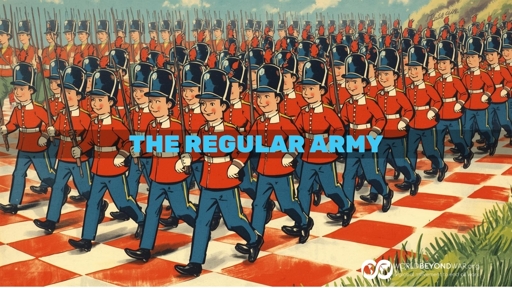
But a phantom presence stalks every page of Kennard’s book. It is the regular army, which is never depicted but constantly implied by the depictions of the irregular army.
Kennard reports on the Bush-Obama era recruiting of not just Nazis and gang members and criminals, but also the overweight and under-educated, as well as non-citizens being teased with citizenship as a reward for what Kennard calls “service.” Kennard also covers the pre-recruiting of children and the opening up of recruiting to older men and women. The toleration, and in fact promotion, of drug and alcohol use in the military comes in as well. All of this seems like very useful documentation of particular elements of the overall problem of the war machine. But that is very far from the conclusion Kennard recommends we draw.
Throughout the book, one senses an implication that up through 1999 the U.S. Army had been non-hateful, even non-violent, sober, fit, and somehow therefore a force for good in the world. Yet the existence of any military in world history, U.S. or otherwise, that didn’t hate or kill or destroy or lie or fail is a hell of a thing to imply and not try to document. In the epilogue, Kennard suggests the example of the military of ancient Rome and that if it hadn’t been degraded along the lines of the U.S. military of Bush-Cheney times, the Roman Empire might not have collapsed. Of course, the notion that that would have been a good thing is highly debatable. And the notion that a better U.S. military would have somehow succeeded in Afghanistan and Iraq is never even explained or given the slightest meaning.
The wars in Afghanistan and Iraq, which Kennard falsely calls the longest in U.S. history — following the convention that holds Native Americans to not be real people and therefore not the victims of real wars — saw a great lowering of standards for the recruitment of the perpetrators, which, Kennard writes, “unleashed a significant tranche of mentally unstable, extremist, and violent individuals upon the Iraqi and Afghan populations.” Most wars presumably send in nonviolent soldiers to do the massacring?
To be clear, I think Kennard is right about all the changes that he documents, and that we’ve known about for years now thanks to the reporting of him and others. But the changes were a matter of degree. A military is not so much infiltrated by raging sadists as enthusiastically eager to have them, not so much tarnished by a few bad-apple alcoholics as systematically encouraging artificially induced numbness to the commission of evil actions, not so much accidentally inclusive of racism as habitually using racism to dehumanize its victims. These facts are established by Kennard’s own reporting. And a military constrained to be less proudly genocidal, less drugged up, less gleeful about torture and rape, and so on, would still be a military, would still be organized around murder and destruction, would still be no more capable of winning a war than of winning a hurricane.
Kennard documents comments from U.S. soldiers in Iraq and Afghanistan “shooting the locals not to further the military’s strategic goals but because killing ‘hajjis’ is their duty as white militants.” There’s not a speck of that that isn’t deeply offensive, but if those people were shooting those same locals “to further the military’s strategic goals” wouldn’t their victims be equally dead? And isn’t it the military that pumped them up with bigotry to ease their murder fingers and set them down in front of those Iraqi and Afghan households? We should by no means assume that the military’s so-called strategic goals were not being properly pursued in all their traditional incoherent futility.
Kennard claims that these wars simply needed more troops, and denounces as the main problem the Donald Rumsfeld scheme to have a smaller and more privatized military, even while denouncing all the loosening of standards in order to add more troops. But how else would you add more troops? If the wars weren’t so sickeningly evil, more people might want to join them. But as long as the wars are going to be wars, the more you invest in education and fitness, the less you’ll have to invest in the wars, and the more people will be aware enough and have options enough to not join. A well-educated person with another job available would never sign up, or be very good at obeying the orders of higher-ranking imbeciles, so a recruitment plan can hardly insist on serious education standards.
Kennard documents the role of particular “extremists” in some of the famous atrocities of the war on Iraq, and in some of the coming home of that war in the form of military training for gang members and militia members, weapons stolen from the military for domestic use, and crimes committed by veterans in the wrong country. These accounts could be expanded to include soaring domestic violence, mass shootings, and so on, by looking at veterans more broadly, not only veterans who were in other racist militias prior to joining the world’s best funded racist militia. Still, the private racist militias have been given a real boost by the era of endless wars. And leftists who want to overthrow the government should be aware that these people want the same thing, and in such a scenario the outcome would depend on who had the ability to create a new government, not who had overthrown the old one.
Kennard also documents how the military uses so-called moral waivers to allow people with U.S. criminal records to be recruited. I’m reminded of the lyrics of Alice’s Restaurant:
“you want to know if I’m moral enough to join the army, burn women, kids, houses, and villages after being a litterbug.”
In reality, we’re talking about more serious crimes than littering, but none as serious as organized mass murder — also known as “the service.”
Oddly missing from Kennard’s survey of types of military recruits is the uptick in evangelical religion as open U.S. military policy and the likely increase in religious recruits or at least religious veterans. But the bulk of this book is from 2012 and includes such anachronisms as “Western government’s supposed submission to Jewish and Israeli power.” Secretary Kegsbreath says the government of Israel started the current U.S. war on Iran. AIPAC just helped Trump remove a U.S. senator who opposed that war. Yes, the phrase “Jewish and Israeli power” sounds like hateful bigotry, but the Israeli government’s power is no longer treated as a fantasy outside of media outlets loyal to the U.S. government. Still, bigotry against Jews or Muslims or any non-Christian religion may be as pervasive in the U.S. military as racism or other forms of dehumanizing murder-facilitation.
Also missing from this, and from much other analysis of the after-effects of wars, I think, is sufficient focus on the problem of moral injury. When wars are widely understood as evil, unjustifiable, fraudulent enterprises for which at least some people will not thank you for your “service,” it’s not just recruitment that struggles, but also veterans. This fact plays a role in PTSD, in suicides, and in other difficulties in transitioning to a nonkilling way of life. With or without moral injury playing a role, the post-war period can be a nightmare even for the most regular of troops.
In May of 2019, the U.S. Army tweeted a harmless rah-rah tweet and got hit with a burst of reality never encountered on corporate-controlled media. The Army asked: “How has serving impacted you?” Here’s a tiny sample of the responses:
Karen @educatorsresist 5h5 hours ago
Replying to @USArmy
I lost my virginity by being raped in front of my peers at 19. Got married to a nice guy who was part of my unit. He was in the invasion of Iraq. Came home a changed man who beat the shit out of me. He’s convinced y’all are stalking him and he’s homeless so great job there!
KrissyK @krissyk262 58m58 minutes ago
Replying to @USArmy
My sweet friend David can’t answer you. He committed suicide a few years ago after a couple tours of Afghanistan. #MemorialDay2019
Daniel GBO @danny_m94 5h5 hours ago
Replying to @USArmy
The strain of my deployment was too much for my wife to bear. She committed suicide in our home when I had just one month left. When my mental state deteriorated, I was sent to counseling so my COC could check off a box and say “they did everything they could”. (1/2)
I turned to alcohol and other vices. I begged to be sent to any other unit in a different state, just needing a change of scenery. Instead, I was demoted and discharged. Dumped like a bag of trash when I had at one time shown great promise as a leader and soldier.(2/2)
J-Fixx @Chromedominium 5h5 hours ago
Replying to @USArmy
My wife walked in the garage and found me hanging from an extension cord. What’s worse she had to lift me up, cut the cord and resuscitate me all while screaming for help. My black ass is 6ft 245 pounds and she is 5’2 130 pounds. But hey at least I got to shoot some cool shit.
The post The Regular Army appeared first on World BEYOND War.
From World BEYOND War via This RSS Feed.