



I am sorry that it has been so long since my last post. I have been busy with our civil rights work at Civil Rights Corps and co-founding something new called the Hub for Innovative Law Offices. (CRC receives all donations people choose to make for this free newsletter.)
First, at Civil Rights Corps, we recently won the most important civil rights case in our organization’s history. By my calculations, it is probably the single most liberatory court decision in U.S. history in terms of the number of people in jail. The California Supreme Court finally ruled for us on an issue we pioneered and have been litigating for a decade, holding essentially that no one can be detained prior to trial and separated from their family in California in misdemeanor cases or in any non-violent or non-sexual felony. This is the vast majority of arrests in California—hundreds of thousands of people per year. Importantly, the Court held that the government cannot get around these constitutional prohibitions by using money bail, and that any money bail amount must be attainable. These holdings would also apply in a number of other states, and we have begun working around the country to do that. It also comes as a vital moment because of the centrality of pretrial detention to authoritarian projects around the world and Trump’s statements about making pretrial detention and money bail priorities for his administration. Vindicating the fundamental rights to pretrial liberty and the presumption of innocence is one of the most important things that can be done to promote democracy. Because of the magnitude of this victory, we are about to see an unprecedented right-wing fear-mongering campaign against our work, which has already begun in the New York Post by right-wing California prosecutors. Here’s me talking about it all with my great friend Chenjerai Kumanyika on his exciting new podcast Unruly Subjects.
Also, the Hub I mentioned above is the most ambitious project I have ever worked on—an attempt to transform the capacity of public interest lawyering in the United States to meet both this moment of acute authoritarian crisis and the chronic catastrophe of inadequate legal services for a wide range of important causes like economic justice, civil rights, criminal defense, immigration, family defense, the environment, disability, healthcare, and more. We helped incubate 30 public interest law practices at the end of 2025 in our first cohort, and our applications are now open for our 2026 cohort. Within a few years, our goal is to incubate and organize together a social movement of sustainable small public interest law practices that can change the balance of power in our legal system and our society by, for the first time, building the capacity to meaningfully enforce violations of the law that harm marginalized people and communities. We are looking for lawyers who want to be part of a transformational community and make a sustainable living while building at scale a formation critical to enforcing laws that protect the most vulnerable people, communities, and ecosystems. Within a few years, we could help thousands of lawyers across the country transform the organization and capacity of the legal profession.
I’ve also been doing some fun things. Above is my first experiment making art out of melted wax. This one is on a large mirror I salvaged. And, I’m also working on some standup comedy—hopefully I’ll have the courage to start doing it in public in the next few months….
***
Repression and the Liberal Establishment
When I published my last post, I intended to write a three-part series. I had almost completed the second part about Democrats and liberal news media spending years building the physical, economic, and propaganda infrastructure to support what ICE is doing across the U.S. Then, before I could take the time to finish it, masked armed federal agents executed Renee Good and Alex Pretti in Minnesota on camera. And a lot of other stuff has happened since…. The underlying points I want to make are largely the same, but the context requires me to make some adjustments. So, here is the belated Part 2 in my series on three important myths that lead to a lot of establishment institutions and even well-meaning but uninformed professional class elites supporting indefensible repression.
In the first post in this series, I dispelled the myth that reducing investment in repressive bureaucracies is unpopular. Public support for reducing budgets of police/prosecutor/prison/surveillance bureaucracies—and shifting more investment to various institutions of care and connection like healthcare; education; housing; pollution abatement; and community participation through art, music, theater, athletics, food, mutual aid, and urban/architectural planning for beautiful spaces in which to engage in each of these things—is among the most popular consistently polled questions in U.S. politics for decades. Separately, and probably more importantly, I also explained why “popularity,” at least as expressed by superficial polling, is a poor basis for progressive movements to make strategic decisions about how to achieve the power to build a world with more liberty, equality, and mutual flourishing.
In posts 2 and 3, I will address the other key myths: that there are few social costs to increasing the repressive capacity of the government and that more repression is therefore on balance good for safety. I’ll focus primarily on the pervasive assumption that there are not serious negative consequences to growing the capacity for state repression. This assumption is virtually everywhere in mainstream Democratic Party punditry. It’s the air we breathe. It is typified by perennially unquestioned decisions to increase police, prosecutor, and prison budgets, expand surveillance, expand immigration enforcement, militarize the border, respond to public safety fears with punishment, and so on. I view the lack of focus in elite liberal spaces on the enormous harms of repression as perhaps the most pervasive flaw in what passes for liberal intellectual circles and one of the most important things every person of good will must think about.
The almost always unstated assumption that more repression carries few negative consequences has been a recurring feature of my personal interactions in Washington, D.C. for 15 years. Virtually no person I have met in fancy media, well-funded non-profits, and Democratic Party circles has acknowledged to me any negative costs to society of their mantra that Democrats need to be “tougher on crime” by expanding the punishment bureaucracy.
So, why do so many liberal pundits still participate in punishment bureaucracy mythology? There are many cultural and financial reasons I explore in Copaganda, but I want to focus on one intellectual reason here: even well-meaning people in polite liberal society catastrophically underestimate the social costs of the punishment bureaucracy. Most ordinary staffers simply don’t know much about the issue. And the pundits/consultants who preach to liberals promote the punishment bureaucracy because they are fundamentally either (1) misleading people about the social costs or, (2) like much of their audience, ignorant of them.
Most liberal discourse erases three primary harms of the punishment bureaucracy:
- The corrosive effects of the punishment bureaucracy on hope for any semblance of a democratic, flourishing, participatory, healthy, and egalitarian society through its selective targeting of the most vulnerable groups in ways that preserve inequality across every important domain;
- How the punishment bureaucracy is used by explicitly authoritarian forces; and
- How the punishment bureaucracy has been wielded to oppose, infiltrate, and crush every progressive social movement in modern U.S. history.
The failure to grapple with these social costs allows other myths to flourish because, if you believe that the punishment bureaucracy has no negative consequences for all of us, then you are unlikely to ask whether the punishment bureaucracy produces safety or question why it might not be popular. The attitude becomes the Democratic Party mantra for 50 years of mass incarceration: “Why not try more punishment? Who could oppose that? What could go wrong?”
Some cringe-worthy examples
The remarkable thing is that I could choose almost any mainstream news segment or any public appearance by almost any Democrat from the last several decades to illustrate the moral and strategic failure of their public positions on the punishment bureaucracy. Such is the pervasiveness of the repression-has-no-consequences delusion. It’s almost misleading to select just a few examples! Nonetheless, I collected a few recent ones that have particular salience or comedic value now:
-
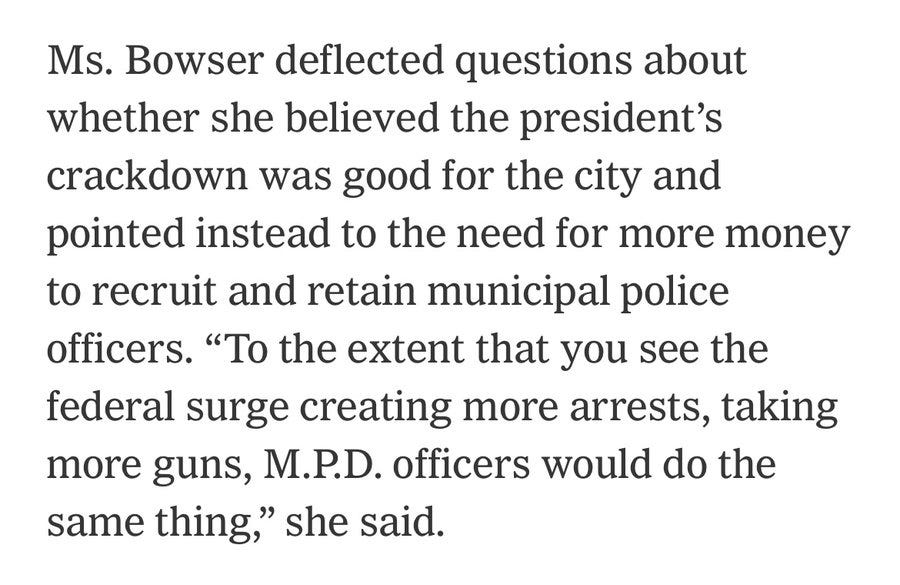
When Trump unleashed the National Guard on us in D.C., Mayor Muriel Bowser said that she “greatly appreciates the surge of officers” and assured all of us who live in D.C. that she wanted to “do the same thing” as Trump during his deployment of the military in D.C., just using local police instead. I scoured the record in the weeks following and, in the wake of Trump’s deployment, I could not find Bowser or any mainstream commentator talking about any negative social costs to D.C. of expanding the scope of the armed surveillance state under the control of the D.C. police. It’s as if there is not even a discussion to be had about what kind of society that might foster.
-
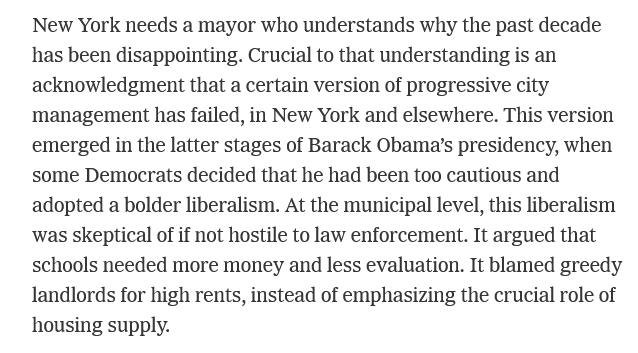
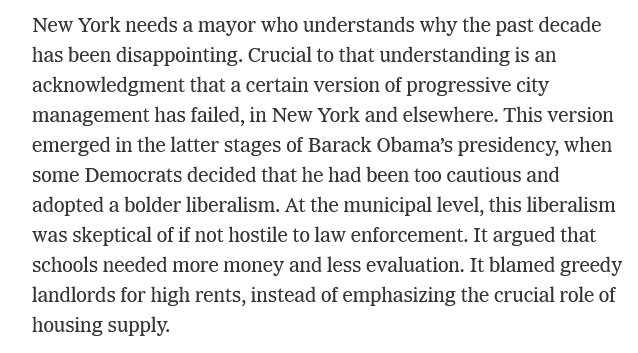
The New York Times Editorial Board is a leading purveyor of the myth that more punishment has no negative consequences. In the below examples from its attempts to stop the election of Zohran Mamdani, the paper asserts, with no evidence, that being “skeptical” of “law enforcement” has “has failed.” Without a single clause of a single sentence explaining its pronouncement, the paper announces that “cuts to policing” are among a vague list of “dubious ideas.” The paper mentions no negative consequence associated with policing in New York:
And from its casual dismissal of another progressive candidate, Brad Lander:

-
Former prosecutor Amy Klobuchar has long stood out among Democrats for her flat-earther public safety views, but last year I bookmarked this tweet because it’s rare that leading Democrats drop the pretense of safety and say in public the things their staffs and consultants say to us in private:
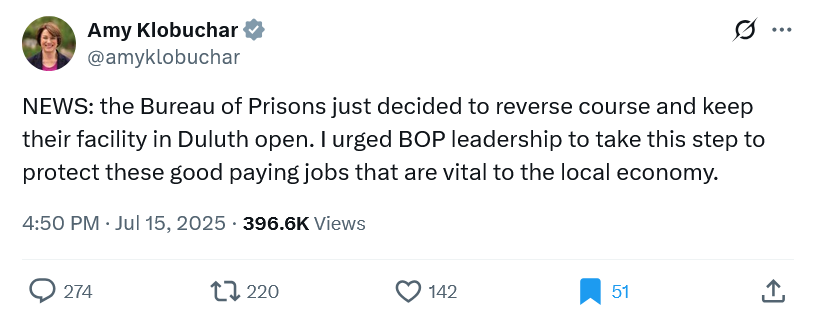

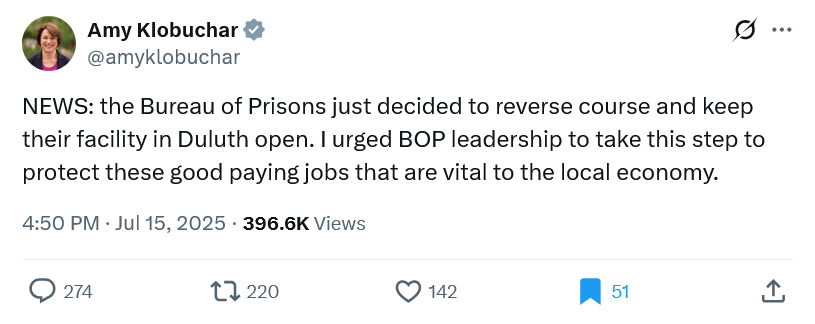
This statement is impossible to parody. A Democratic Senator talks about a prison as if there are no negative social consequences to the greatest expansion of human caging in recorded world history. As I explained in Copaganda, the U.S. does so much caging that it reduces total U.S. life expectancy by 1.8 years from what it would be if the U.S. had incarceration rates like its own history or like other comparable countries. Her policies are, literally, reducing overall life in the U.S. by hundreds of millions of person-years. And I have been unable to find a single example of her even mentioning the costs, let alone justifying these hundreds of millions of years of lost life with corresponding benefits. And she makes the statement celebrating the success of her advocacy to keep the prison open six months into Trump’s second term—at a time when the increasingly fascist government already cages people 6 times its own historical average, 5-10 times comparable countries, and Black people 6 times South Africa at the height of Apartheid. In any reasonable world, this person would not be taken seriously, let alone as a leader of a supposedly progressive political party.
-
Leading Democratic Party officials—while issuing a steady slop of cliches and platitudes about the “rule of law” and fighting repression for low-information liberals—worked hard to give Trump officials sweeping and draconian new powers to criminalize coordinated boycott campaigns targeting Israel, including even advocacy targeting illegal Israeli settlements, and even as the U.S. sanctions judges of the International Criminal Court for minimal attempts to enforce international law:

-
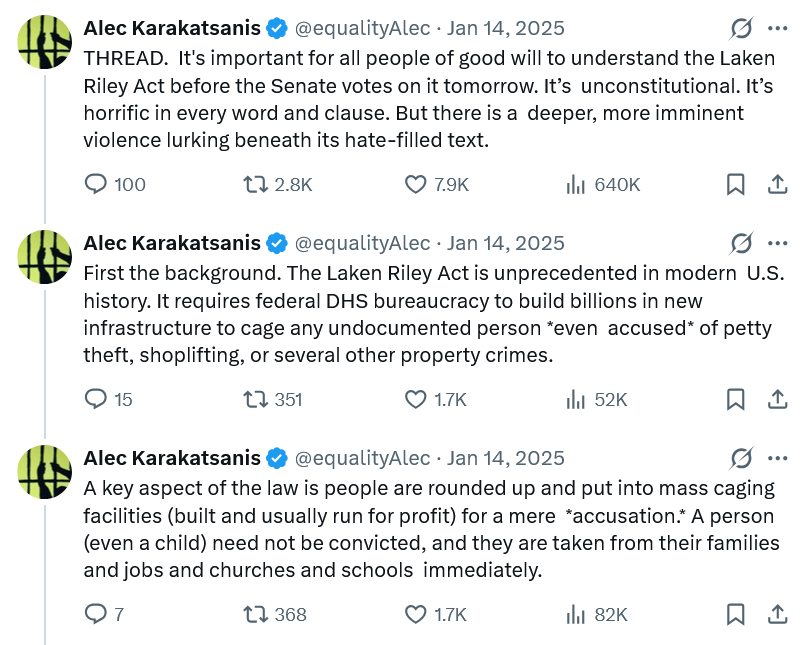
Angie Craig, Congressperson from Minnesota, was seen in the news performing the role of loud critic of ICE in Minnesota. But Craig had voted shortly before to “express gratitude” to ICE and to call for greater collaboration with ICE among state and local officials. Incredibly, she was one of Democrats who supported and voted for the Laken Riley Act sponsored by Democratic Senator Ruben Gallego, a prominent fiend for more repression:
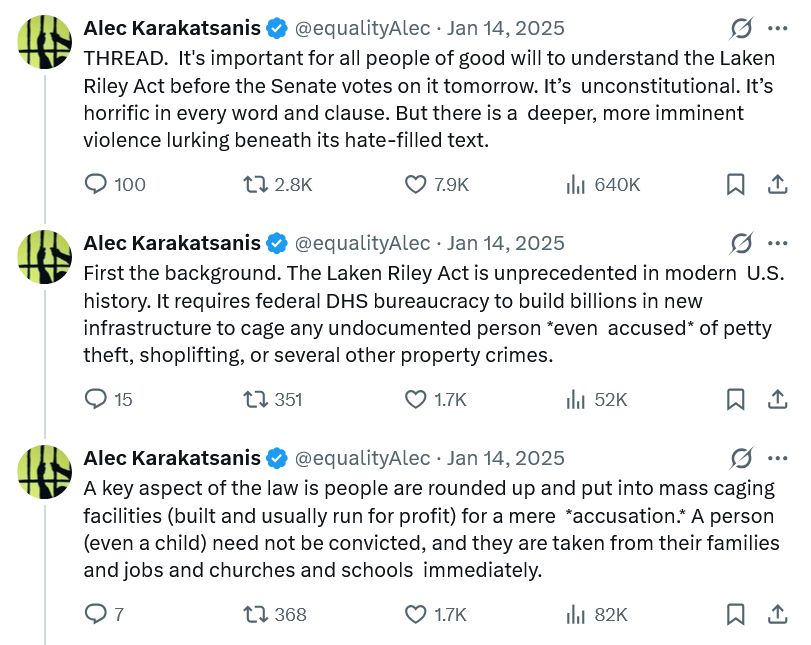
It is worth reading my thread on the Laken Riley Act in full to understand some of the consequences of the Democratic Party’s embrace of repression, but here’s another key point about laws that expand the repressive tools of the government:
-
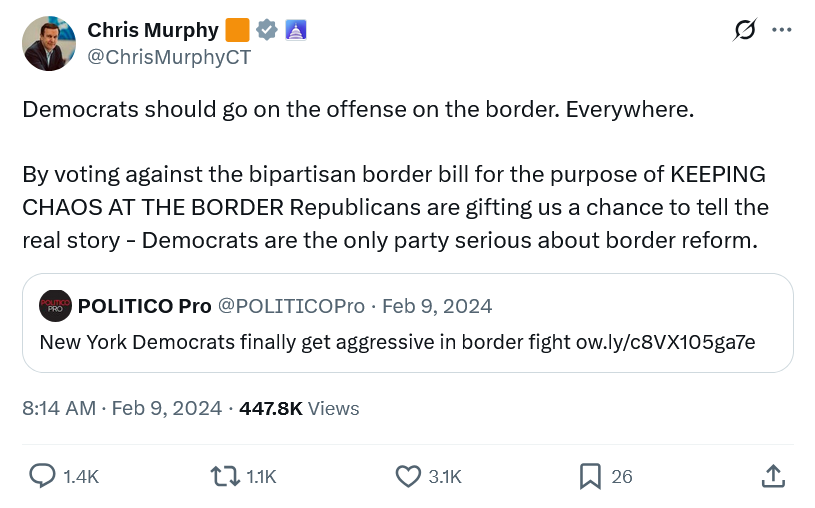
Then there is Chris Murphy, one of the most buffoonish of a new generation of Democrats who are adopting faux-casual TikTok personas as they promote the same mass repression agenda but with “cooler vibes” to seem more relatable. In 2024, he supported doubling ICE’s budget and curtailing of the basic human right to asylum (in his own words, following the “instructions” of Republicans “to the letter”). Murphy’s alarming embrace of what Democrats had just a few years ago likened to Nazi policies and rhetoric at the border elicited the following statement from MSNBC cartoon character Al Sharpton: “we’re looking every day at the invasion of migrants.” Here is Murphy in 2024 denouncing “CHAOS AT THE BORDER” and claiming that the “real story” is that the Democrats are tougher on immigrants than the fascists:
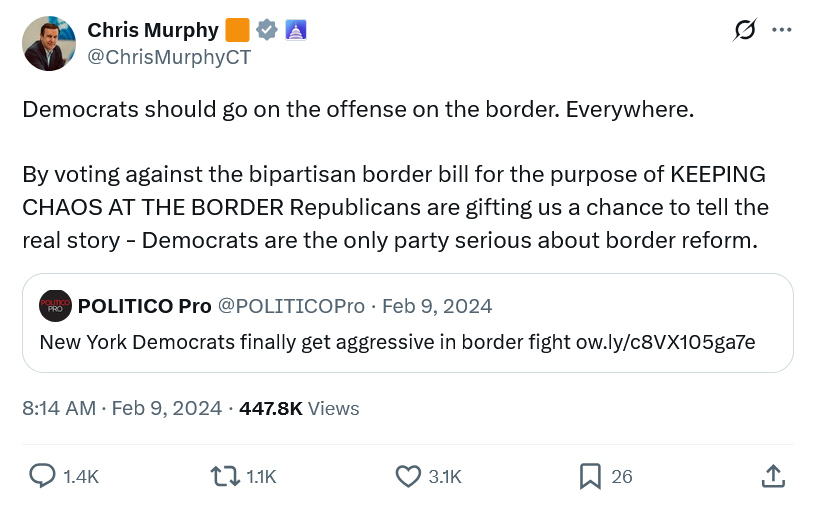

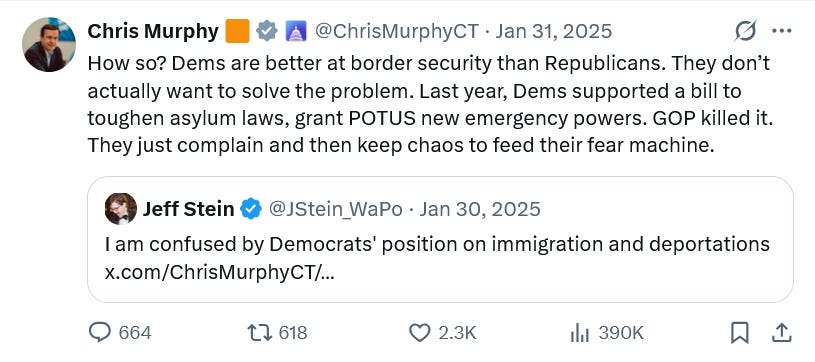
Then, even after Trump came to power, here he is again promoting immigrant “chaos” propaganda and celebrating that Democrats had, with the endorsement of the far right border guard union, attempted to give the Executive “new emergency powers” and tried to “toughen asylum laws”:
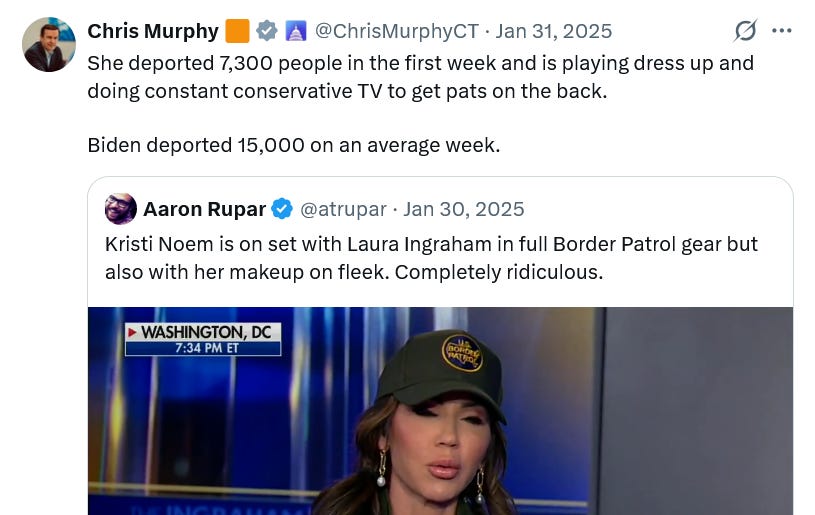
In a crescendo of cruelty, Murphy went on to make fun of Kristi Noem by bragging that Biden had deported twice as many people per week as she did in her first week:
None of this is new. It fairly describes the establishment strategic and moral consensus in the Democratic Party for decades:
And then, after public outcry relating to ICE reached a crescendo, the Democratic Party establishment all came together to promote one of the great counterinsurgency frauds of modern times: co-opting people’s anger and outrage into calls for even more money for ICE for surveillance and training. The Trump administration immediately celebrated this consensus to expand funding and surveillance for DHS. Here’s me on Democracy Now on this shameful episode:
Many of the people I love most in this world spend their lives confronting the unspeakable human costs of these senseless policies and strategic catastrophes. The cumulative effect is that well-meaning people across our society have massively uninformed and misinformed intuitions, attitudes, and conscious views on the costs of repression. So, it’s difficult to write about what people like Chris Murphy are doing in a tone that is appropriate given that my grandma reads these posts. But, in the next and final post in this series, I’ll try to explain the costs of repression and why this should be one of the primary areas of focus for every person of good will in our society.
From Alec’s Copaganda Newsletter via This RSS Feed.