

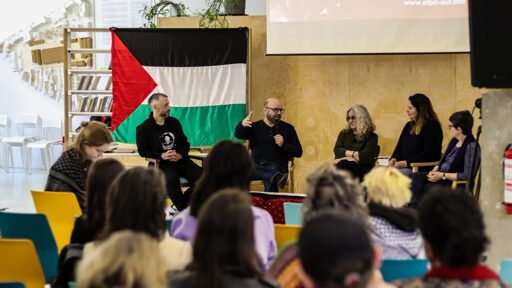
As Romania prepared to host a Bucharest Nine (B9) summit and the Black Sea Defense, Aerospace and Security arms exposition, over 100 people gathered to discuss anti-militarization and solidarity with Palestine at the “From Palestine to the Black Sea” counter-conference. The meeting followed months of work through the Elbit Out! campaign, aiming to unmask and drive Israeli arms producer Elbit System out of the country, where several of its subsidiaries currently operate.
A day before the counter-conference launched on May 9, Palestine solidarity activists organized a protest in front of one of these subsidiaries in Chitila near Bucharest, warning that its production lines include drone variants used in the genocide in Gaza.
Read more: BDS movement makes significant strides across Europe
“There’s a very special importance of severing ties with Elbit Systems,” said Maren Mantovani from the International Secretariat of the Palestinian Boycott, Divestment and Sanctions National Committee (BNC), pointing to the company’s embeddedness in the occupation of Palestine and the role its products continue to play in the ongoing genocide.
Such embeddedness was echoed by Shir Hever of the Alliance for Justice Between Israelis and Palestinians, whose primary research focus is the economic aspects of Israel’s occupation. While Elbit Systems’ role in Israel’s armed forces is significant – for example, it provides the majority of drones Israel is deploying – Hever emphasized that more recently there were signs the company is feeling the heat from a growing Palestine solidarity movement and its own business model.
He explained that Elbit’s strategy since the mid 1990s has been based on a policy of mergers and acquisitions in the attempt to grow as rapidly as possible. “There is no way for an Israeli company to compete with giants like Lockheed Martin or Northrop Grumman – Elbit Systems is tiny compared to them,” Hever said. “But they know that if they somehow grow enough in certain arms of the arms trade, they can establish a monopoly and secure a strong place in the market.”
This policy is pursued by taking on debt. “This policy means very rapid growth, but it is also very unsustainable growth, because the more they grow – the bigger the debt,” Hever added. “The way to leverage the debt is by showcasing their assets and mortgaging them in order to borrow more, and so on.”
While the company is still trying to claim it is doing wonderfully, in reality, recent finance reports indicate it has no answer to recent divestment announcements. At the same time, Hever said, Elbit Systems has prioritized supplying weapons to the occupation regime, neglecting deliveries to international buyers – the source of their financial strength. This has led to a USD 28 billion backlog and threats by some countries to cancel orders. “Money is also part of the Israeli genocidal machine: they need this money urgently,” Hever emphasized, pointing out that this represents a possible pressure point for movements to campaign on.
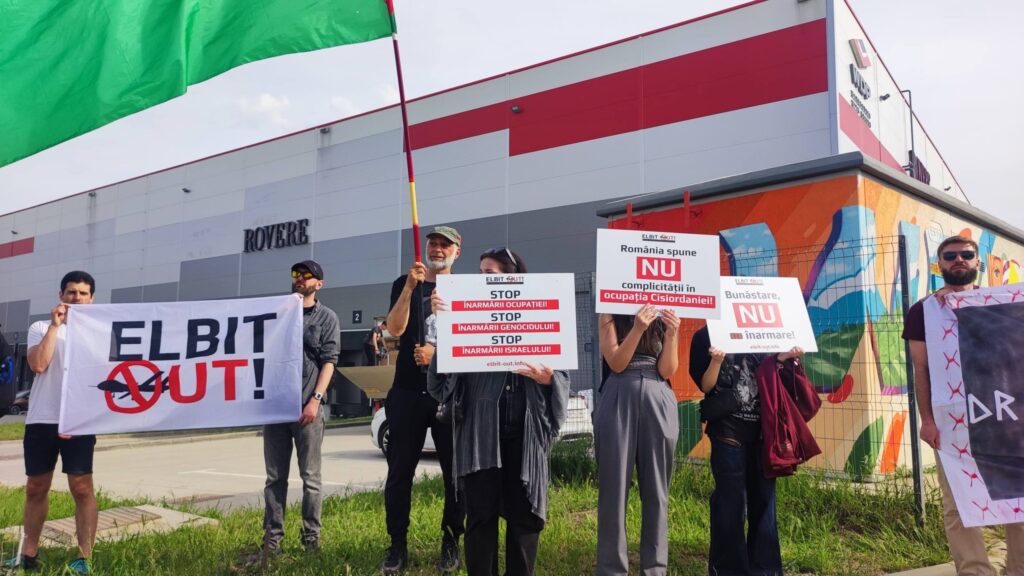
Activists during protest action near Elbit Systems subsidiary in Chitila near Bucharest. Source: Palestine Solidarity Cluj-Napoca/Facebook
As previously reported by Peoples Dispatch, the strengthening of solidarity movements and growing difficulties of conducting operations in West Europe has pushed Israeli companies to increase their footprint in Eastern Europe – as surfaced on numerous occasions during the Elbit Out! campaign interventions.
Yet conference participants insisted that Israel’s growing presence in this part of Europe is not only indicative of the region’s complicity in genocide, but that it also cannot be decoupled from Europe’s own drive for armament and war. “The European Union,” pointed out Irish politician Clare Daly, “was a military project from the very beginning” – with strong links to the region’s racist legacy, as emphasized by her comrade Mick Wallace.
The realization of this military project has visibly picked up speed over the past four years, yet as Laëtitia Sédou from the European Network Against Arms Trade (ENAAT) noted, it has been ongoing since before 2016. One of the main characteristics of this decade-long pursuit of EU rearmament, Sédou pointed out, is that it is industry-driven: with industry representatives being openly consulted about plans – without matching space given to voices from peace movements or civil society.
Sédou tracked how this approach to shaping military industry strategy in Europe has meant that arms producers and traders were able to co-opt the bloc’s buzz about sustainability: by claiming that sustainability can only be achieved in a secure environment and framing security as the natural result of armed defense capacities, they argued in favor of more spending on weapons on different governance levels.
Read more: Rethinking (in)security: security for people, not states
This is expectedly leading to high amounts of money being allocated to so-called defense, either by reallocating funds that could otherwise be spent on welfare and social services or by taking on additional debt. Defense-related debt might currently be categorized as “good” by EU institutions, Sédou emphasized, yet it will have to be serviced at some point, begging the question where the money to do so will come from.
The financial impacts of military spending have already been notable on the national level, Enikő Vincze from Căși Sociale ACUM! illustrated in the case of Romania, while the links between the arms industry, politicians, and governments appear as solid as ever – fueling the deadly trade further – as Andrew Feinstein from Shadow World Investigations outlined.
Katerina Anastasiou of transform! europe added that the security discourse in the region is clearly being shaped in a context where elites are at threat of losing hegemony and in which “we are losing the possibility of choosing who lives in dignity,” referring to expected assaults on social and welfare services. One of the starting points to build a counter-narrative, she suggested, should be asking whose security – and against whom – we are discussing as this political moment evolves, tabling an alternative vision corresponding to the slogan “Welfare not warfare.”
Alternative visions brought to the discussion in Bucharest on May 9-10 also included the abolition of war, as outlined by Annachiara Canetta of World Beyond War’s Europe chapter, through the elimination of the physical infrastructure that allows its perpetuation, divestment from the industry, and strengthening drives for conscientious objection, thus taking away human bodies sacrificed to wage wars.
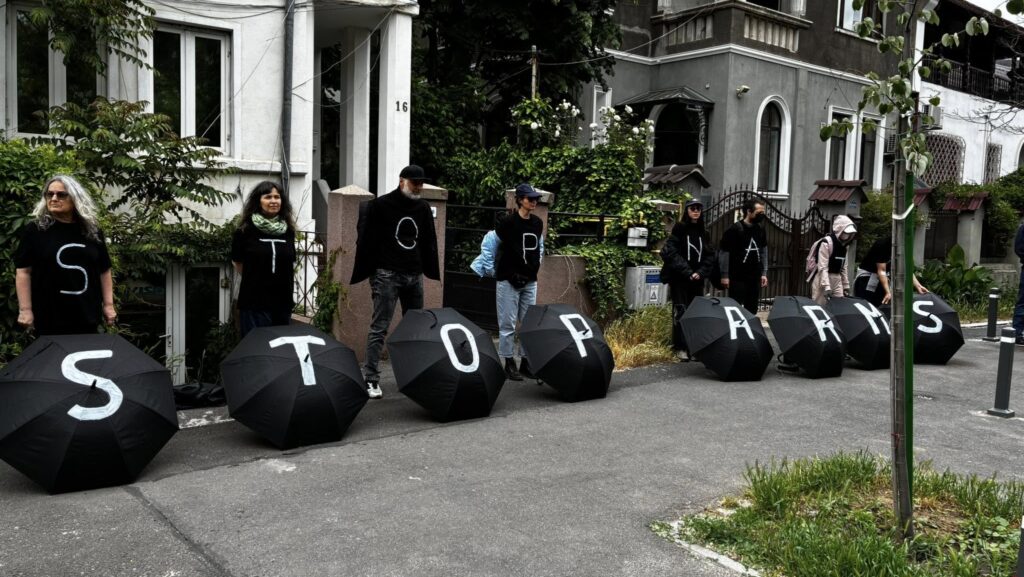
Activists during protest action against B9 summit. Source: Palestine Solidarity Cluj-Napoca/Facebook
However, the discussion also acknowledged the unequal position of specific parts of Europe in the ongoing armament discussions. Gavin Rae of transform! europe underlined that countries of the B9 – dubbed as NATO’s Eastern Flank – are among those facing the greatest danger if war in the region escalates.
The same part of the region is also struggling with the consequences of deindustrialization following the restoration of capitalism, as several Eastern European speakers emphasized during the conference. In this context, countries like Romania and its neighbors can be perceived as a sort of brownfield military investment opportunities not only for Israeli companies like Elbit, but also German and other European investors. In this situation, workers across Eastern Europe are essentially forced to choose between producing war for export elsewhere – currently West Asia – and witnessing their own communities becoming a locus of war, Vlad Mureşan from the Elbit Out! campaign warned, signaling a growing need to organize together.
Read more: In Eastern Europe, resistance grows to militarism and Israeli arms production
In response, “From Palestine to the Black Sea” brought together Palestine solidarity initiatives from across the Balkans, including BDS Greece, Solidarity with Palestine Bulgaria, Solidarity with the Palestinian People (Podrška narodu Palestine, Serbia), Balkan Solidarity Network (Albania), Palestine Book Club (Clubul de carte despre Palestina, Moldova), and Palestine Solidarity Cluj-Napoca, to discuss regional developments and potential joint activities.
Similarly, recognizing the importance critical media can play in shattering the mainstream’s biased approach to reporting on Palestine and European armament, organizers also assembled a panel with Moldovan investigative outlet Centrul de Investigații Jurnalistice, Peoples Dispatch, Shadow World Investigations, and Romanian portal Snoop.
Activists continued their actions in the days following the conference, staging protest actions against the B9 summit and the arms fair. They stated: “We also know, because history shows us: militarization leads to wars, not to peace. That is why we say no to rearmament! STOP NATO!”
The post Activists in Bucharest conference reject militarization “from Palestine to the Black Sea” appeared first on Peoples Dispatch.
From Peoples Dispatch via This RSS Feed.